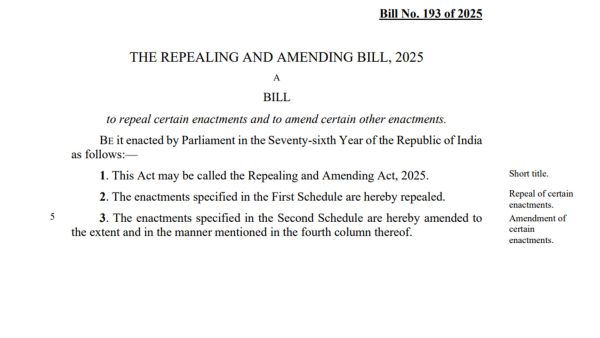
Lok Sabha okays bill: List of 71 laws proposed to be repealed
Lok Sabha Passes Repealing and Amending Bill 2025: Union law minister Arjun Ram Meghwal said the Parliament made these changes to reverse the effects of colonisation.
Lok Sabha passed bill to repeal 71 laws, including ones dating back to the 19th century.
Lok Sabha Passes Repealing and Amending Bill 2025: The Lok Sabha during the ongoing winter session of Parliament passed the ‘The Repealing and Amending Bill, 2025’, for repealing 71 laws.
Union law minister Arjun Ram Meghwal said these changes are aimed at reversing the effects of colonisation. Some of the laws proposed to be repealed include Acts dating back to the 19th century.
You’ve Read Your Free Stories For Now
Sign up and keep reading more stories that matter to you.
Lok Sabha on December 16 passed the bill to repeal and amend obsolete laws.
Here are the 71 laws proposed to be repealed
The Indian Tramways Act, 1886
The Levy Sugar Price Equalisation Fund Act, 1976
The Britannia Engineering Company Limited (Mokameh Unit) and the Arthur Butler and Company (Muzaffarpore) Limited (Acquisition and Transfer of Undertakings) Act, 1978
The Chaparmukh-Silghat Railway Line and the Katakhal-Lalabazar Railway Line (Nationalisation) Act, 1982
The Hooghly Docking and Engineering Company Limited (Acquisition and Transfer of Undertakings) Act, 1984
The Bharat Petroleum Corporation Limited (Determination of Conditions of Service of Employees) Act, 1988
The Arbitration and Conciliation (Amendment) Act, 2015
The Payment of Wages (Amendment) Act, 2017
The Enemy Property (Amendment and Validation) Act, 2017
The Maternity Benefit (Amendment) Act, 2017
The Employee’s Compensation (Amendment) Act, 2017
The Banking Regulation (Amendment) Act, 2017
The National Bank for Agriculture and Rural Development (Amendment) Act, 2018
The High Court and Supreme Court Judges (Salaries and Conditions of Service) Amendment Act, 2018
The Payment of Gratuity (Amendment) Act, 2018
The Specific Relief (Amendment) Act, 2018
The State Banks (Repeal and Amendment) Act, 2018
The Negotiable Instruments (Amendment) Act, 2018
The Commercial Courts, Commercial Division and Commercial Appellate Division of High Courts (Amendment) Act, 2018
The Central Universities (Amendment) Act, 2019
The Protection of Human Rights (Amendment) Act, 2019
The Airports Economic Regulatory Authority of India (Amendment) Act, 2019
The Motor Vehicles (Amendment) Act, 2019
The National Institute of Design (Amendment) Act, 2019
The Chit Funds (Amendment) Act, 2019
The Special Protection Group (Amendment) Act, 2019
The Arms (Amendment) Act, 2019
The Insolvency and Bankruptcy Code (Amendment) Act, 2020
The Constitution (Scheduled Tribes) Order (Amendment) Act, 2020
The Aircraft (Amendment) Act, 2020
The Insolvency and Bankruptcy Code (Second Amendment) Act, 2020
The Salaries and Allowances of Ministers (Amendment) Act, 2020
The Homoeopathy Central Council (Amendment) Act, 2020
The Indian Medicine Central Council (Amendment) Act, 2020
The Banking Regulation (Amendment) Act, 2020
The Arbitration and Conciliation (Amendment) Act, 2021
The Insurance (Amendment) Act, 2021
The Medical Termination of Pregnancy (Amendment) Act, 2021
The Government of National Capital Territory of Delhi (Amendment) Act, 2021
The Factoring Regulation (Amendment) Act, 2021
The Coconut Development Board (Amendment) Act, 2021
The Insolvency and Bankruptcy Code (Amendment) Act, 2021
The Central Universities (Amendment) Act, 2021
The Airports Economic Regulatory Authority of India (Amendment) Act, 2021
The Deposit Insurance and Credit Guarantee Corporation (Amendment) Act, 2021
The Constitution (Scheduled Tribes) Order (Amendment) Act, 2021
The General Insurance Business (Nationalisation) Amendment Act, 2021
The National Commission for Indian System of Medicine (Amendment) Act, 2021
The National Commission for Homoeopathy (Amendment) Act, 2021
The National Institute of Pharmaceutical Education and Research (Amendment) Act, 2021
The High Court and Supreme Court Judges (Salaries and Conditions of Service) Amendment Act, 2021
The Election Laws (Amendment) Act, 2021
The Constitution (Scheduled Castes and Scheduled Tribes) Orders (Amendment) Act, 2022
The Constitution (Scheduled Tribes) Order (Amendment)Act, 2022
The Delhi Municipal Corporation (Amendment) Act, 2022
The Weapons of Mass Destruction and their Delivery Systems (Prohibition of Unlawful Activities) Amendment Act, 2022
The Energy Conservation (Amendment) Act, 2022
The Constitution (Scheduled Castes and Scheduled Tribes) Orders (Second Amendment) Act, 2022
The New Delhi International Arbitration Centre (Amendment) Act, 2022
The Constitution (Scheduled Tribes) Order (Second Amendment) Act, 2022
The Constitution (Scheduled Tribes) Order (Fourth Amendment) Act, 2022
The Competition (Amendment) Act, 2023
The Multi-State Co-operative Societies (Amendment) Act, 2023
The Cinematograph (Amendment) Act, 2023
The Constitution (Scheduled Tribes) Order (Amendment) Act, 2023
The Constitution (Scheduled Tribes) Order (Second Amendment) Act, 2023
The Mines and Minerals (Development and Regulation) Amendment Act, 2023
The Offshore Areas Mineral (Development and Regulation) Amendment Act, 2023
The Government of National Capital Territory of Delhi (Amendment) Act, 2023
The Coastal Aquaculture Authority (Amendment) Act, 2023
“This Bill is one of those periodical measures by which enactments, which have ceased to be in force or have become obsolete or the retention whereof as separate Acts is unnecessary are repealed and by which certain amendments and formal defects detected in enactments are amended and corrected.”
The bill stated that the amendments proposed to the Indian succession Act, 1925 seek to attain uniformity by omission of section 213 which is discriminatory and provides that Hindus, Buddhists, Sikhs, Jains and Parsis have to obtain probate (official proving) of the Will or letter of administration where the Will is made within the local limits of the ordinary original civil jurisdiction of the High Courts at Calcutta, Madras and Bombay, and where such Wills are made outside those limits, insofar as they relate to immovable property situated within those limits.
In law, probate is the court-supervised legal process of proving a will’s validity, identifying the deceased’s assets, paying debts, and distributing the remaining property (estate) to beneficiaries as directed by the will or state law. It grants the executor (or administrator) legal authority (Letters Testamentary) to manage the estate, essentially validating the will and administering the deceased’s financial affairs.
Vineet Upadhyay is an Assistant Editor with The Indian Express, where he leads specialized coverage of the Indian judicial system.
Expertise
Specialized Legal Authority: Vineet has spent the better part of his career analyzing the intricacies of the law. His expertise lies in "demystifying" judgments from the Supreme Court of India, various High Courts, and District Courts. His reporting covers a vast spectrum of legal issues, including:
Constitutional & Civil Rights: Reporting on landmark rulings regarding privacy, equality, and state accountability.
Criminal Justice & Enforcement: Detailed coverage of high-profile cases involving the Enforcement Directorate (ED), NIA, and POCSO matters.
Consumer Rights & Environmental Law: Authoritative pieces on medical negligence compensation, environmental protection (such as the "living person" status of rivers), and labor rights.
Over a Decade of Professional Experience: Prior to joining The Indian Express, he served as a Principal Correspondent/Legal Reporter for The Times of India and held significant roles at The New Indian Express. His tenure has seen him report from critical legal hubs, including Delhi and Uttarakhand. ... Read More