Calcutta High Court says parties must not be forced to stay in ‘dead marriage’ if reunion impossible, allows divorce
The petitioner husband in the high court alleged that apart from her regular job, his estranged wife gave private tuition at her parental home and returned home late at night.
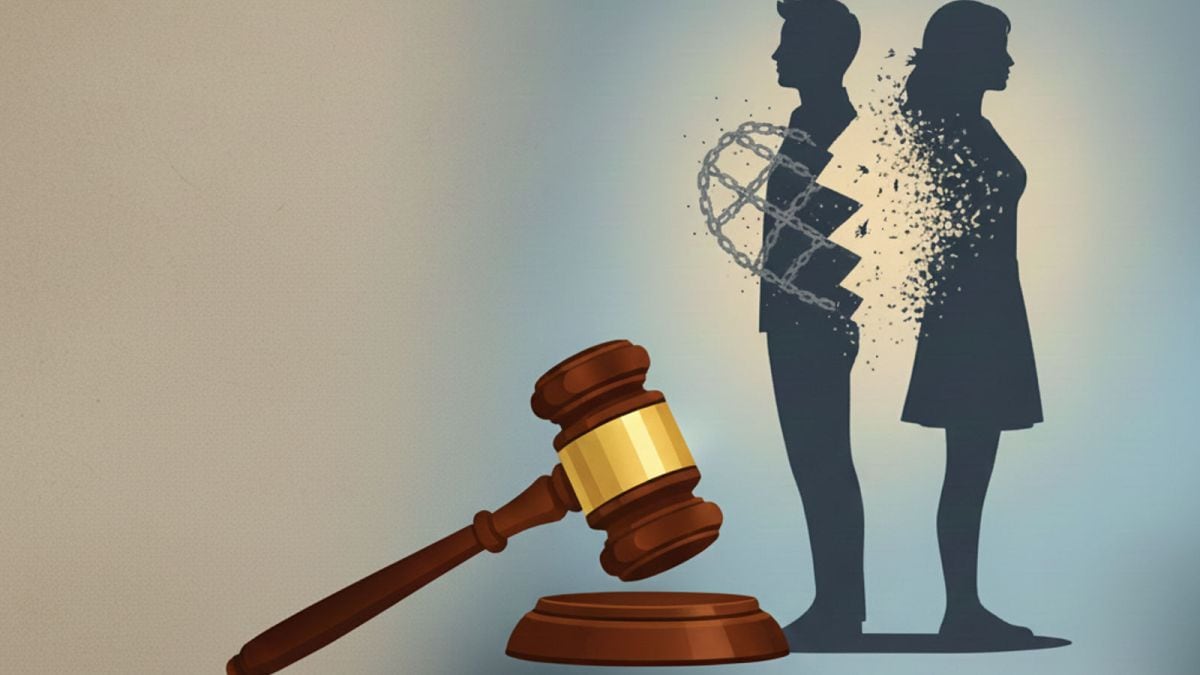
Calcutta High Court was hearing a challenge against a family court's order dismissing the plea of a man’s divorce plea. (Image is gnerated using AI)
The Calcutta High Court has observed “irretrievable breakdown” of marriage amounts to “cruelty” for estranged partners and said such couples should not be forced to remain in a “dead marriage” if there is no hope for reconciliation.
A bench of Justices Sabyasachi Bhattacharyya and Supratim Bhattacharya was hearing a challenge against a family court’s order dismissing the plea of a man’s divorce plea.
You’ve Read Your Free Stories For Now
Sign up and keep reading more stories that matter to you.
“The sacramental footing, on which a Hindu marriage originally stood, has undergone a sea change with the evolution of society, and at present, courts have been repeatedly holding that parties ought not to be bound to a dead marriage, if there is no chance of reconciliation,” the court observed.
Referring to the Supreme Court, the bench noted that a marriage which has irretrievably broken, spells cruelty to both parties, as in such a relationship, each party is treating the other with cruelty.
After being denied divorce by the family court, the husband moved the high court against the 2022 order.
The petitioner alleged that apart from her regular job, his estranged wife gave private tuition at her parental home and would return to her matrimonial home late at night.
Advocate Rajdeep Bhattacharya, who represented the husband, argued that the marriage between the parties had irretrievably broken, which was reflective from the fact that the estranged wife never appeared to contest the appeal and even chose to abstain from the mediation process, for which the matter was referred by the high court.
Story continues below this ad
He submitted that there was nothing on record to show that for the last decade, the wife ever made an attempt to resume conjugal ties with the husband.
Cannot overlook the evolution of matrimonial law in India in such a context. Whereas under the personal laws, such as the Hindu Marriage Act (HMA), previously a Hindu marriage was considered to be a sacrament, times have changed, and a contractual ingredient has slowly been read into it.
Court’s intervention in matrimonial relationships was widened with the enactment of the Hindu Marriage Act, 1955.
The sacramental footing, on which a Hindu marriage originally stood, has undergone a sea change with the evolution of society, and at present, courts have been repeatedly holding that parties ought not to be bound to a dead marriage if there is no chance of reconciliation.
The Supreme Court, in its previous judgments, has exercised its powers under Article 142 (enforcement of decrees and orders of the Supreme Court and orders as to discovery) of the Constitution to grant dissolution of marriage on the ground of irretrievable breakdown alone.
Decision
After hearing the submissions, the bench held that the marriage between the parties was “broken beyond repair”.
“Insofar as the late return of the wife is concerned, we agree with the conclusion of the learned Trial Judge that such conduct on the part of the wife cannot ipso facto be construed to be cruelty as such,” the court said.
The order further noted that the element of “animus revertandi” (intention to return) was completely absent on the part of both sides in the present case for the decade which had passed from the filing of the suit in 2015.
Jagriti Rai works with The Indian Express, where she writes from the vital intersection of law, gender, and society. Working on a dedicated legal desk, she focuses on translating complex legal frameworks into relatable narratives, exploring how the judiciary and legislative shifts empower and shape the consciousness of citizens in their daily lives.
Expertise
Socio-Legal Specialization: Jagriti brings a critical, human-centric perspective to modern social debates. Her work focuses on how legal developments impact gender rights, marginalized communities, and individual liberties.
Diverse Editorial Background: With over 4 years of experience in digital and mainstream media, she has developed a versatile reporting style. Her previous tenures at high-traffic platforms like The Lallantop and Dainik Bhaskar provided her with deep insights into the information needs of a diverse Indian audience.
Academic Foundations:
Post-Graduate in Journalism from the Indian Institute of Mass Communication (IIMC), India’s premier media training institute.
Master of Arts in Ancient History from Banaras Hindu University (BHU), providing her with the historical and cultural context necessary to analyze long-standing social structures and legal evolutions. ... Read More