Journalism of Courage



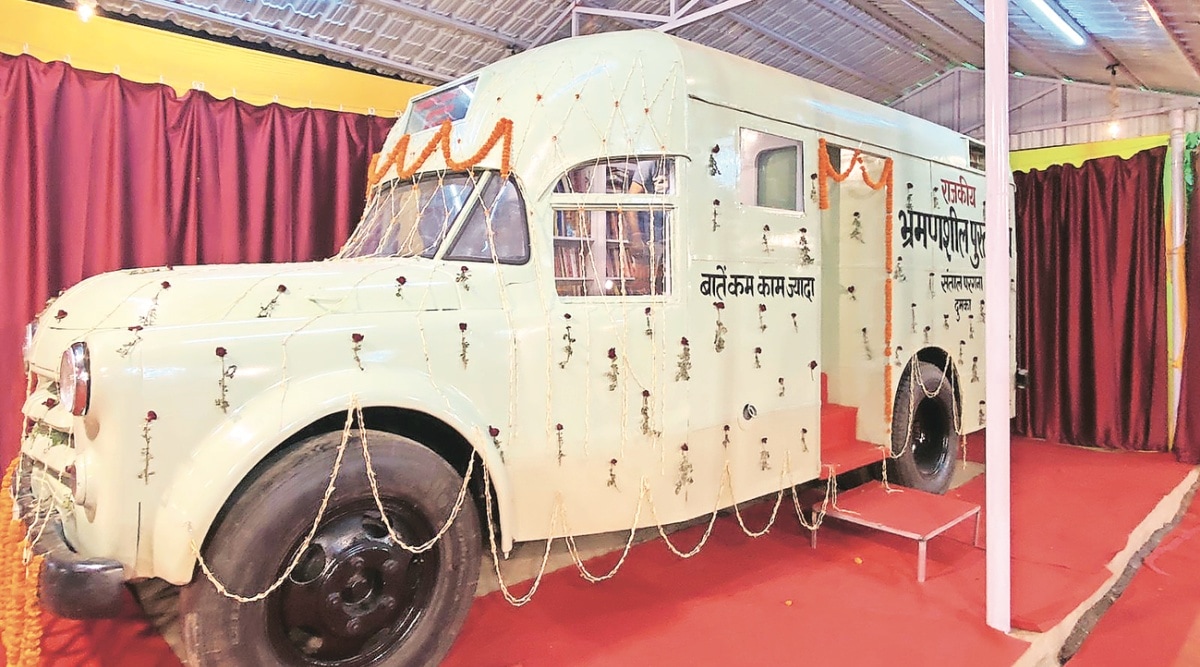 Rajkiya Bhramanshil Pustkalay (Library on Wheels), built on a truck in 1958, at Dumka State Library Literature Festival. It has travelled thousands of kilometres in Jharkhand. Express
Is the Adivasi community uncouth; does it follow any religion; does it have a global vision, and why is that the Santhal rebellion, which took place before the Revolt of 1857, is left out of mainstream history?
These were some of the questions that emerged during a discussion on ‘Tribal Literature: Present and Future’ during the inaugural State Library Literature Festival in Dumka district.
🗞️ Subscribe Now: Get Express Premium to access the best Election reporting and analysis 🗞️
Other sessions included discussions on the wildlife crisis of India, on wandering writers, among others.
The event was centred around refurbishment of ‘Rajkiya Bhramanshil Pustkalay (Library on Wheels)’ built on a truck in 1956, which had travelled thousands of kilometres in remote areas of Jharkhand. Although not mobile any longer, it was refurbished by Odisha-born poet and bookseller Akshay Bahibala, who travels with his “Walking Bookfairs” — a van full of books — in small towns to elicit the spirit of reading. Originally, the ‘Bhrahmanshil Pustakalaya’ had travelled in Santhal Pargana Commissionerate districts: Dumka, Deoghar, Jamtara, Godda, Sahibganj, and Pakur.
Writers from the tribal community such as writer-poet Anuj Lugun, winner of Sahitya Akademi Yuva Puraskar in 2019, and Mahadev Toppo, a leading Adivasi litterateur from Jharkhand, discussed on how Adivasis are perceived differently.
The perception that the tribal community is backward, and that it does not know the ways of the world, is “unfounded”, Lugun said. “Sosobonga, which are orally recited epics of Adivasis, particularly in Mundas and Asur communities, tell us how there should be balance between nature and humans,” he said.
Toppo said that the lockdown culture has existed for long within Adivasi communities. “Adivasis don’t venture into forests for a few months each year in a bid to protect baby animals, growing shrubs and plants. With such a viewpoint, how can an Adivasi person be called uncouth or ignorant? This is the real challenge in front of upcoming writers and generation to bring this view out to the mainstream,” Toppo said.
Lugun said an Adivasi writer from Khunti commented on the First World War that “log hawa mein lad rahe hain, zameen ke liye (people are fighting in the air for land)”. “This is an amazing viewpoint from an Adivasi person and his society. So the community isn’t aloof,” Lugun said.
He emphaised that in academia there is little talk of the Adivasi knowledge system. “It is a problem if there is no Santhali school beside an English school. It means the direction in which we are going in policy-making, the knowledge of indigenous culture is not included,” he said.
Toppo seconded him and said the real challenge for upcoming writers, who wish to tell stories of Adivasi communities, is to bring their views in the mainstream, which hold significance.
During the question-answer session, when asked why the Santhal rebellion of 1855 — when two Santhal rebel leaders mobilised 60,000 people from Santhal community and declared a rebellion against the East India Company — is not documented in a manner that it should be, and why newer generations are not writing about it, Lugun said: “There was a mindset created that Adivasis were barbaric and hence there was no bond established with the mainstream society with Adivasis. So their history, in a sense, got excluded.”
Ranendra, director at Jharkhand’s Ram Dayal Munda Tribal Welfare Research Institute, who was present in the audience, however, said that the university in the area never tried to document it and only some people from other states or some IAS officers write about it. “This is the failure of universities, and also of our organisation…that we are being fed the mainstream version of history from Delhi. Currently we are working on documenting the Santhal Hul or Phulo Jhano revolt.”
Stating that he was responding on behalf of the university or academia, Achyut Chetan, professor of English at St Xavier’s, Kolkata, said Adivasi history is a little complex, as it is combined with the history of others as well. He said it was difficult to extract only Adivasi history from it.
Explaining the difficulty he faced while publishing two books on Santhal rebellion: “Two books, revisiting the Santhal rebellion, were published in Dumka in 2018 and 2019. I was the editor and I was pained to realise that there was no thought process on who will write Adivasi history and how it will be written — will the history be only of Adivasis, or it will be an history of an event?…”
Anuj Lugun, in reply, said: “It is true that other people’s history will also come when history of Adivasis are written. But somehow when India’s history was written, the history Adivasis never came…”

 5 min read