Journalism of Courage



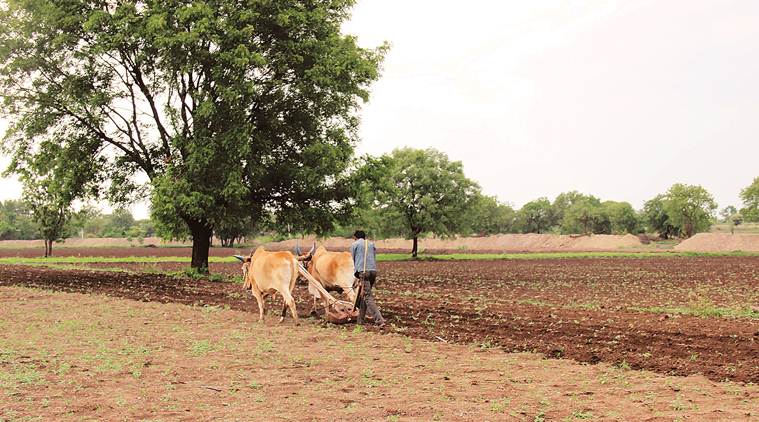 The onus of implementing the government’s new MSP policy will be not just on state procurement agencies but even the private trade. (Archive)
With just over a month to go for the arrival of the current kharif season’s crop in the markets, the Maharashtra government has made purchase of any farm commodity below the official minimum support price (MSP) by even a private trader an offence attracting a one-year jail term and a fine of Rs 50,000.
The Devendra Fadnavis government, following a Cabinet meeting Wednesday, approved amendments to the Maharashtra Agricultural Produce Marketing (Development & Regulation) Act, 1963 to make it conform to the Centre’s Model Agricultural Produce and Livestock Marketing (Promotion & Facilitation) Act, 2017.
Accordingly, there will no longer be fragmentation of markets within the state through notification of “market areas” where sale/purchase of farm commodities can take place. Instead, it has now been decided to declare the entire state as a single market and traders will not require separate licences for operating in each “notified” APMC market. They can purchase produce from any mandi within Maharashtra, which will also help farmers realise better prices from more buyers.
While the above amendment amounts to a significant reform, what may not be so, however, is the decision to make purchase of a farm commodity below the government’s MSP a punishable offence. The onus of implementing the government’s new MSP policy – which seeks to provide farmers a minimum 50 per cent return over their production costs – will be not just on state procurement agencies but even the private trade.
The implications of this may not be small.
Tur (pigeon-pea), for instance, is currently trading in Maharashtra’s markets such as Akola, Latur and Amravati at Rs 3,600-3,700 per quintal – well below the Centre’s MSP of Rs 5,675 for 2018-19 or even last year’s Rs 5,450. Soyabean, another major crop in the state, is currently selling at Rs 3,400-3,450 per quintal – just above the latest announced MSP of Rs 3,399. But last year during the peak marketing season of October-November, farmers were selling the oilseed at Rs 2,600-2,700 per quintal, as against the then MSP of Rs 3,050.
If the Maharashtra government’s new decision is enforced, private traders will have to purchase at the MSP, even if the market supply-and-demand conditions do not make it a viable proposition.
“This move will be counterproductive and the biggest hit will be taken by farmers. Which trader will buy at the rate fixed by government?,” said Lalit Kumar Shah, chairman of the Latur APMC.
He pointed out that the National Agricultural Cooperative Marketing Federation of India – the apex government procurement agency for pulses and oilseeds – is disposing its tur stocks from purchases made in 2016-17 and 2017-18 at Rs 3,400-3,500 per quintal. “Nafed is selling at a loss, which the government will most probably cover. But who will compensate us if we buy at MSP and sell at the rate that the market can bear?” he added.
Satish Kumar Vyas, director of the Achalpur APMC in Amravati, said that many farmers who sold tur and chana (chickpea) to government agencies in 2017-18 are still to even receive their MSP payments. “When the government itself is unable to the pay the MSP, how does it expect us to do so? Today, both domestic and international commodity markets are depressed. We can pay higher prices to farmers only when we are able to sell at least at those rates,” he said.
Shah claimed that traders in markets such as Jalna, Solapur and Khamgaon have already gone on strike against the government’s decision and “traders in Latur may also soon follow suit”.

 4 min read