Premium

The many wrong turns that led to Bhopal’s infamous right-angle bridge

Railways spokesperson Naval Agarwal acknowledged that both departments had coordinated during the design phase and that Railways had raised early concerns about the alignment

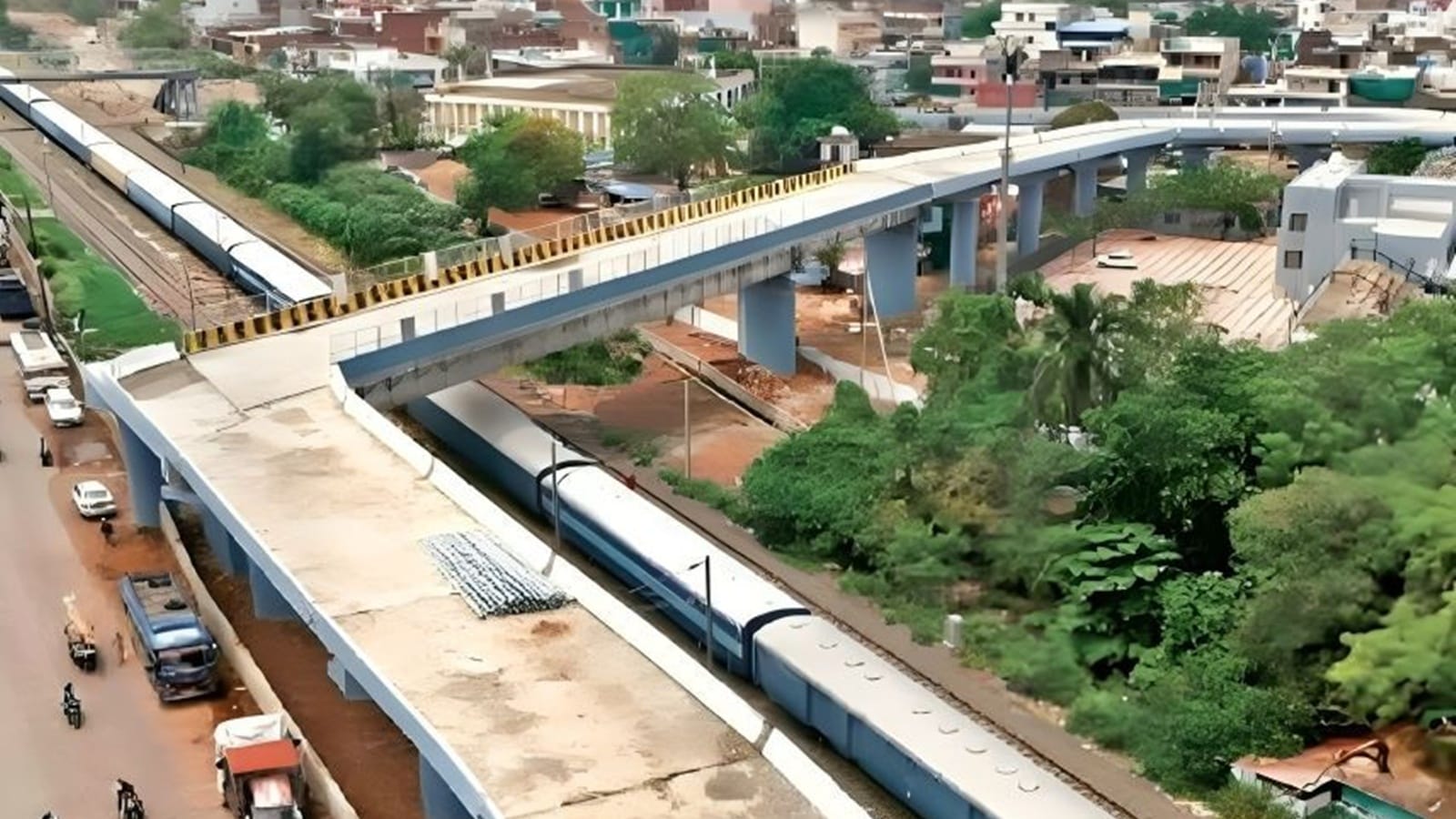
bhopal right angle bridgeThe 648-metre bridge in the Aishbagh area, which cost Rs 18 crore to build, was meant to eliminate long delays at railway crossings and shorten the commute for nearly three lakh people daily. (Photo: X/@theskindoctor13)

A newly constructed rail overbridge (ROB) in Bhopal, which made headlines for its almost 90-degree turn, has quickly gone from being the subject of memes to the subject of an investigation. And, as an enquiry gets underway to figure out what led to the peculiar construction, officials from the Madhya Pradesh Public Works Department (PWD) and the Indian Railways appear to be shifting blame.

The 648-metre bridge in the Aishbagh area, which cost Rs 18 crore to build, was meant to eliminate long delays at railway crossings and shorten the commute for nearly three lakh people daily.

KPS Rana, the engineer-in-chief of the PWD, told The Indian Express that the bridge’s design was sanctioned in 2018 and was executed by a team originally from the bridge engineering department, comprising officials at the assistant engineer, superintendent engineer, executive engineer, and chief engineer levels.

“We have formed a committee to look into the role of these officials,” he said. Rana emphasised that the General Arrangement Drawing (GAD), a comprehensive layout plan necessary for all ROB projects, was prepared in collaboration with the Indian Railways and supervised within the PWD by the Chief Engineer (Bridges). G P Verma, the Chief Engineer (Bridges), refused to comment on the matter.

Rana said the “final approval” remained within the department of the Chief Engineer (Bridges), and “the design did not escalate to higher authorities.”

“It was the bridge engineering department which had dealt with the design. The GAD was formulated with the help of railway officials and PWD officers. A private contractor was engaged to execute the work, and they also have a final role to execute the design in the later stages. If there had been better communication, we could have rectified the design or made an underbridge. The railway built its own ROB considering the space crunch,” he said.

Rana said the project faced spatial constraints, and the issue of alignment should have been flagged earlier in the GAD formulation phase.

Story continues below this ad

“There was a lack of communication between different departments over this. If we could have got this at the reception stage itself, the Railways could have denied giving approval to the project. Then we could have worked on a redesign,” he said.

And so, the departments proceeded with the existing design, and alternatives such as an underground crossing or different alignment were not explored, Rana said.

Railways spokesperson Naval Agarwal acknowledged that both departments had coordinated during the design phase and that Railways had raised early concerns about the alignment. “We had done our job and built our portion of the ROB as per the GAD. We had communicated to the PWD through a letter some time ago on the design flaws. We did our job.”

Anupam Awasthi, the Chief Project Manager, declined to comment in detail, stating only that he was not involved when the GAD was prepared and suggesting that any design flaws could have been addressed via a revision proposal at that time. “If there was an approach problem, then there could have been a revision proposal. That was not done,” he said.

Story continues below this ad

The construction contract was awarded to M/s Puneet Chadha, a private firm based in Bhopal. Senior structure engineer Kailash Kushwaha, who worked on-site for two years, supervising a team of 60 people, said the design came directly from the PWD. He said that the bridge was constrained on one side by metro construction and on the other by an electrified railway line, limiting available space.

He said they worked with the Chief Engineer (Bridges). “The PwD had raised these issues of lack of space; it’s mainly the railway department’s fault that they did not coordinate with us,” Kushwaha alleged.

The PWD has constituted a four-member committee, including two chief engineers and an executive engineer, on the orders of PWD Minister Rakesh Singh. This committee will assess the design, evaluate accountability, and recommend corrective measures. The safety measures under consideration include installation of speed breakers at five locations, mirrors for visibility at the 90-degree turn, reflective radium strips, speed limit signage, 20 new streetlights on the bridge, and widening the curve using girders at the triangle base of the ROB.

Anand Mohan J is an award-winning Senior Correspondent for The Indian Express, currently leading the bureau’s coverage of Madhya Pradesh. With a career spanning over eight years, he has established himself as a trusted voice at the intersection of law, internal security, and public policy. Based in Bhopal, Anand is widely recognized for his authoritative reporting on Maoist insurgency in Central India. In late 2025, he provided exclusive, ground-level coverage of the historic surrender of the final Maoist cadres in Madhya Pradesh, detailing the backchannel negotiations and the "vacuum of command" that led to the state being declared Maoist-free. Expertise and Reporting Beats Anand’s investigative work is characterized by a "Journalism of Courage" approach, holding institutions accountable through deep-dive analysis of several key sectors: National Security & Counter-Insurgency: He is a primary chronicler of the decline of Naxalism in the Central Indian corridor, documenting the tactical shifts of security forces and the rehabilitation of surrendered cadres. Judiciary & Legal Accountability: Drawing on over four years of experience covering Delhi’s trial courts and the Madhya Pradesh High Court, Anand deconstructs complex legal rulings. He has exposed critical institutional lapses, including custodial safety violations and the misuse of the National Security Act (NSA). Wildlife Conservation (Project Cheetah): Anand is a leading reporter on Project Cheetah at Kuno National Park. He has provided extensive coverage of the biological and administrative hurdles of rewilding Namibian and South African cheetahs, as well as high-profile cases of wildlife trafficking. Public Health & Social Safety: His recent investigative work has uncovered systemic negligence in public services, such as contaminated blood transfusions causing HIV infections in thalassemia patients and the human cost of the fertilizer crisis affecting rural farmers. Professional Background Tenure: Joined The Indian Express in 2017. Locations: Transitioned from the high-pressure Delhi City beat (covering courts, police, and labor issues) to his current role as a regional lead in Madhya Pradesh. Notable Investigations: * Exposed the "digital arrest" scams targeting entrepreneurs. Investigated the Bandhavgarh elephant deaths and the impact of kodo millet fungus on local wildlife. Documented the transition of power and welfare schemes (like Ladli Behna) in Madhya Pradesh governance. Digital & Professional Presence Author Profile: Anand Mohan J at Indian Express Twitter handle: @mohanreports ... Read More

Stay updated with the latest - Click here to follow us on Instagram

Latest Comment
Post Comment
Read Comments
Advertisement
Advertisement
Loading Taboola...
Advertisement