Journalism of Courage



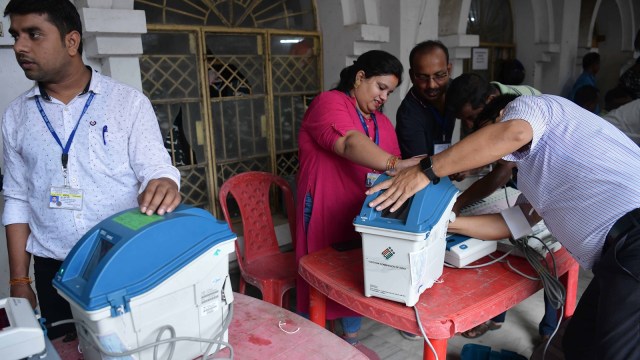 Polling officers with VVPAT machines. (Express file photo)
Dismissing the idea of a return to the ballot paper era, the Supreme Court Tuesday questioned petitioners who raised doubts on the sanctity of voting through Electronic Voting Machines (EVMs) with the judges stating that they have not yet forgotten what used to happen when votes were cast through ballot papers.
“Fortunately, we are now in our sixties. We have seen what used to happen earlier. Have you forgotten that? If you have forgotten that, I am sorry, I have not forgotten,” Justice Sanjiv Khanna, presiding over a two-judge bench, told Advocate Prashant Bhushan who appeared for petitioner-NGO Association for Democratic Reforms seeking 100% verification of EVM votes with VVPAT slips. At present, 5 EVMs are randomly verified against VVPAT slips per Assembly segment.
Bhushan wondered if it was booth capturing that the judge was referring to.
To this, Justice Khanna said, “Forget about booth capturing. What happens when ballot papers are… anyway. Let’s not enter into a debate.”
Bhushan had brought up the idea of ballot papers when the bench, also comprising Justice Dipankar Datta, asked him what alternative he had in mind to the EVMs.
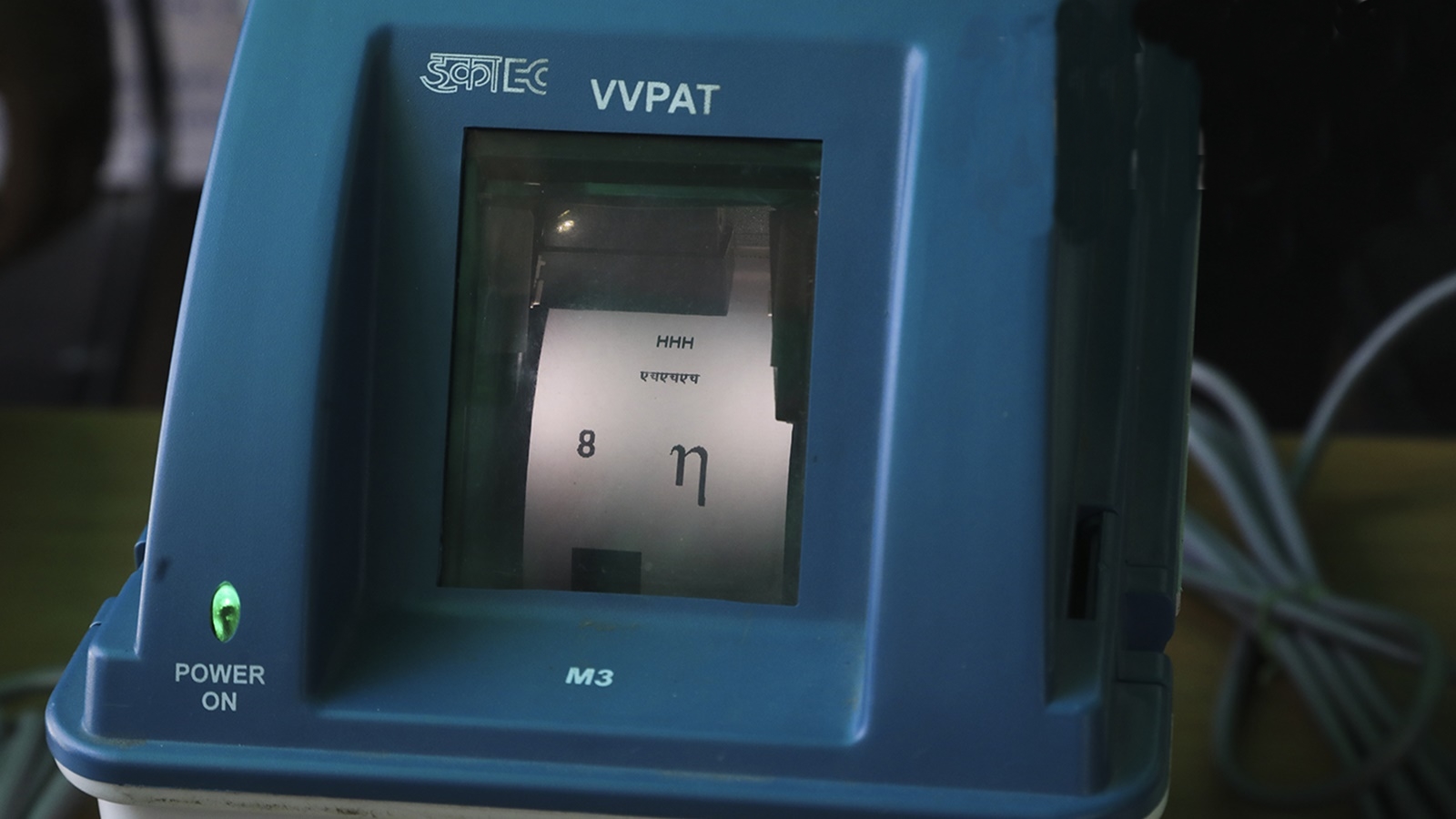 A demo VVPAT machine. (Express photo by Abhinav Saha)
“Earlier, there used to be ballot papers. There can be ballot papers. Most European countries have gone back to ballot papers,” Bhushan said. He said the German constitutional court had given a judgment on why EVMs cannot be trusted and, therefore, paper ballots should be resorted to.
Junking the suggestion, Justice Datta said the conduct of elections in India is “a humongous task. Not possible for any European country to conduct. Let’s not draw analogies and comparisons from Germany and other countries. My home state West Bengal has more population than what Mr Bhushan said about Germany’s population. It’s a very small state… We have to repose some trust and confidence in somebody. Of course, they are accountable… But don’t try to bring down the system like this.”
The bench also posed a series of searching questions on the working of the EVMs and the process of storing them and counting the votes.
It also questioned the ADR submission that “majority of voters don’t trust EVMs” and asked Bhushan who made the submission “where do you get that” from.
Bhushan replied that it was a CSDS-Lokniti poll.
“Poll! …Let’s not believe in these private polls,” Justice Datta said.
The petition for 100% verification of EVM votes with VVPAT slips is being heard at a time when the Lok Sabha election process is underway. The Opposition has been asking questions about the foolproof nature of the EVMs and some have even suggested a return to the ballot paper. Currently, 5 EVMs are randomly verified against VVPAT slips per Assembly segment.
Justice Khanna said, “This type of argument may not be acceptable because there is no data with regard to that. A private poll will not be able to… It’s possible somebody else will take out a poll to the contrary. Let’s not go into all that.”
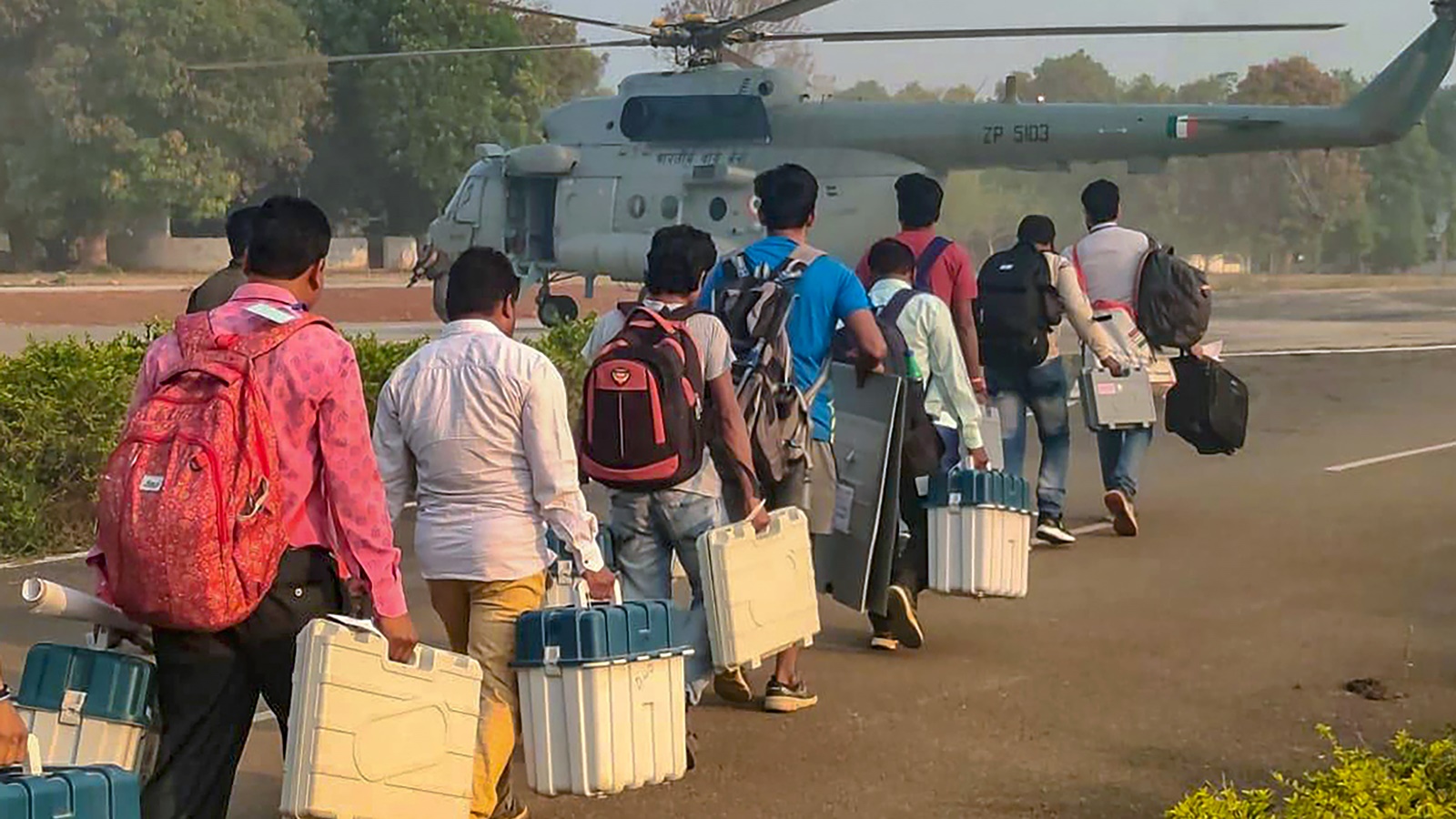 Polling staff with EVMs leave for election duty in Sukma district of Chhattisgarh Tuesday. (PTI)
To an intervenor who contended that EVMs are manufactured by a Public Sector Undertaking and the technical person there is not accountable, Justice Khanna said, “You will be happy with the private sector manufacturing the machines?… If the private sector was manufacturing, you would have come here and said it should not be manufactured by the private sector.”
The bench said, “As far as when we have to examine whether the EVMs are functioning properly, we will have to go by the data. With regard to what is the total number of votes polled in a particular year-on-year together, and whether they have tallied it with the total number of votes counted later on, how many cases there were discrepancies. How many cases ultimately the candidates request for counting of the paper slips were done, how much discrepancies were found in that. That will give us the true picture whether the EVMs are being manipulated or the chances of manipulation or not. That data they will provide. We will ask them for that data.”
Bhushan said, “We are not saying that EVMs are being manipulated or have been manipulated. What we are saying is that EVMs can be manipulated because both EVM as well as the VVPAT have a programmable chip.”
He said the other suggestions were to allow voters to physically take the VVPAT slip and deposit it in the ballot box so that they can be sure that their vote has been recorded correctly and to replace the opaque mirrored glass on the EVM with a transparent glass so that one can see what is happening inside.
According to the petitioners, the Election Commission of India had said it would take 12 days if all VVPAT slips were to be counted.
Bhushan said the Election Commission had said it cannot share the source code of the EVM chips citing intellectual property rights of the maker, and this casts a greater suspicion about the machines. He said the EVMs are assembled by two PSUs — Electronics Corporation of India Ltd and Bharat Electronics — which have many BJP office bearers as Directors.
Senior Advocate Gopal Sankaranarayanan cited a news report about ECI data on the mismatch in the number of votes cast on EVMs and the number of votes counted in some constituencies during the 2019 Lok Sabha polls. He said there were “serious discrepancies… in 373 constituencies which went to polls in the first phase of the election”.
But the bench said there may be some discrepancy sometimes because the button may not have been pressed immediately but in such cases the candidates would have the data and would ask for counting of VVPAT slips.
“If there is any such discrepancy… each candidate will be given that data… the candidates would have immediately challenged it,” Justice Khanna said.
Sankaranayanan said the data came subsequently, but the bench did not agree.
Referring to a July 2023 report of the Committee on Government Assurances, Sankaranarayanan also said that in July 2023, “a Parliamentary panel has said that the Union government is yet to provide a reply for the last four years after it promised Parliament that it would obtain information from the Election Commission about possible discrepancies between the EVMs and VVPAT rally during the 2019 elections”.
The bench said it would ask the ECI about this.
Sankaranayrayan also raised apprehensions about the rule that a voter asking for VVPAT slip will have to give a declaration that he is aware of the consequences if his claim is found to be untrue which includes imprisonment up to 6 months and fine up to Rs 1,000. This, he said, acts as a deterrent.
Justice Khanna said, “There is a reason behind it. At this stage, the voter is not given the paper slip. If he asks for the paper slip, he will be entitled to it. But then the electoral process will have to stop. Somebody will have to open the machine and take it out, the candidates’ representatives will have to be called in.” He said, “Look at the practical side. Suppose 10 per cent of the people ask for the slips, the whole electoral process could come to a stop.”
Hearing in the matter will resume April 18.



 8 min read