Journalism of Courage

Border
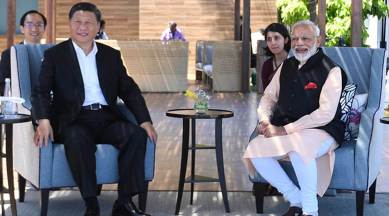
Mahabalipuram: The two leaders welcomed the work of the Special Representatives on the boundary question, and in trying to arrive at a mutually acceptable settlement based on political parameters and guiding principles agreed upon in 2005. They reiterated that efforts would continue for peace and tranquillity in border areas, and on additional Confidence Building Measures.


Terrorism
Mahabalipuram: The leaders agreed that terrorism continued to pose a common threat, and recognised the need to make “joint efforts” to ensure that the international community strengthens the framework against terror.
Wuhan: Modi and Xi reiterated their resolute opposition to terrorism in all its forms, and committed themselves to cooperate against it.
Economy
Mahabalipuram: A big takeaway from the Indian perspective was the announcement of a high-level mechanism for trade, headed by Finance Minister Nirmala Sitharaman and Chinese Vice Premier Hu Chunhua, to better balance trade and encourage mutual investments.
Wuhan: The two leaders agreed to promote bilateral trade and investment in a balanced and sustainable manner through complementarities between their two economies.
Disputes
Mahabalipuram: The consensus evolved in Astana in June 2017, that differences should not become disputes, was finally made a part of the Indian statement. The two leaders reiterated the Wuhan agreement that India and China are factors for stability in the current international landscape. They also decided to continue with the informal summits.
Wuhan: While welcoming the opportunity offered by the 2018 informal summit, the leaders hoped that peaceful, stable and balanced relations between India and China would be a positive factor for stability amidst global uncertainties, and go on to create the conditions for an Asian Century.
Strategic communication
Mahabalipuram: Originally a Chinese idea, but now India has adopted the idea of “strategic communication” and leader-driven mechanism. Modi and Xi agreed to enhance communication on all matters of mutual interest, and continue the momentum of high-level exchanges. 2020 would be marked as Year of India-China Cultural and People to People Exchanges, involving respective legislatures, political parties, cultural and youth organisations and militaries. 70 activities are planned, including a sea voyage tracing the historical connect between the two civilisations.
Wuhan: Modi and Xi agreed on the need to strengthen strategic communication through greater consultation.