Journalism of Courage



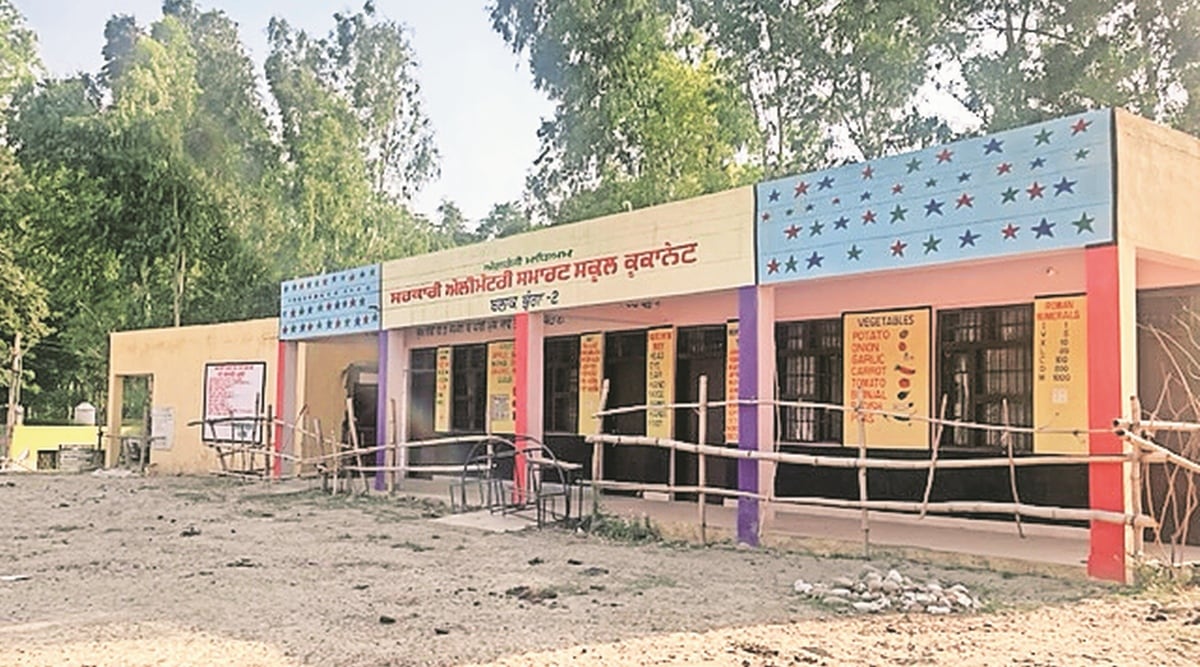 The Government Elementary Smart School at Kukanet with its makeshift ‘boundary’. (Express Photo by Divya Goyal Gopal)
The signage on the single-storey building proudly announces: Government Elementary Smart School, Kukanet. The signage, flanked by a multitude of stars painted on both sides, however, is the only ‘smart’ thing about the school in the village.
Nestled in the foothills of Shivalik, in the Kandi belt near the Himachal Pradesh border in Hoshiarpur, Kukanet village is slowly gaining fame as Punjab’s best-kept secret among nature lovers. The “forest village”, with its unexplored jungles and a huge potential of eco-tourism, however presents a picture of disappointment with its ‘smart’ school, which is managed by a solo teacher.
To keep stray animals out and to keep the students in, the teacher has come up with a unique ‘jugaad’ — pieces of bamboo have been tied across the campus with ropes creating a “boundary” wall, which has been “reinforced” and ‘strengthened” at strategic points with other discarded products such as old benches, wooden chairs.
But why this ‘jugaad’ for the newly-constructed “smart” school?
Mukesh Kumar, the head teacher, and the only one, at the school, says they are yet to receive funds for constructing the boundary wall even though it has been a year that the school building was constructed. The news building does not even have toilets.
The school turns into a cattle shed with strays barging into campus even during school hours, sometimes even jumping over the bamboo fence. Heaps of dung outside the school is a testimony of how the campus turns into a shed every night.
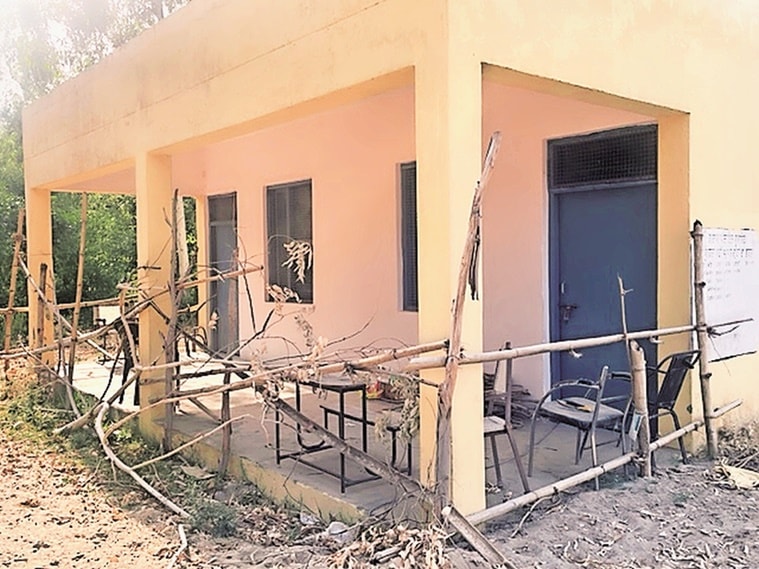 The “forest village”, with its unexplored jungles and a huge potential of eco-tourism, however presents a picture of disappointment with its ‘smart’ school, which is managed by a solo teacher. (Express Photo by Divya Goyal Gopal)
“Stray animals keep sitting in the campus and that’s why we got these bamboos installed. How do we keep the children inside all the time when there is no boundary wall? There’s a road in front of the school and it becomes too dangerous when kids try to run outside,” says Kumar.
The school has 41 students in classes 1 to 5
“We have written at least 6-7 times to the panchayat and to the education department explaining that it is unsafe for students and a boundary wall needs to be constructed immediately. But no action has been taken yet. So we had no option but to get bamboo installed and for that too, we paid labourers from our pocket,” he adds.
The teacher further adds that the situation turns so pathetic during rains, animals jump over the bamboo fence and enter the building. “Even parents ask us why we can’t get a boundary wall constructed. They send their children to a school, not to a cattle shed. What if a stray bull attacks a child? Who will be responsible,” he asks.
This single-teacher school has no class-IV employee or sweeper. The mess that animals leave behind becomes another headache for Kumar. “Sometimes we request the panchayat to get it cleaned and other times we hire labourers. It’s not possible to both teach and sweep,” says Kumar.
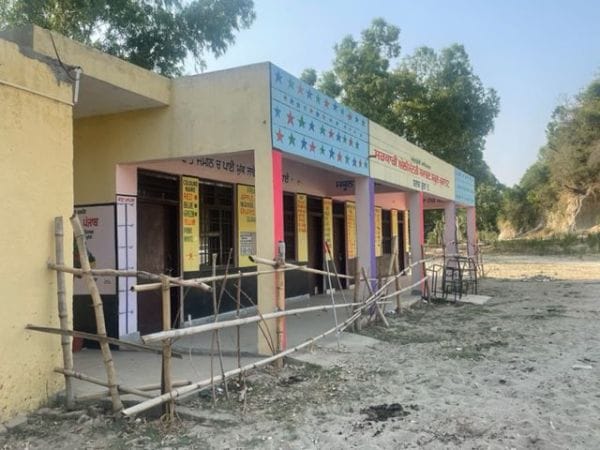
More than 2900 schools still without boundary wall
While presenting this year’s budget, Punjab Finance Minister Harpal Singh Cheema had said that more than 2900 government schools in state still do not have a boundary wall, and another 2400 require funds for immediate repair of boundary walls. “Schools ought to be safe and secure places, especially for girl students. Our survey shows that there are still 2,728 rural schools & 212 urban schools where a new boundary wall is required and there are 2,310 rural schools & 93 urban schools where urgent repair of the boundary wall is required. A budgetary allocation of Rs 424 crore has been made in this budget for this purpose,” said Cheema.
The budget, however, is yet to reach the schools.

 4 min read