External Affairs Minister S Jaishankar addressed the 78th UN General Assembly, where he underlined that “political convenience” cannot determine responses to terrorism, extremism and violence.
Jaishankar’s statement appears to be a veiled attack at Canada, which is locked in a diplomatic rift with India over Canadian PM Justin Trudea’s allegations of Indian interference in the killing of Khalistani separatist Hardeep Singh Nijjar.

The union minister also talked about India as a leading power, the G20 Summit in Delhi and its achievements, the emergence of a new democratic order, and concluded his speech by stating what defines today’s ‘India, that is Bharat.’
Here are top 10 quotes from the EAM’s address:
- “We must never again allow an injustice like vaccine apartheid to recur. Climate action too cannot continue to witness an evasion of historical responsibilities. The power of markets should not be utilized to steer food and energy from the needy to the wealthy. Nor must we countenance that political convenience determines responses to terrorism, extremism and violence.”
- “Similarly, respect for territorial integrity and non-interference in internal affairs cannot be exercises in cherry picking. When reality departs from rhetoric, we must have the courage to call it out.”
- “It was (also) noteworthy that at India’s initiative, the African Union was admitted as a permanent member of the G20. By doing so, we gave voice to an entire continent that has long been denied its due… This significant step in reform should inspire the United Nations, a much older organization, to also make the Security Council contemporary. Broad representation is a pre-requisite for both effectiveness and credibility.”
- “It is still a few nations who shape the agenda and seek to define the norms. This cannot go on indefinitely. Nor will it continue to go unchallenged… A fair, equitable and democratic order will surely emerge, once we all put our minds to it. And for a start, that means ensuring that rule makers do not subjugate rule takers.”
Story continues below this ad
- “At this juncture, it was with a sense of exceptional responsibility India took up the presidency of G20. Our vision of ‘One Earth, One Family, One Future’ sought to focus on the key concerns of the many just the narrow interests of the few.”
- “India also seeks to promote cooperation with diverse partners. From the era of non-alignment, we have now evolved to that of ‘Vishwa Mitra – a friend to the world.”
- “This is reflected in our ability and willingness to engage with a broad range of nations and where necessary harmonise interests. It is visible in the rapid growth of the QUAD; it is equally apparent in the expansion of the BRICS grouping or emergence of I2U2.”
- “G20 vision of One Earth One Family sought to focus on concerns of many, bridge divides and sow seeds of collaboration. Declaration articulates collective ability to do so. At a time when North-South divide is deep–the Delhi Summit affirms that diplomacy and dialogue is the only way forward, and those days, when a few nations used to set agenda are over.”
Story continues below this ad
- “I speak for a society where ancient traditions of democracy have struck deep modern roots. As a result, our thinking, approaches and actions are now more grounded and authentic.”
- “As a civilisational polity that embraces modernity, we bring both tradition and technology equally confidently to the table. It is this fusion that today defines India, that is Bharat.”


 4 min read



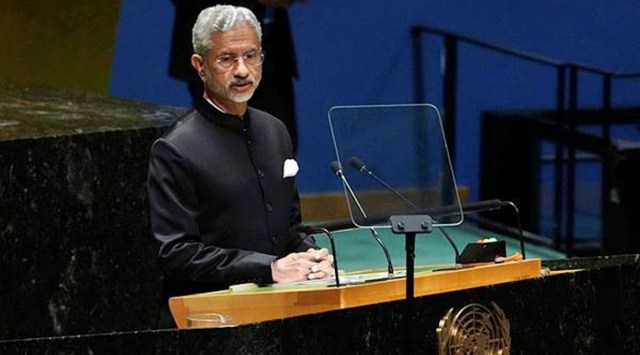 External Affairs Minister S Jaishankar addressed the 78th UN General Assembly, where he underlined that "political convenience" cannot determine responses to terrorism, extremism and violence.