Journalism of Courage



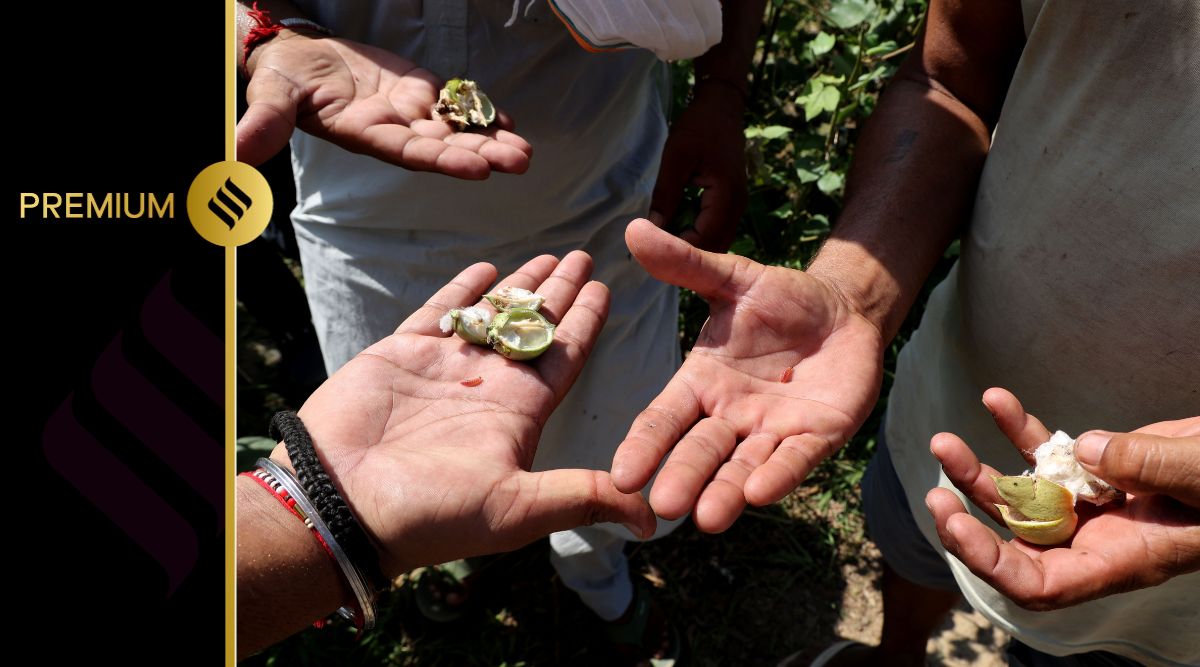 Farmers finding pink bollworm at a field in Rajasthan's Hanumangarh. A farmer in the area, Harvinder Singh, says he doesn't have enough yield for even one picking. (Express Photo: Prem Nath Pandey)
 At Rajasthan’s Hanumangarh, Sukhdev Singh has been growing cotton on six acres for decades, well before the advent of genetically modified Bt hybrids.
Now, all around him, as far as the eye can see, is a sea of green with small clumps of white. “Till two-three years ago, the cotton bolls would have burst by now and these fields would look like it was snowing. Instead, what we have are green bolls that are yet to open,” he said.
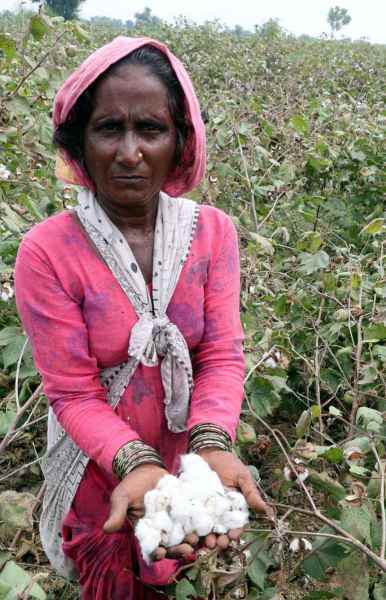 A labourers at the cotton field. (Express Photo: Prem Nath Pandey)
The Pink Bollworm (PBW) is to be blamed for Singh’s woes. The infestation by this insect pest has been common in the cotton belt of northern Rajasthan, Haryana and Southwestern Punjab since 2021. But the damage reported is much more widespread and serious this time. So much so that on Thursday, the Rajasthan government declared that farmers in Hanumangarh and Ganganagar districts, whose crops have been affected, will get relief within 10 days.
The PBW larvae burrow into the developing fruits (bolls) of cotton plants, and the damage affects both the weight and quality of the harvested bolls containing the lint fibre and seeds inside.
From Rajasthan’s Hanumangarh and Ganganagar to Haryana’s Sirsa districts, The Indian Express found the infestation of the pest on the kapas (raw unginned cotton) plants in varying degrees. In many fields, the damage was near complete, leaving no yield for all the work put in.
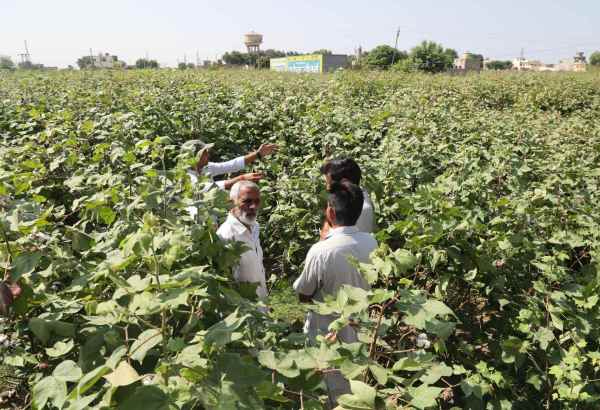 Labourers who pick cotton now say they get 20 kg every day as compared to last year when the yield was around 60 kg a day. (Express Photo: Prem Nath Pandey)
“The Bt seeds we sow now are not working against PBW. Yet, there is no one to monitor or assess losses. We noticed the damage in July and flagged this to insecticide dealers. They just prescribed more insecticides, but that was not effective,” said Gursevak Singh, a farmer. He added that agriculture department officials asked them to plant seeds in wider spaced rows, but that did not work either.
Sukhpal Singh, who farms on 2.5 acres at Bangu village in Sirsa, expects a kapas yield of 2.5 quintals of cotton per acre this year. In 2020, before the PBW was first sighted, it was 10 quintals per acre. Singh has to pay Rs 9-10 per kg for labourers who pick his cotton. Earlier, they charged Rs 7 per kg, owing to the ease of picking. Now, with the bolls either shrunk or fully closed, labourers are unwilling to pick for a low wage.
Inclusive of the amount that Singh invested for seed, fertilisers and insecticides, diesel and labour, the cultivation cost for kapas comes to around Rs 15,000 per acre. With the 2.5 quintals yield that will fetch him Rs 17,250 (at Rs 7,000 per quintal, but varying according to quality), he would hardly make any money. “Sometimes, I think it would be better to leave the field empty than grow this crop. Next year, I will go for guar farming (cluster bean). It may not also give any returns, but it’s better I wait till there is an improved cotton variety in the market,” he said.
Singh estimates that guar would net him around Rs 8,000 per acre: “We are back to the same place where we were 20 years ago before the arrival of the Bt seeds.”
Dr C D Mayee, president of the South Asia Biotechnology Centre, a Jodhpur-based agricultural science organisation, explained that Bt cotton – which incorporates genes from a soil bacteria that code for proteins toxic to the American bollworm – has lost its efficacy against PBW.
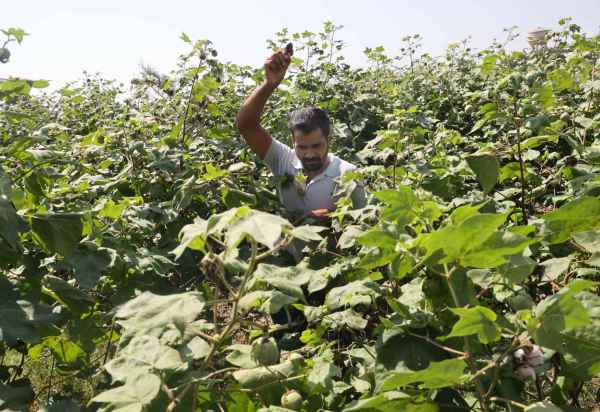 Gursevak Singh showing a green boll infested by the pest.
“Farmers were supposed to plant non-Bt cotton on the sides of the field with the Bt. By growing non-Bt as a refuge crop, it would have delayed the process of the PBW developing resistance and prolonged the life of Bt. The apathy of the state agricultural department and absence of monitoring did not help either ” said Mayee.
Both state governments are acutely aware of the crisis. Dr Narhari Banger, director, agriculture, Haryana, said that according to their estimate for this season, there is a 50 percent damage in 25 percent of the areas where cotton is cultivated. “There are two ways the Haryana government provides compensation – insurance and disaster relief fund. If the loss is higher than 25 per cent, the disaster relief fund will kick in. We are monitoring the situation and issue an advisory every 15 days. We also visited the area on September 1 to evaluate the damage this season,” he said.
Commissioner for Agriculture, Rajasthan, Gaurav Agarwal said that according to their estimates, there is a damage of 10-50 percent. “We will ascertain the actual losses after the crop cutting experiment this year… The pink bollworm infestation is higher this year because of early rains making it conducive for the worms to grow and fester.”
‘My hands are sore from picking this cotton’
Labourers have their own set of difficulties working in a field infested by the PBW. Mamta Bai (40) in Sirsa notes that in a field where she could earlier pick 60 kg of cotton per day, the same has now come down to 20 kg for Rs 10 per kg.
“Earlier, the cotton would come out of the bolls, but now my hands are sore from picking the shrunk cotton. Farmers are working hard and when they are hit, imagine what a blow it is for us. The skin scrapes from picking and when I go home and wash clothes or make food, a sharp pain shoots through my fingers,” Mamta said. “Some labourers hesitate to go because of the low wages and decreased output.”
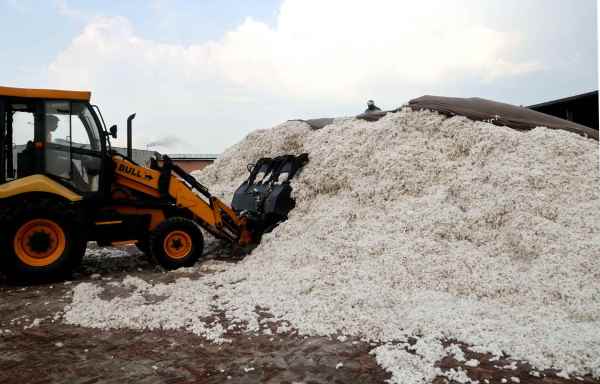 At a cotton ginning mill in Sirsa where the lint is separated from the seed. Lint later is turned into bales of cotton and sent to spinning mills while the seed is processed to form cooking oil, and cake which is an ingredient for cattle fodder. (Express Photo: Prem Nath Pandey)
Robin Moond (28), a farmer with 20 bighas of land in Sri Ganganagar, said: “It is time for first picking, but no one is ready to work for last year’s wages. Last year, the damage was limited to the topmost part of the plant, but this year, the entire field has faced the attack. For many years after BT2 was introduced, we would get 9 quintals per acre; this year it won’t go above 2 quintals.”
Double trouble
Then there are farmers who cultivate cotton on land on lease. For Harvinder Singh from Hanumangarh, who has taken 8 acres on lease for Rs 25,000 per acre, the infestation brings a double whammy. “I have invested Rs 20,000 for cultivation but have not been able to do even the first picking due to the state of the crop. We met the Hanumangarh Deputy Commissioner but no decision or resolution was made. We have tried calling insurance companies under the Bima Yojana (Pradhan Mantri Fasal Bima Yojana of the Ministry of Agriculture), but there is no human interface. The toll-free number does not connect us to anyone,” he said, adding, “Money is deducted online but we have not been able to claim any losses.”
Prahlad Kumar (46), a farmer from Sirsa with 15 acres of land, said that when he started noticing the crop damage, he called agricultural officers in the district to assess the situation on the ground and claim insurance. “They checked a plot with relatively better yield, and informed us later that they had a good report,” Kumar said, adding that this would result in difficulties in getting insurance claims. His land is situated a few kilometres from Chautala, the village of Deputy CM Dushyant Chautala. “Our MP or MLA have not paid a visit. The next time they come asking for votes, we will drop our stalks at their feet,” Kumar said

 8 min read