Probe report says shut down LG Polymers, file FIR against directors
The committee noted that the accident occurred due to uncontrolled styrene vapour release from the M6 tank and qualified it as a major accident as per the definition under Manufacture, Storage and Import of Hazardous Chemical Rules, 1989 rules.
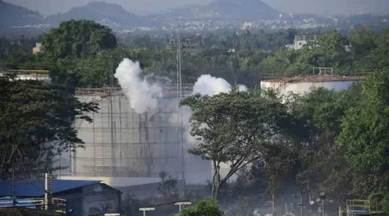
At least 12 persons died and more than 300 affected by the leak on May 7 early morning. (File Photo)
Advertisement
A high-powered committee probing the leak of styrene vapour at LG Polymers factory at Visakhapatnam has recommended filing of cases against all directors and managers of the company, shutting it down or shifting it out, or converting it into a non-polluting unit.
At least 12 persons diedand more than 300 affected by the leak on May 7 early morning.
You’ve Read Your Free Stories For Now
Sign up and keep reading more stories that matter to you.
“The company cannot be allowed to function in its existing form at RR Venkatapuram. It should be shifted out or it should turn into a non-polluting unit,’’ stated the 4,000-page report submitted to Chief Minister YS Jagan Reddy on Monday. He directed authorities of various departments to initiate legal action against those responsible under relevant laws.
“We have pointed out and fixed the negligence of each and every person responsible for the styrene leak. It includes the Korean directors and managers. We have also recommended that either the company turn into a white and green unit or it be shifted out. The company, as it exists now, cannot be allowed to function,’’ Chairman of the committee Neerabh Kumar Prasad, Special Chief Secretary (Environment, Forests, Science and Technology) told The Indian Express.
Indicting the top management for not taking precautions during the lockdown, the committee pointed out that the LG Polymers factory had no stock of inhibitors and negligible stocks of terminators which could have been used to minimise the impact of the accident if not neutralise it. It also said all top officials of LG Polymers be booked for negligence and mismanaging the situation.
The committee noted that the accident occurred due to uncontrolled styrene vapour release from the M6 tank and qualified it as a major accident as per the definition under Manufacture, Storage and Import of Hazardous Chemical Rules, 1989 rules.
Story continues below this ad
The root causes, according to the report, are poor design of the tank; inadequate refrigeration and faulty cooling system; absence of circulation and mixing systems; inadequate measures and parameters; poor safety protocol; poor safety awareness; inadequate risk assessment response; poor process safety management system; slackness of management; insufficient knowledge of the chemical properties of styrene, especially during storage conditions; total breakdown of the emergency response of the procedures; and safety protocol not being followed by the authorities during the lockdown period.
The committee comprising Neerabh Kumar Prasad, Special Chief Secretary (Environment, Forests, Science and Technology); Karikal Valaven, Special Chief Secretary (Industry and Commerce); V Vinay Chand, Collector, Visakhapatnam; R K Meena, Police Commissioner, Visakhapatnam; Dr Anjan Ray, Director, CSIR, Indian Institute of Petroleum, Dehradun; Vivek Yadav, Member Secretary, AP Pollution Control Board; Dr R K Elangovan, Director General, DGFASLI; and Bharat Kumar Sharma, Regional Director, CPCB, Pune, had also invited suggestions and questions from citizens. Over 1,200 queries, 180 phone calls and 250 emails were received by the committee.
Sreenivas Janyala is a Deputy Associate Editor at The Indian Express, where he serves as one of the most authoritative voices on the socio-political and economic landscape of Telangana and Andhra Pradesh. With a career spanning over two decades in mainstream journalism, he provides deep-dive analysis and frontline reporting on the intricate dynamics of South Indian governance.
Expertise and Experience
Regional Specialization: Based in Hyderabad, Sreenivas has spent more than 20 years documenting the evolution of the Telugu-speaking states. His reporting was foundational during the historic Telangana statehood movement and continues to track the post-bifurcation development of both Telangana and Andhra Pradesh.
Key Coverage Beats: His extensive portfolio covers a vast spectrum of critical issues:
High-Stakes Politics: Comprehensive tracking of regional powerhouses (BRS, TDP, YSRCP, and Congress), electoral shifts, and the political careers of figures like K. Chandrashekar Rao, Chandrababu Naidu, and Jagan Mohan Reddy.
Internal Security & Conflict: Authoritative reporting on Left-Wing Extremism (LWE), the decline of the Maoist movement in former hotbeds, and intelligence-led investigations into regional security modules.
Governance & Infrastructure: Detailed analysis of massive irrigation projects (like Kaleshwaram and Polavaram), capital city developments (Amaravati), and the implementation of state welfare schemes.
Crisis & Health Reporting: Led the publication's ground-level coverage of the Covid-19 pandemic in South India and major industrial incidents, such as the Vizag gas leak.
Analytical Depth: Beyond daily news, Sreenivas is known for his "Explained" pieces that demystify complex regional disputes, such as river water sharing and judicial allocations between the sister states. ... Read More