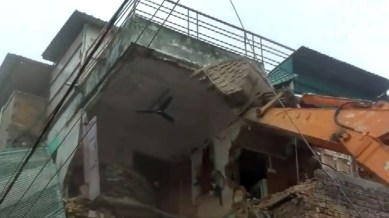
The youths — two brothers aged 18 and 15, and their friend, also aged 15 — were picked up by the police on July 17. The next day, amid protests by right-wing outfits, the Ujjain district administration had razed “illegal constructions” at the home of the brothers, as a heavy police contingent stood guard and drummers played in the background.
According to the police FIR, the complainant, Sawan Lot, claimed that around 6.30 pm on July 17, he saw “three unknown boys spitting on Baba’s Palanquin, they washed their mouths with water and spit on the palanquin”. A person identified as Masoom Jaiswal also claimed to have shot a video of the incident and handed it over to the police.
The FIR was filed under various IPC sections, including 295A (outraging religious feelings) and 153A (promoting enmity).
However, during cross-examination, Sawant told the local district court that it was only when he was taken to the police station by officers that he “got to know that someone had spit” on the procession. “I did not see anyone spitting. There were a lot of policemen and I was told to sign some papers. The policemen did not tell me why my signatures were taken,” he told the court.
He further told the court that he was not part of any procedure to identify the accused in CCTV footage. “I have no information about the incident. The police did not question me or take my statement,” he told the court on August 28. He also denied that a video was made by Jaiswal capturing the incident.
The other witness, Ajay, during his deposition on November 9, denied telling the police that he could identify the youth or that they belonged to the Muslim community.
Story continues below this ad
“I saw a huge crowd at the police station, where some members of Hindu organisations were shouting. The policemen took my signatures on some documents; they did not question me or record my statement,” he told the court.
When contacted, sub-inspector Liban Kujor, the investigating officer of the case at Kharakuwan police station, told The Indian Express, “I don’t know why the witness became hostile in court. We deny any wrongdoing in the matter. We did not make them sign blank documents.”
Superintendent of Police (Ujjain) Sachin Sharma said, “There are many reasons because of which prosecution witnesses become hostile. This happens sometimes.” Asked why the witnesses claimed they were made to sign on papers without reading, Sharma said, “Even in murder cases witnesses become hostile. That doesn’t mean the murder hasn’t happened.”
Asked about the legality surrounding the demolition, Sharma said, “That was separate from the police investigation. The building was deemed to be dangerous and was razed.”
Story continues below this ad
The Ujjain district administration did not comment on the demolition.
The boys’ lawyer, Devendra Sengar, told The Indian Express he had urged the family to pursue action against the administration for the demolition. “I tried my best to convince them. But they said they do not have the strength left to fight anymore, so I did not pursue it. This case has become sensitive and the family is scared of persecution.”
At his home, one of the boys, aged 15, now spends most of his time in his room, playing video games. His family says he does not like meeting anyone anymore. Like the other 15-year-old, he does not go to school. While these two were granted bail in September, the 18-year-old got court relief in December.
For the families, only an acquittal would mean they can finally move on.
Story continues below this ad
At the home of the teenage brothers that faced bulldozer action, a green net has been propped up over the building to hide the exposed iron beams and the damage dealt during the demolition. In the days that followed, family members had frantically packed their belongings into white cement packets. They now live in a rented accommodation.
“They two would work till the evening with our father at our small store. Now, they barely leave their room,” said their elder brother.
Recalling the time the 18-year-old spent in jail, he said: “My brother used to be scared all the time. Jail authorities had separated him from the other inmates; he was scared he would be branded as someone who disrespected Hinduism. He cried every time I saw him, and I would tell him he would come out in no time.”
The teenagers’ uncle chimed in, “Nobody wrote about him when he went to jail; now everyone wants to know his story. Elections came and politicians used that controversy and won. The media had a lot of fun. The damage has been done. We want to move on and be left alone.”
Story continues below this ad
On July 17, the three teenagers were chatting on a busy street outside their home when Mayank, a shoe salesman in the area, asked them to get off the road and watch the procession from their terrace. “I should never have told them to go to that terrace. Their parents had locked the home and handed me the keys, I opened it and asked them to go inside. The streets are packed during the procession and I thought it was the best spot to be. I am a Hindu and I am defending those boys; they have never in their lives disrespected any religion,” he said.
Anand Mohan J is an award-winning Senior Correspondent for The Indian Express, currently leading the bureau’s coverage of Madhya Pradesh. With a career spanning over eight years, he has established himself as a trusted voice at the intersection of law, internal security, and public policy.
Based in Bhopal, Anand is widely recognized for his authoritative reporting on Maoist insurgency in Central India. In late 2025, he provided exclusive, ground-level coverage of the historic surrender of the final Maoist cadres in Madhya Pradesh, detailing the backchannel negotiations and the "vacuum of command" that led to the state being declared Maoist-free.
Expertise and Reporting Beats
Anand’s investigative work is characterized by a "Journalism of Courage" approach, holding institutions accountable through deep-dive analysis of several key sectors:
National Security & Counter-Insurgency: He is a primary chronicler of the decline of Naxalism in the Central Indian corridor, documenting the tactical shifts of security forces and the rehabilitation of surrendered cadres.
Judiciary & Legal Accountability: Drawing on over four years of experience covering Delhi’s trial courts and the Madhya Pradesh High Court, Anand deconstructs complex legal rulings. He has exposed critical institutional lapses, including custodial safety violations and the misuse of the National Security Act (NSA).
Wildlife Conservation (Project Cheetah): Anand is a leading reporter on Project Cheetah at Kuno National Park. He has provided extensive coverage of the biological and administrative hurdles of rewilding Namibian and South African cheetahs, as well as high-profile cases of wildlife trafficking.
Public Health & Social Safety: His recent investigative work has uncovered systemic negligence in public services, such as contaminated blood transfusions causing HIV infections in thalassemia patients and the human cost of the fertilizer crisis affecting rural farmers.
Professional Background
Tenure: Joined The Indian Express in 2017.
Locations: Transitioned from the high-pressure Delhi City beat (covering courts, police, and labor issues) to his current role as a regional lead in Madhya Pradesh.
Notable Investigations: * Exposed the "digital arrest" scams targeting entrepreneurs.
Investigated the Bandhavgarh elephant deaths and the impact of kodo millet fungus on local wildlife.
Documented the transition of power and welfare schemes (like Ladli Behna) in Madhya Pradesh governance.
Digital & Professional Presence
Author Profile: Anand Mohan J at Indian Express
Twitter handle: @mohanreports ... Read More