Journalism of Courage



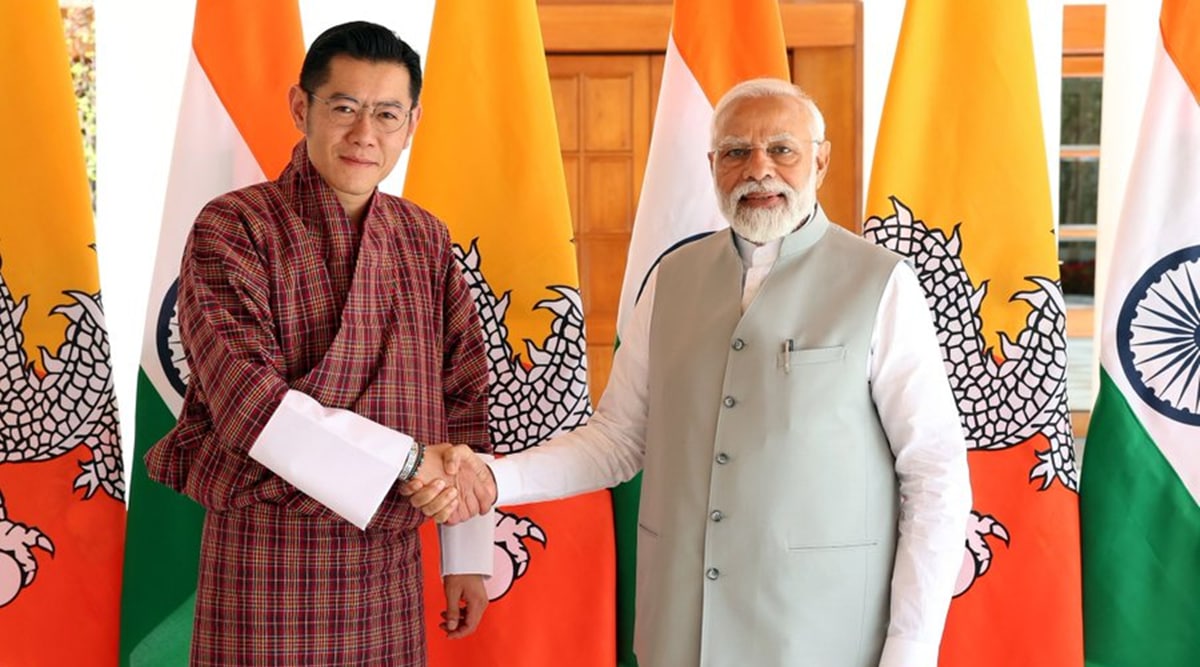 India has consistently been Bhutan's top trading partner, and remains the leading source of investments in Bhutan. (MEA/ANI)
 As the King of Bhutan Jigme Khesar Namgyel Wangchuck and Prime Minister Narendra Modi met in New Delhi, days after Bhutan Prime Minister Lotay Tshering raised eyebrows with his statement on China having an equal say in resolving the border dispute at Doklam, India said Tuesday that it follows all developments which have a bearing on its national interest “very closely” and will take all “necessary measures to safeguard them”.
Underlining that India and Bhutan share ties characterised by “trust, goodwill, mutual understanding,” Foreign Secretary Vinay Mohan Kwatra said, “India and Bhutan remain in close touch relating to our shared interest, including security interest.”
Asked whether the Doklam issue figured in the talks, Kwatra, who was briefing reporters after Prime Minister Modi met the visiting King, said, “India and Bhutan remain in close touch relating to security cooperation.”
“Besides this exemplary and unique relationship that India and Bhutan have, we also have a time tested framework of security cooperation. And as part of that, both countries maintain (a) long-standing tradition of very close consultation on matters relating to their mutual interest and of course, security also. Now, in this context, the intertwined and indivisible nature of our security concerns is self-evident.”
“All I would say is that the Government of India very closely follows all developments, which have a bearing on our national interest, and we will take all necessary measures to safeguard them as necessary.”
Bhutan Prime Minister Lotay Tshering’s recent comments sparked a controversy, as many in Delhi saw it as giving an upper hand to Beijing.
In an interview to the Belgian newspaper La Libre during his recent trip to Europe, he said: “Doklam is a junction point between India, China and Bhutan. It is not up to Bhutan alone to solve the problem. We are three. There is no big or small country, there are three equal countries, each counting for a third. We are ready. As soon as the other two parties are also ready, we can discuss. India and China have problems all along their border. We are, therefore, waiting to see how they will resolve their differences.”
He was responding to questions on the ongoing Bhutan-China boundary talks, in the wake of the 2017 border Doklam border standoff.
Last Saturday, Prime Minister Tshering told The Bhutanese newspaper that he had said nothing new in his statements to the Belgian paper on Doklam and the Bhutan-China boundary talks. “I have said nothing new and there is no change in position.”
After meeting the King, Prime Minister Modi, in a Twitter post, said, “Pleased to receive His Majesty the King of Bhutan, Jigme Khesar Namgyel Wangchuck. We had a warm and productive meeting. Deeply value our close friendship and the vision of successive Druk Gyalpos in guiding India-Bhutan relations to new heights.”
Foreign Secretary Kwatra listed the outcomes of the talks, which covered the entire gamut of bilateral ties including issues of respective national interests.
Kwatra said, “It was agreed that India would step up its support to Bhutan’s upcoming 13th Five Year Plan.”
At Bhutan’s request, he said India would work to extend an additional standby credit facility. This would be over and above the two existing standby credit facilities that are operating between the two countries.
“We would work to shape long-term sustainable arrangements for export of agricultural commodities from Bhutan. Also work to develop long term bilateral arrangements for a short supply of critical commodities to Bhutan, which would include petroleum, fertilisers and coal,” he said.
“We are also examining and considering setting up the first Integrated Check Post (ICP) along India-Bhutan border, which would be somewhere near Jaigaon,” he said.
“We will try to expedite the proposed Kokrajhar-Gelephu rail link project through Government of India support in consultation, of course, with the Bhutanese side. This in some ways will be historic because this would be the first ever rail link between India and Bhutan,” he said, adding that it naturally links up to the rest of the regional connectivity infrastructure in South Asia.
In the field of hydro-power, Kwatra said India has agreed to an upward revision of the tariff of the Chhukha hydro-electric project. “This is the oldest hydro-electric project with Bhutan and is of great significance,” he said.
“We will consider positively Bhutan’s request to sell power from its hydro-power project known as Basochhu hydro-electric project. This would be perhaps done, through the energy exchange mechanism of the market,” he said.

 5 min read