4 min read
Stay updated with the latest - Click here to follow us on Instagram

Journalism of Courage



 The court also asked the committee to conduct the inquiry and submit its report “expeditiously”.
The Technical Committee appointed by the Supreme Court to inquire into allegations of unauthorised surveillance using Pegasus software has submitted its interim report to the top court. A bench headed by Chief Justice of India N V Ramana will consider pending petitions along with the interim report February 23.
The SC had, on October 27, 2021, constituted a three-member technical committee comprising Dr Naveen Kumar Chaudhary, Dean of National Forensic Sciences University in Gandhinagar; Dr Prabaharan P, Professor at Amrita Vishwa Vidyapeetham in Kerala; and Dr Ashwin Anil Gumaste, Institute Chair Associate Professor at Indian Institute of Technology, Bombay; for conducting the probe.
It also appointed former SC judge Justice R V Raveendran, to oversee its functioning and two other experts — former IPS officer Alok Joshi and cyber security expert Dr Sundeep Oberoi — to assist him.
Last month, The Indian Express had reported that at least two security experts, engaged by the petitioners, had deposed before the committee that there is a presence of “strong indicators” pointing to the involvement of “the state, its intelligence and law enforcement agencies” in using the Pegasus spyware for unauthorised surveillance against individuals.
The terms of reference of the committee included:
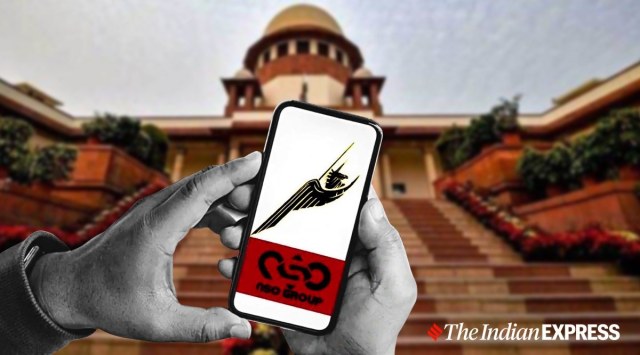
Ruling on a batch of 12 petitions which sought an independent probe into the alleged illegal use of the spyware created by Israeli firm NSO, the bench of CJI Ramana, Justices Surya Kant and Hima Kohli had said that given the “omnibus and vague denial” by the Centre, “we have no option but to accept the prima facie case made out by the Petitioners to examine the allegations made”.
The Centre, while “unequivocally” denying the allegations against it, had said that the matter involved national security questions due to which it did not wish to put the details in a public affidavit. It said it would divulge the details to a committee of experts who would examine the issue and had urged the court to allow it to set up the committee.
But the SC turned down the request saying allowing this “would violate the settled judicial principle against bias, i.e., that ‘justice must not only be done, but also be seen to be done’.”
The court also asked the committee to conduct the inquiry and submit its report “expeditiously”.
On February 3, the panel had extended, until February 8, the time for people who suspected their mobile phones to be infected, to get in touch with it. In a public notice, the committee said that in response to its earlier January 2 notice calling for people submit their devices, only two people had given their devices for “taking digital images”.
A global consortium of media groups had revealed in July 2021 that the spyware had been used by several governments around the world to snoop on opponents, journalists, businessmen etc.
The Indian leg of the investigation, conducted by The Wire, reported that among the potential list of targets were Congress leader Rahul Gandhi, political strategist Prashant Kishor, the then Election Commissioner Ashok Lavasa, now Information and Technology Minister Ashwini Vaishnaw (who was not the minister than), along with several other prominent names. The list also mentioned numbers of around 40 journalists, including three editors of The Indian Express — two current and one former.
Stay updated with the latest - Click here to follow us on Instagram