Journalism of Courage



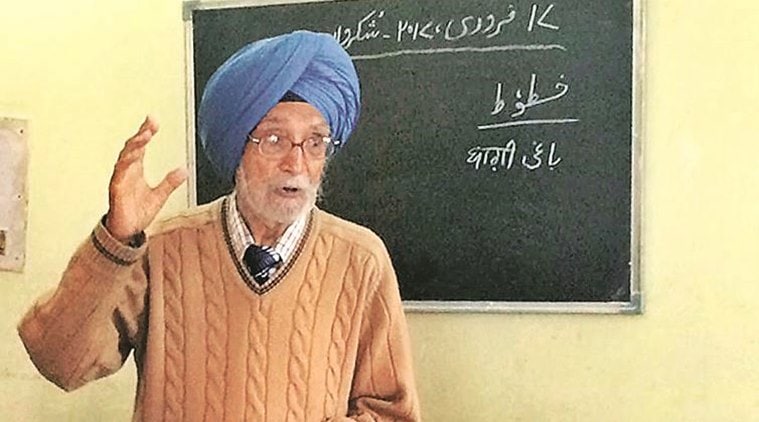 Prem Singh Bajaj taking an Urdu class at Punjabi Bhawan in Ludhiana. (Express photo)
“Mere azeez doston, aaj kya tareekh hai….”
With these words, Prem Singh Bajaj, would scribble the date in Urdu on the blackboard and then explain the beauty of the language he loved teaching to a motley group of students huddled in small classroom inside Ludhiana’s Punjabi Bhavan. The groups always comprised of lovers of Urdu — young and old — with some wanting to pick it up early in life and others trying to learn the language after retirement.
For nearly 24 years, Bajaj (88), a retired principal of Lajpat Rai DAV College in Jagraon, taught the language at a classroom housed inside the Punjabi Bhavan. The class was part of a six-month certificate course in Urdu run by the Punjab’s Department of Languages.
After his retirement from the college, Bajaj also served as director of Punjab Sahit Akademi’s reference library for over two decades and took its collection of books from 7,000 to 62,000. The collection now boasts of 3,000 rare Urdu books.
On Tuesday, Bajaj passed away at his residence in Vikas Nagar of Ludhiana after a brief illness. His son Tajinder Singh Bajaj said his father died while still doing what he loved the most. He added: “Since some days he wasn’t keeping well but on Monday he insisted that I take him to the library. I dropped him on a scooter and he spent three hours there. Five days back, he took his last Urdu class. Despite being unwell, he was worried about students as their exams are approaching. He said two of them were very good and could possibly score well. He was very excited to see their results…He had come back from Australia few months back and had again started going to library and teaching Urdu. That is where his heart was forever.”
Born on February 13, 1931, Prem Singh Bajaj had migrated from Sargodha in Pakistan to India during Partition. While he was a postgraduate in Punjabi, he would often call Urdu his “love and passion”. If it wasn’t for Bajaj’s personal efforts, the Department of Languages might have wrapped up the course way back, not just because it hardly ever had more than fifteen students, but because there was no other teacher who would teach Urdu for Rs 2,500 a month.
“A serious effort is required to preserve a language. If I did this job for Rs 2,500 a month for two decades, doesn’t mean every teacher would do it. You need more batches, proper classrooms and qualified teachers and salaries for them,” Bajaj had told to The Indian Express in February 2017. Initially, he had even refused to take Rs 2,500 from the department but agreed after insistence.
Speaking to The Indian Express in 2017, he had added: “I loved reading and studying Urdu literature when we lived in Sargodha (now in Pakistan). My heart did not allow me to leave the language that I studied till Class 10 back home at Khalsa High School in Farooqa of Pakistan. I refused to leave Urdu and decided to tell people here in India how beautiful this language is. How can a language be Hindu or Muslim. It is an Indian language. And how can a teacher be Sikh or Muslim or Hindu. I am an Indian and can teach whichever language I love. Urdu to ek khazana hai..It (teaching) is my duty for Urdu.”
‘Dedicated his life to Urdu’
“It is nearly impossible now to find another man as committed and dedicated as Bajaj who gave his life to literature and Urdu without any monetary gain. He nurtured the reference library in Punjabi Bhavan like his home and kept Urdu classes going without expecting anything in return from the government. Few days back when I went to meet him, he was still busy teaching Urdu. The greatest tribute to him now would be that government doesn’t let his two projects die,” said Malkiat Singh Aulakh, a writer from Ludhiana.
Ravinder Singh Bhathal, president, Punjabi Sahit Akademi, told The Indian Express, “It is like we have lost our father. Punjabi Sahit Akademi’s library has lost its most dedicated caretaker who gave thirty years of his life to keep this library and Urdu classes running. We have no idea from where will we get someone to replace him and who will take care of his treasure of books now with same dedication as him.”

 5 min read