7 min read


Stay updated with the latest - Click here to follow us on Instagram
© IE Online Media Services Pvt Ltd



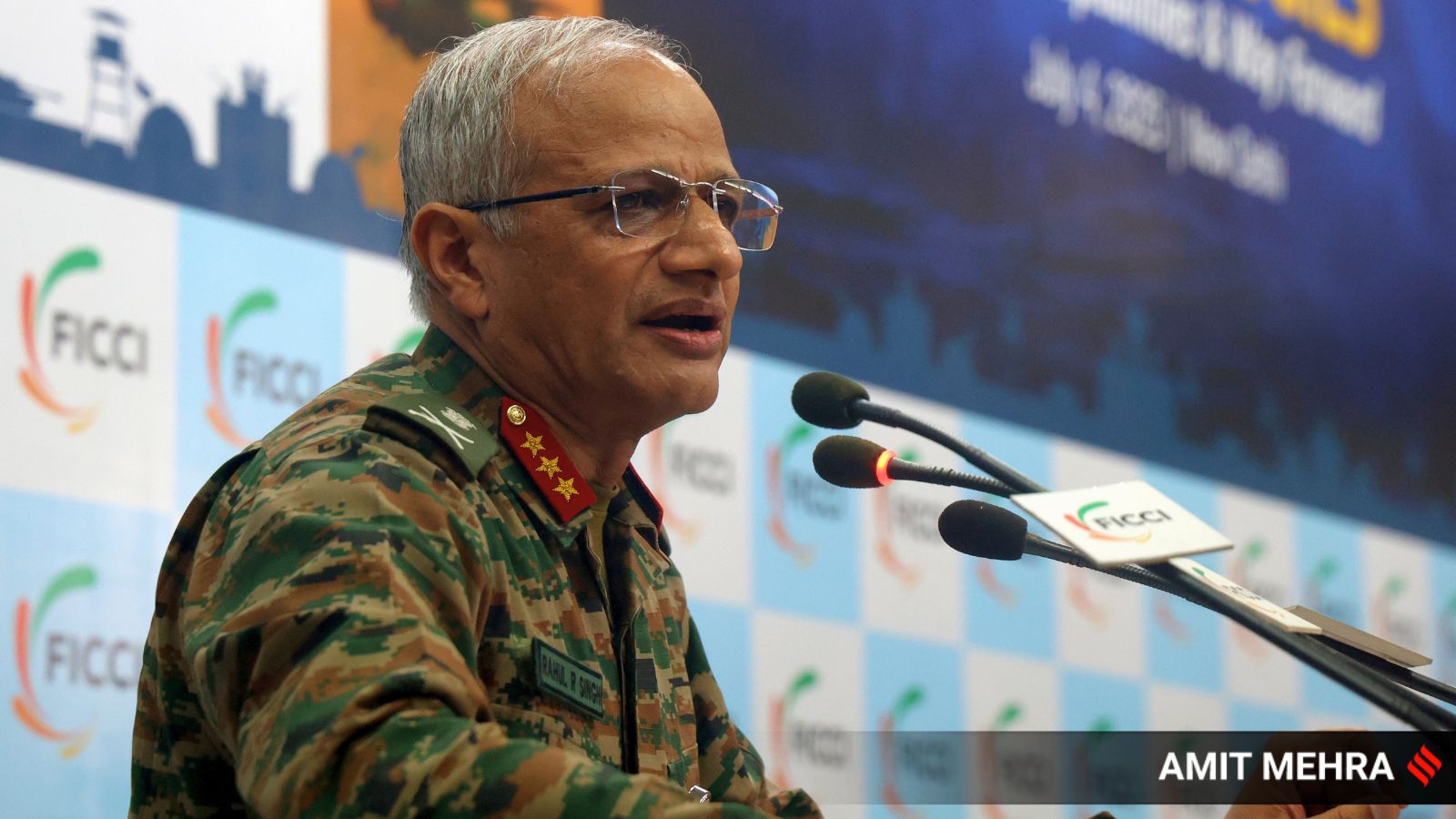 Deputy Chief of Army Staff Lieutenant General Rahul R Singh speaking at an event on Friday. (Express Photo by Amit Mehra)
In first official remarks accusing China of complicity in Pakistani military strikes against India in the wake of Operation Sindoor, Lt General Rahul R Singh, Deputy Chief of Army Staff (Capability Development and Sustenance), said Friday that Beijing provided “live inputs” to Pakistan on Indian operational deployment even when talks were underway between the Indian and Pakistani Directors General of Military Operations regarding cessation of hostilities.
Naming Pakistan, China and Turkey as the “three adversaries” India faced on its “one border” in the north, Lt Gen Singh said China was providing “all possible support”, treating the northern border as a “live lab” to test its weapons supplied to Pakistan, and was following its “36 stratagems”, hoping to kill the adversary with “a borrowed knife”, and to “use the neighbour to cause pain”.
Speaking at the ‘New Age Military Technologies’ event organised by the FICCI, he said Turkey also “played a very important role in providing support” to Pakistan with its supply of the Bayraktar unmanned combat aerial vehicle, “numerous other drones” and “trained individuals”.
He said Pakistan was “the front face” and the Chinese provided “all possible support” which was “no surprise” because statistics in the last five years have revealed that 81 percent of the military hardware procured by Pakistan is Chinese.
“China, of course, the good old dictum… killed by a borrowed knife… he would rather use the neighbour to cause pain than get involved in the mud-slinging match on the northern borders,” he said.
“And another thing that China perhaps has seen is that he’s able to test his weapons against, say, various other weapon systems that are there. It’s like a live lab which is available (to China),” he said.
The next lesson, he said, is the importance of C4ISR (Command, Control, Communications, Computers, Intelligence, Surveillance and Reconnaissance) and civil-military fusion, and there is still a lot to be done in this domain.
“When the DGMO-level talks were going on, Pakistan was mentioning that we know that your such and such vector is primed and is ready for action. I would request you to perhaps, you know, pull it back. So, he was getting live inputs as far as from China,” he said, adding that is one area where India needs to move fast and take appropriate action.
Speaking on electronic warfare and the need for a robust air defence system, Lt Gen Singh underlined the need to protect India’s population centres. While the population centres were not addressed during Operation Sindoor, there is a need to be prepared for that.
“For that, more and more air defence, more and more counter rockets, artillery, and drone sort of systems have to be prepared for which we have to move very, very fast,” he said.
He said while indigenous systems performed well, some did not. “It is a cat-and-mouse game, we need to be at it,” he said.
He said India does not have the luxury like Israel, which has deployed its Iron Dome and several other air defence systems.
“We do not have the luxury, because the country is vast, and such things cost a lot of money,” he said.
The defining thing in Operation Sindoor, he said, was the unambiguous strategic messaging by India’s leadership. “You cross our red lines, and there will be action. There will be punitive action, if required,” he said.
“There is no scope of absorbing the pain the way we did a few years ago. So that is one important message that stands out loud and clear,” he said.
He said the planning and selection of targets was based on a lot of data that was collected. “A lot of data that was collected using technology and, I would say, human intelligence. So a total of 21 targets were actually sort of identified, out of which nine targets we thought would be prudent to engage.”
“It was only the final day or the final hour that the decision was taken that these nine targets would be engaged. A considered decision was taken that it would be a tri-services approach to send the right message that we indeed are an integrated force. So, the Army, Navy, Air Force, all played their part,” he said.
He said an important consideration was the need to be on top of the escalation ladder, and when a political military objective has been achieved, a stop should be put to it.
“So, a lot of naysayers say, why did we stop now? So, war is easy to initiate, but it’s very difficult to control. A very masterly stroke that was played to stop the war at an appropriate time.”
He said a message was sent to Pakistan letting them know that only terrorist targets had been engaged and that India put an end to it.
“However, the Pakistani side decided that they wanted to come equal. They engaged (Indian) military targets. So, in step two of the escalation, a very strong message was sent by engaging their military targets in a manner that on May 10, there was a message from the military operations, Pakistan, that they would want a ceasefire,” he said.
He said the reason why this happened was because there was a punch that was ready, and Pakistan realised that in case this hidden punch comes through, Pakistan would be in a “very, very bad condition”.
At the event, Lt Gen Amardeep Singh Aujla, the Army’s Master General Sustenance, said wars are becoming increasingly intense and complex due to evolving geopolitical dynamics and rapid technological advancements, which are transforming war-fighting practices.
“Op Sindoor has underscored the value and importance of these new war-fighting practices that are currently in vogue, whether it is related to precision or speed.
“The better part in this entire thing is a fine convergence between the kinetic and non-kinetic means. And this is where the drone and the counter-drone warfare come into play in a big way,” he said.
He said it has also highlighted the importance of touching base with new age technologies which are relevant to the Indian Army today. “How good are we at this, what is it that we need to scale up and what is the way ahead for the future,” he said.
Stay updated with the latest - Click here to follow us on Instagram