Journalism of Courage



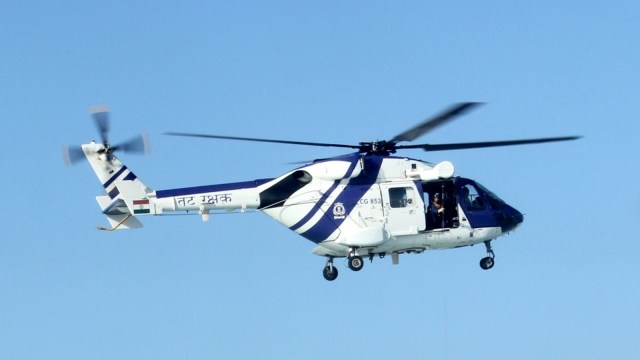 Dhruv, an indigenously developed ALH, is a twin-engine, multi-role helicopter in the 5.5 tonne weight class. indiancoastguard.gov.in
The Advanced Light Helicopter (ALH) Dhruv fleet of the Indian Coast Guard (ICG) and the Indian Navy will soon receive manufacturing modifications to a key component, senior officials familiar with the developments have told The Indian Express.
These modifications, officials said, will be implemented in batches before the helicopters are delivered to the ICG and the Navy, about six months from now.
It is learnt that the Defect Investigation Committee, probing the crash of a Coast Guard-operated ALH Dhruv on January 5, recommended a manufacturing process improvement of the Non-Rotating Swashplate Bearing (NRSB) for the choppers with the Navy and Coast Guard to improve its fatigue life.
These helicopters operate in corrosive saline environments and have to deal with the mechanical stress of deck landings.
An NRSB in a helicopter is a mechanical component that passes inputs via flight controls into the movement of the main rotor blades.
All 28 Dhruvs with the ICG and the Navy will now undergo the requisite manufacturing modifications to the specific part of the choppers in batches over the next few months, before they are returned to the forces in around six months and cleared for flying.
There has been no official comment from the HAL on the matter.
All ALHs with the ICG, Navy, Army and IAF were grounded after an ICG-operated Dhruv crashed in Porbandar on January 5, killing three personnel on board. A fracture of the NRSB was detected in the Dhruv that crashed.
The Defect Investigation Committee probing the crash found the need for this specific manufacturing modification in the NRSB of the ALHs of only the Navy and the ICG, but not in those with the Army and the IAF. The ALH fleet of the Army and the IAF have already resumed flying operations.
Deck landing stress and exposure of mechanical components to the corrosive saline environment of the seas put naval helicopters through more gruelling tests, different from the choppers operated by land-based forces. The ALH naval variant awaits modification to a key component.
The committee looked at possibilities that could have contributed to the fracture, and on the way forward, including new checks and possible changes in manufacturing.
This is the first time such a fracture of a key component took place in a Dhruv, a workhorse of the Indian Armed Forces, in 25 years of its induction into the military. A variety of tests for different batches were carried out, after which data was collected and analysed to reach the conclusion.
The Dhruv, an indigenously designed and developed ALH, is a twin-engine, multi-role, multi-mission new-generation helicopter in the 5.5 tonne weight class. According to the HAL website, a total of 345 helicopters were produced until June 2024 including 313 for the Indian Armed Forces. The choppers together have clocked over four lakh flying hours.
Four Dhruvs have crashed since 2023, including the crash in January this year. In March 2023, a Navy Dhruv MK III had made an emergency landing on water, off the coast of Mumbai. The same month, an ALH Dhruv Mk III of the Coast Guard crashed close to Kochi International Airport during a training flight. In September 2024, another Coast Guard chopper was forced to ditch at sea off the coast of Porbandar, killing three personnel.

 4 min read