Journalism of Courage



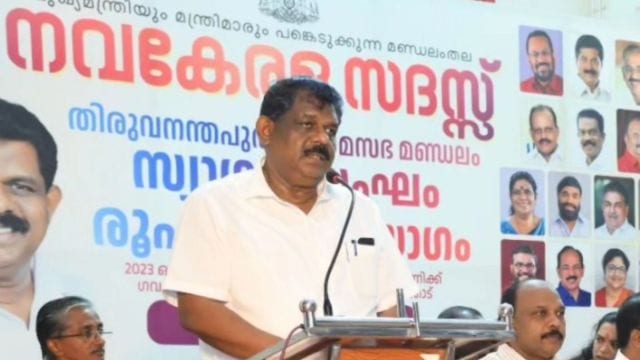 Antony Raju, an MLA from the Janadhipathya Kerala Congress, is part of the state’s ruling Left Democratic Front coalition. (X/@advantonyraju)
The Supreme Court on Wednesday revived a criminal case against Kerala MLA and former state transport minister Antony Raju for allegedly tampering with evidence in a 1990 drug case. Raju had been practising as a lawyer at the time and had appeared for the accused, an Australian national.
A bench of Justices C T Ravikumar and Sanjay Karol directed that the trial be completed in a year given that the proceedings stem from a case that is over two decades old.
Raju, an MLA from the Janadhipathya Kerala Congress, is part of the state’s ruling Left Democratic Front coalition.
In 1990, the police had arrested an Australian national in a Narcotic Drugs and Psychotropic Substances (NDPS) Act case after drugs were seized from his underwear. The accused was convicted by a trial court but the Kerala High Court set him free as the innerwear was not of his size. However, the high court was of the view that tampering with evidence may be a possibility.
Subsequently, a vigilance inquiry followed and Raju and a court employee were arraigned as accused in a First Information Report (FIR) registered in 1994 on charges of conspiracy to cause disappearance of evidence. Raju challenged this before the high court, which quashed the FIR on the grounds that cognisance cannot be taken on a police chargesheet in a case relating to the fabrication of evidence in a court proceeding.
Acknowledging the serious nature of the offence, the high court, however, asked its registry to take appropriate action to pursue the complaint under the relevant provisions of the Criminal Procedure Code (CrPC).
Two appeals were filed against this before the Supreme Court — one by a third person challenging the acquittal and the other by Raju against the high court direction that the complaint be pursued under relevant provisions of CrPC. Raju questioned the locus of the appellant before the Supreme Court but on Wednesday, the bench of Justices Ravikumar and Karol rejected his objections.
On the question of whether the high court rightly held that the proceeding in question would be hit by the bar under CrPC, the Supreme Court said, “We are of the view that the high court committed an error and there is no bar.” It added that there was no error in the high court ordering steps to be taken on the complaint.
“Applying the above principles to the case in hand where the alleged forgery of evidence in a criminal investigation has resulted in acquittal in an NDPS case and thereafter FIR has been registered, the HC has rightly considered this to be an exceptional circumstance where the accused persons should not be protected from facing the processes of law. Therefore…it cannot be said that the HC ordering fresh steps to be taken against the upper end was bad in law,” the Supreme Court said.
“In view of the above, impugned (HC) order is set aside. The order taking cognisance…and all other proceedings pursuant to the same are restored to the files of the judicial first class magistrate, concerned,” the Supreme Court added.
It directed that the accused shall appear before the trial court on December 20, 2024, or on the next working day of the court concerned.

 4 min read