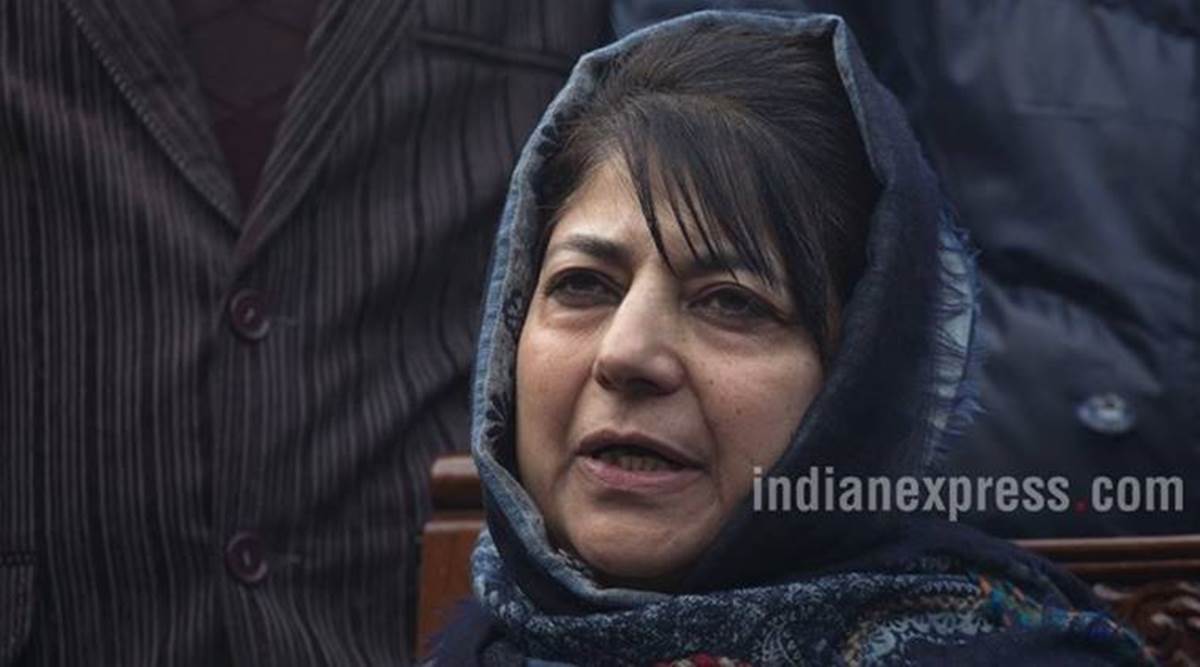
Kathua rape-murder case: Don’t need CBI probe, if not police, who to trust, says Mehbooba Mufti
Mehbooba Mufti said that “to question the officers of the Crime Branch team based on their religion or which region they belong to is shameful and dangerous”.
J&K Chief Minister Mehbooba Mufti has said there is “absolutely no need for a CBI probe” into the rape and murder of an eight-year-old Bakerwal girl in Kathua and “if you don’t trust J&K Police, there is no one left to be trusted in the state”.
Mufti said that “to question the officers of the Crime Branch team based on their religion or which region they belong to is shameful and dangerous”. “Each time there is a crime, we can’t organise a referendum to choose the team of investigators,” she said, adding, “Those who question the Crime Branch investigation have a vested interest and their aim is to protect the perpetrators of this heinous crime”.
You’ve Read Your Free Stories For Now
Sign up and keep reading more stories that matter to you.
On Monday, the Supreme Court is hearing a petition filed by the biological father of the victim who has sought transfer of the trial to Chandigarh. The J&K government is against transferring the trial outside the state. A Public Interest Litigation seeking the case to be handed over to the CBI has also been filed but the SC is yet to admit it. In its report to the Supreme Court, Bar Council of India had claimed that “the demand for a CBI inquiry. appears to be justifiable”.
Though Mufti’s alliance partner BJP had asked two of its ministers to step down for attending a rally in support of the accused, the party is “not objecting” to a transfer of the case to the CBI. In fact, several leaders associated with the BJP and the Sangh have been part of the Hindu Ekta Manch, a group formed in Kathua to support the accused and demand a CBI probe into the case.
“I am very clear about this case. J&K Police’s Crime Branch has done a very good investigation, collected all the evidence scientifically. Now the trial will be in the court, which will decide the outcome. We are convinced that there is absolutely no need for a CBI inquiry. We cannot take such a decision because the accused are demanding it,’’ Mufti said.
Story continues below this ad
“When a villager was tied to a jeep (by Army in Budgam last year), we were told not to be critical of the illegal action because it will lower the morale of the forces. What about J&K Police? If you don’t trust J&K Police, which is at the forefront of a war in the State and is fighting in very difficult circumstances, who is left to be trusted in J&K?” she said.
“My question is, why are the accused in this case desperately seeking a CBI inquiry? Why are they convinced about the outcome of such an inquiry? And when does a government decide the investigating agency based on what the accused in such a case want? We have serious challenges ahead and we cannot allow a communal flare-up to burn everything in our state. Our government handled this case very well. Any misstep could have lead to a situation where the entire state would have burnt in communal violence,” she said, adding, “there are people who are hell bent (on making) this heinous crime into a Hindu-Muslim issue”.
“We are concerned because we have Amarnath yatra to start in a month. The situation is already precarious. I told Delhi too that if these communal flames are not doused immediately, it will consume the entire state,’’ she said.
“Look at the details of this case, the findings of the Crime Branch investigation – an eight-year-old child was kidnapped, drugged, raped in a devasthan, a place of worship, and then brutally murdered. The heinousness of this crime is beyond words and we were extremely worried that this may become a trigger for a wide-spread communal violence. Our administration didn’t allow that. But unfortunately, this horrible crime was used for politics,’’ she said.
Story continues below this ad
“I am not only a Chief Minister who heads this administration. I am also a woman and a mother of two girls. I had expected that people across sectarian and political divides would come together. I had expected that everyone will be shocked by this abhorrent crime against our little child, they will be sad, they will come together to support the family of the victim, rally around the grieving mother whose 8-year-old child had been taken away from her in such a brutal manner,’’ she said. “Unfortunately, this heinous crime was used to play divisive politics. And instead of supporting the victim’s family. instead of being angry that a place of worship was desecrated, there are people who rallied behind the accused because they saw political benefit in it. It is a petty and heartless thing to do,” she said.
Mufti said she was aware about the reasons behind this sectarian politics. “There are several reasons. It is shocking. Till now, Hiranagar has been a reserved (Assembly) constituency and there is a talk that it may be de-reserved. That also is one of the reasons for this politicking,” she said.
“We won’t allow anybody to question officers and men of our J&K Police only because they belong to a particular faith or religion… Still, the Crime Branch team that probed this case is mixed,’’ she said.
“Those who question our police need to know that the J&K Police is an institution and has been working above everything. It doesn’t function with sectarian motives. They are sacrificing their lives, their houses are being attacked and how can I tell them you aren’t trustworthy enough to investigate a case where the accused question your motivation?
Muzamil Jaleel is a Deputy Editor at The Indian Express and is widely recognized as one of India’s most authoritative voices on Jammu & Kashmir, national security, and internal affairs. With a career spanning over 30 years, he has provided definitive on-the-ground reportage from the heart of the Kashmir conflict, bearing witness to historic political transitions and constitutional shifts.
Expertise and Investigative Depth
Muzamil’s work is characterized by a rare combination of ground-level immersion and high-level constitutional analysis. His expertise includes:
Conflict & Geopolitics: Decades of reporting on the evolution of the Kashmir conflict, the Indo-Pak peace process, and the socio-political dynamics of the Himalayan region.
Constitutional Law: Deep-dive analysis of Article 370 and Article 35A, providing clarity on the legal and demographic implications of their abrogation in 2019.
Human Rights & Accountability: A relentless investigator of state and non-state actors, uncovering systemic abuses including fake encounters and the custodial death of political workers.
International War Reporting: Beyond South Asia, he provided on-the-spot coverage of the final, decisive phase of the Sri Lankan Civil War in 2009.
Landmark Exposés & Impact
Muzamil’s reporting has repeatedly forced institutional accountability and shaped national discourse:
The Kashmir Sex Scandal (2006): His investigative series exposed a high-profile exploitation nexus involving top politicians, bureaucrats, and police officers, leading to the sacking and arrest of several senior officials.
Fake Encounters: His reports blew the lid off cases where innocent civilians were passed off as "foreign terrorists" by security forces for gallantry awards.
SIMI Investigations: He conducted a massive deep-dive into the arrests of SIMI members, using public records to show how innocuous religious gatherings were often labeled as incriminating activities by investigative agencies.
The Amarnath Land Row: Provided critical context to the 2008 agitation that polarized the region and altered its political trajectory.
Over the years, Muzamil has also covered 2002 Gujarat riots, Bhuj earthquake, assembly elections in Bihar for Indian Express. He has also reported the peace process in Northern Ireland, war in Sri Lanka and national elections in Pakistan for the paper.
Awards and Fellowships
His "Journalism of Courage" has been honored with the industry's most prestigious accolades:
Four Ramnath Goenka Awards: Recognized for J&K Reportage (2007), On-the-Spot Reporting (2009), and Reporting on Politics and Government (2012, 2017).
Kurt Schork Award: From Columbia University for international journalism.
Sanskriti Award: For excellence in Indian journalism and literature.
IFJ Tolerance Prize: For his empathetic and nuanced reporting in South Asia.
International Fellowships: Served as a visiting scholar at UC Berkeley and worked with The Guardian, The Observer, and The Times in London. He has also received Chevening fellowship and a fellowship at the Institute of Social Studies, Hague, Netherlands.
Professional Presence
Current Location: New Delhi (formerly Bureau Chief, Srinagar).
Education: Master’s in Journalism from Kashmir University.
Social Media: Follow him for field insights and rigorous analysis on X (Twitter) @MuzamilJALEEL. ... Read More