Journalism of Courage



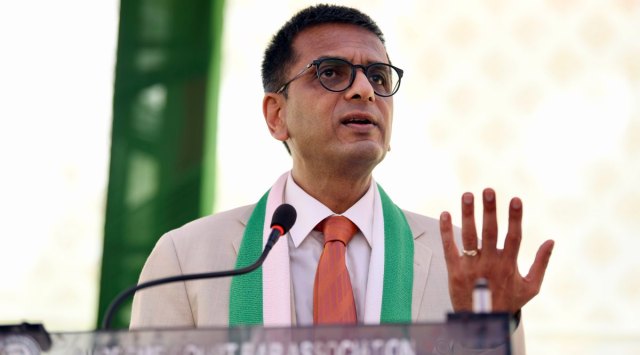 Chief Justice of India (CJI) Justice DY Chandrachud addresses the gathering during an event organised by the Supreme Court Bar Association on the occasion of the 77th Independence Day, at the Supreme Court premises. (ANI)
The “greatest challenge” before Indian judiciary is to eliminate the barriers to accessing justice and the functionality of courts is “determined by how effectively they can answer the call of Constitutional duty”, Chief Justice of India D Y Chandrachud said on Tuesday.
Addressing the Independence Day celebrations organised by the Supreme Court Bar Association (SCBA), the CJI also emphasised the need to overhaul court infrastructure on priority to make them accessible and inclusive.
“As I look towards the future, I believe the greatest challenge before Indian judiciary is to eliminate the barriers to accessing justice,” he said. “We have to enhance access to justice procedurally by eliminating the constraints which prevent citizens from approaching courts, and substantively by building confidence in the court’s ability to dispense justice. And we have the road map in place to make sure that the future Indian judiciary is inclusive and accessible to the last person in the line.”
CJI Chandrachud gave details on the “plan to expand the Supreme Court” as part of modernising judicial infrastructure to meet future challenges. The plan, he noted, includes constructing a new building to accommodate 27 additional courts, 51 judges’ chambers, 4 registrar court rooms, 16 registrar chambers, and other requisite facilities for lawyers and litigants.
He said it will be executed in two phases: in the first phase, the museum and annexe building will be demolished to pave way for a new building providing for 15 courtrooms, judges’ chambers, the SCBA library, offices for the president, vice-president, and secretary of SCBA and SCAORA, an SCBA executive meeting Room, canteen, ladies Bar room, and other requisite facilities for lawyers and litigants.
In the next phase, CJI Chandrachud said, some part of the existing court complex will be razed to build a second part of the new building to accommodate 12 courtrooms, judges’ chambers, registrar courts, and lounge for SCBA and SCORA.
The CJI said the new building will “reflect the Constitutional aspirations, beliefs, and priorities of the people, in addition to providing a space which facilitates access to justice”.
CJI Chandrachud, who has been driving technological changes in the judiciary, said, “They say sunshine is the best disinfectant. I say technology is the best tool at our disposal to eliminate the inefficiency and opacity surrounding the judicial processes.”
Stating that “we have to tap into the full potential of technology to overcome procedural barriers to justice”, he said the third phase of the e-courts project is being implemented for that.
“After Independence, we inherited the colonial legal traditions which were opaque and impersonal. But our courts have ensured that the law exudes human interest and responds positively to the plight of every individual in our society, regardless of their social and economic factors,” the CJI said.
He pointed out that “our aim for the future is to ensure our judicial systems are capable of managing the expectations of the people” and “legitimacy of our institutions can be secured only when the courts establish themselves as robust independent institutions, impervious to the identity of the litigant before us, but cognisant at the same time of their context”. For this, he urged judges and lawyers to “conduct themselves in a manner which will inspire confidence about the Independence and the integrity of our legal processes”.
The CJI also said the Supreme Court will soon release a handbook on combating gender stereotypes in judicial decision-making. “These efforts are aimed to ensure that we look inwards, question our biases, and insulate judicial institutions from embodying and entrenching those biases,” he added.

 4 min read