Stay updated with the latest - Click here to follow us on Instagram

Journalism of Courage
 6 min read


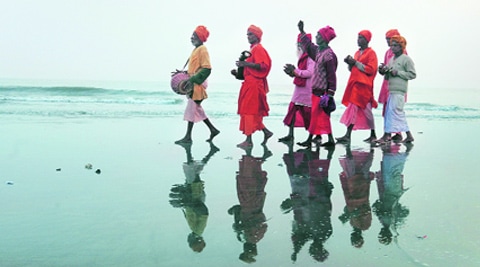 Baul singers at Sagar Island, where the Ganga meets the Bay of Bengal. (IE Photo: Partha Paul)
Departing from the text of her Jawaharlal Memorial Lecture in November 2012, Aung San Suu Kyi had struck a note of disappointment at old friend India’s continuing business-as-usual dealings with the military junta of Myanmar during the long period of her house arrest. It was understandable, she intoned softly, that in such matters there never are long-term friends. For its part, it was not just geopolitics, but competition with China for oil and gas in Burma that had made India play along with the rulers of Nyapyidaw, as the new capital of Myanmar is called. For generations of Tamils, UPites and Andhra residents, however, Burma and Rangoon are redolent of history and intimate middle-distance connections. The 1949 Hindi hit song, Mere piya gaye Rangoon kiya hai wahan se telephone, tumhari yaad satati hai, with its play on the bridging of longing between the single male migrant and the woman left behind, is still so wildly evocative that there’s even a steamy remix.
Sunil Amrith’s astonishingly researched and lyrically written book evokes and showcases the toils, trials and fortunes of millions of Indians who have made the turbulent expanse of water from Trincomalee, Chennai and Vishakhapatnam to Calcutta, Chittagong, Rangoon, Penang, Malacca and Singapore their karm-bhoomi over the last several centuries. Crossing the Bay of Bengal is, in a very real sense, a life of that Bay itself, as it was buffeted and regulated by the monsoon winds during the long Age of Sail, then harnessed by steamships from the 1870s. “The power of steam promised [and effected] the conquest of the monsoon,” writes Amrith. The coastal land mass and the hinterland which had earlier traded pepper and cinnamon for south Indian cloth and European silver, was now made to yield the everyday riches of rice, tea, coffee, tin and rubber, aided by “coolie” labour and British, Chinese and Tamil commercial capital.
With the consolidation of British power in India and Ceylon in the early decades of the 19th century and its subsequent spread and consolidation in Burma and the Straits Settlements (including Singapore), the Bay became virtually a British lake. Millions of crossings were made by all manner of Indians under the watch and ward of colonial rule. Twenty thousand Indian convicts were shipped to the Straits Settlements between 1790 and 1862. They built the infrastructure of that territory — roads, public buildings, drainage of swamps. When relieved of their iron shackles, they formed relationships with local women. “They asserted a sense of worth in identifying themselves as ‘company servants’.” Between 1840 and 1940, estimates Amrith, 8 millions Indians went to Ceylon, 4 million to Malaya and 12-15 million to Burma. These were the non-convicts — peasants who were recruited through the machination of the debt trap (the kangany system) and the promise and prospect of a better life across the waters on the tea and rubber plantation of Ceylon and Malaya.
And then there were the Chettiars. Starting as a caste of salt traders, they soon graduated to banking. Initially focused on financing the early commercial advances in nearby Ceylon, the Chettiars moved along with the British military advances into the Straits Settlements and Tenasserim, and then beyond the British pale into Dutch Indonesia and French Indochina. By the 1880s, the Chettiars had travelled along the Burman railway line. They advanced credit directly to Burmese cultivators, who pledged land and property as collateral. This led to a huge increase in rice production: Burma exported 162,000 tons of rice in 1855; by 1905-06 that figured had jumped to 2 million, the exports feeding the rubber-tapping plantation labour in Malaya and even poor peasants growing jute in eastern Bengal.
Tied to the world economy through the production of tin, tea, rice and rubber — the last enabling Detroit-built cars to roll on the roads in the US — this complex, intertwined economy and hybrid society of Indian and Chinese migrants and local Burman and Malay peasants crashed with the global Depression of 1929-34. The market for tin and rubber collapsed. The value of Malayan rubber fell by 84 per cent, that of rice even more. Chettiar firms took over the land of Burman peasants, becoming considerable landowners. The facilitators of production had turned into land grabbers. Burmese nationalism, fuelled by boycotts of Indian traders and shopkeepers and a major peasant rebellion, were energised by a radical student movement of the late 1930s. From the 1920s, it had set its goal as separation from India. In the words of a journalist, “Burma finally divorced India” on April 1, 1937.
The Second World War and Japanese occupation of Southeast Asia heralded the end of colonial rule, which in turn raised the difficult question of long-term Indian residents of these countries. Writes Amrith, “Now migrants and tenants and their descendants became ‘minorities’; they troubled the architects of the new nation-states who erected high walls around the prize of citizenship”. However, blurred boundaries, which made the littoral world of the Bay what it was, somehow remained. The 1936 Rangoon students strike which was led by U Nu, the first premier of independent Burma and the legendary Aung San, Suu Kyi’s charismatic father, had MA Rashid, a north Indian, as its vice-president. In U Nu’s 1952 cabinet, Rashid held the portfolio of labour and housing; Rashid’s brother, a Rangoon-based barrister, served as India’s ambassador to Burma.
Today, it is not so much the hybrid relations between locals and migrants that animate and trouble the lands and nations along the Bay. It is the dread of large numbers of coastal migrants who, faced with the destruction of local ecologies, would in all probability rebound on the inland cities as internally displaced “climate refugees”. The furies of the Bay are now threatening to strike us well beyond the coast.
Shahid Amin
Amin is a professor of history at Delhi University
Stay updated with the latest - Click here to follow us on Instagram