3 min read
Stay updated with the latest - Click here to follow us on Instagram

Journalism of Courage



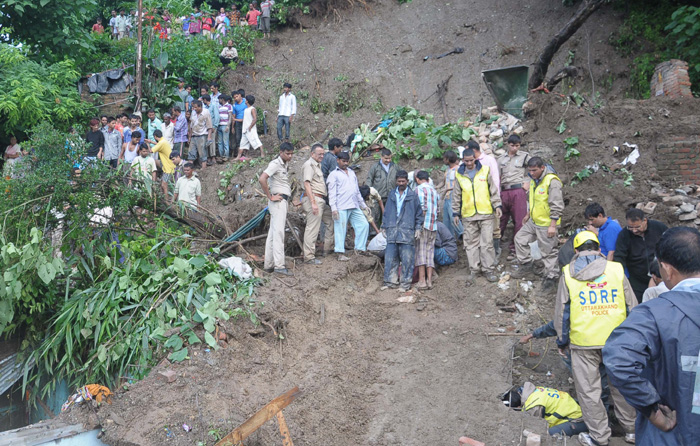 In the last 48 hours, Uttarakhand has lost at least 25 lives in separate incidents of landslides, cloudburst and flashfloods caused by the incessant rains. (Source: Express photo by Virender Singh Negi)
A day after it admitted that hydropower projects (HEPs) had “direct and indirect impact in the aggravation of floods” that hit Uttarakhand in 2013, the Centre was Tuesday questioned by the Supreme Court as to how these projects were granted clearances if they were potential danger to the environment.
Putting the government in a tight spot over its stance, the court sought to know what was the process and the consideration that resulted in the project proponents getting all clearances for operating HEPs.
“Your affidavit now says that these projects had adverse impacts on the environment. Then how did you grant the clearances? Did you not consider the impact assessment before giving them a go ahead? This is strange,” said a bench of Justices Dipak Misra and Uday U Lalit.
The government was left in the piquant position in the wake of its affidavit wherein it conceded that HEPs were also to be blamed for aggravating the Uttarakhand flood tragedy, that killed hundreds while leaving thousands homeless. The Ministry of Environment and Forest (MoEF) also said the projects caused “irreversible damage” to the environment and enhanced landslides and other disasters.
This was the first such admission by the Centre in the court, which had stalled 24 of the 39 proposed projects in Uttarakhand after noting that they significantly impacted biodiversity in two sub-basins of the Alaknanda and Bhagirathi rivers. The Centre had earlier denied that the projects had played a role in escalating the 2013 disaster. Perusing this affidavit, the bench wondered what prompted the authorities concerned in the MoEF and the state government to accord requisite clearances if expert reports had been pointing out that HEPs could damage the environment.
As the counsel for the Centre failed to answer, the court also censured the government for its reluctance to put forth a detailed report on assessment of each project individually, and trying to argue on the basis of cumulative impact.
“We have repeatedly asked you to make individual assessment of every project but it seems you have not done anything in the last 18 months. We had expected the MoEF to categorise the 24 projects that we had stayed and then make qualitative assessment but you have done nothing,” it said.
The bench took note of a vehement plea by state-run National Thermal Power Corporation, which sought its approval to go ahead with construction of 171 MW power project in Uttarakhand. The NTPC said it had all approvals in place and the under-construction project was losing money due to the court stay order. “We cannot let public money to be wasted like this.
This is why we had asked you to give us an assessment of individual projects. But there is no clear picture from the government. We have no intention to stall the project but we cannot give you a free hand after what has happened. There must be an acceptable solution,” said the bench. It fixed the matter for hearing on Wednesday, asking the Centre to make submissions on individual projects.
Stay updated with the latest - Click here to follow us on Instagram