The Lok Sabha on Tuesday referred the land acquisition bill to a Joint Committee of Parliament after sustained resistance from the Opposition and some of its allies.
Having had to promulgate an ordinance twice on the bill and having failed to get the bill cleared in Parliament, the government referred it to a 30-member committee comprising MPs from both the Houses. The Joint Committee has been mandated to submit its report on the first day of Monsoon Session.
Interestingly, the Congress, which has vociferously opposed the amendments introduced in the bill, was silent on the move. Party vice-president Rahul Gandhi slammed the government for making changes to the UPA bill but did not touch upon the joint committee aspect.
[related-post]
Sources within the party said the Congress was divided on the question of sending the bill to a parliamentary committee. A meeting of Congress leaders on Tuesday morning saw the divergent views coming to the fore.
An influential section of the party, comprising some Rajya Sabha members, was not in favour of demanding or supporting the bill’s referral to the Joint Committee as the party had already taken the stand that it wanted the 2013 bill unchanged. “How can then we be part of a committee and consider the amendments then,” a senior leader asked.
On the other hand, another section felt they should try to block the bill using parliamentary procedures. They, sources said, argued that the committee should be used as a tool to convey the party’s opposition. Their argument was that the Congress had been demanding referral of many bills to the select committees and attacking the government for bypassing standing committees.
“How can we then oppose when the government says let the bill be considered by a parliamentary committee. We can fight within the panel and at the end give dissent notes. Then we can take the fight to the Parliament,” another leader said.
Story continues below this ad
Sources said a section felt the party should continue to hold up Rajya Sabha over the Nitin Gadkari issue, thwarting the government’s attempt to pass the legislation in the Upper House. Finally, the view that prevailed was that the party should not oppose the referral of the bill to the joint committee.
Manoj C G currently serves as the Chief of National Political Bureau at The Indian Express. A veteran journalist with a career spanning nearly two decades, he plays a pivotal role in shaping the publication's coverage of India's political landscape.
Experience & Career: Manoj has built a robust career in political journalism, marked by a transition from wire service reporting to in-depth newspaper analysis.
The Indian Express (2008 – Present): He joined the organization in 2008 and has risen to lead the National Political Bureau, overseeing key political coverage.
Press Trust of India (PTI): Prior to his tenure at The Indian Express, Manoj worked with India’s premier news agency, PTI, honing his skills in breaking news and accurate reporting.
Expertise & Focus Areas: As a seasoned political observer, Manoj focuses on the nuances of governance and party dynamics.
National Politics: extensive reporting on the central government, parliamentary affairs, and national elections.
Political Strategy: Deep analysis of party structures, coalition politics, and the shifting ideologies within the Indian political spectrum.
Bureau Leadership: directing a team of reporters to cover the most critical developments in the nation's capital.
Authoritativeness & Trust: Manoj’s authoritativeness is grounded in his nearly 20 years of field experience and his leadership role at a legacy newspaper. His long-standing association with The Indian Express underscores a reputation for consistency, editorial integrity, and rigorous reporting standards required of a Bureau Chief.
Find all stories by Manoj C G here. ... Read More


 3 min read


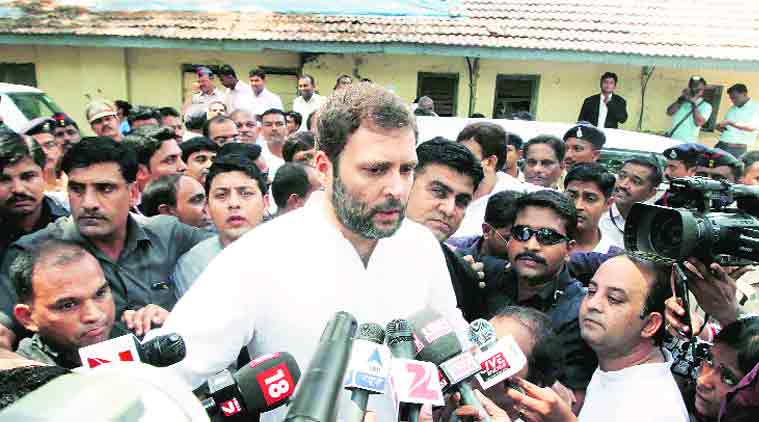 Land bill: Congress vice president Rahul Gandhi.