Stay updated with the latest - Click here to follow us on Instagram

Journalism of Courage
 4 min read


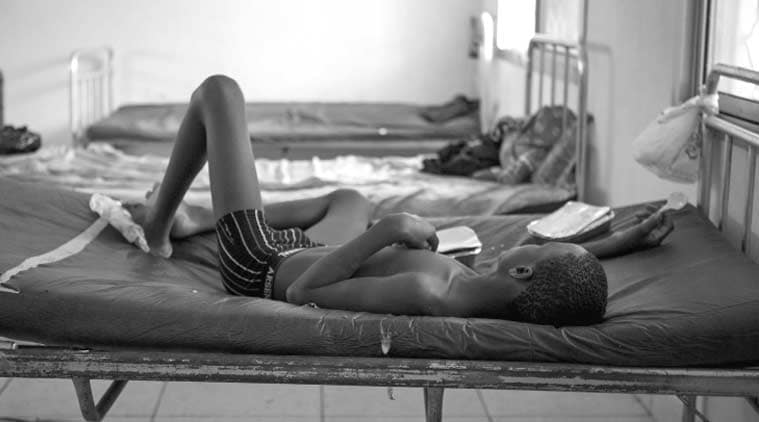 A child suffering from the Ebola virus at a health centre in Makeni, Sierra Leone. (Source: AP)
As the Ebola virus raged through West Africa, the US Centers for Disease Control and Prevention predicted in November 2014 that 1.4 million West Africans would be infected by mid-January. It’s mid-January and something else has happened. The latest report from WHO suggests that the worst may be over and there is now a significant drop in numbers being reported from Liberia, Guinea and Sierra Leone, the countries worst affected by the epidemic.

1. Work on the ground: After a slow start — WHO called a public health emerge-ncy in August 2014, five months after the first infection in March — local governments gathered their resources to fight the virus. Sierra Leone launched a military-style operation over a month ago: doubling the number of ambulances, checking temperatures at checkpoints, and following strict burial protocols. Nigeria moved swiftly to contain the epidemic: training health workers, declaring a national public health emergency, identifying and monitoring people who may have had contact with Ebola patients, etc.
2. People learned fast: Initially, health workers had a tough time getting locals on their side. There was a lot of mistrust, many refused to go to treatment centres and kept health workers out by force. Families of the dead ignored warnings and used traditional burial practices that involve washing, kissing, and embracing the corpse. Slowly, that changed. Volunteers teamed up with community leaders to educate them about how the virus spreads. They began to accept that burials had to be done differently. Those infected went to treatment centres and isolated themselves voluntarily.
3. The nature of the virus: Though nobody would believe this at the height of the epidemic, by viral standards, Ebola is not particularly successful in humans. Unlike HIV, which has been killing more than a million people a year for almost two decades, Ebola has so far caused only small, localised outbreaks. This is likely because Ebola has not adapted to human hosts, but is introduced into populations only when people come into close contact with its natural reservoirs — bats and other wildlife. So while it wreaks havoc on our bodies, it runs out of steam soon enough.
4. Immunity factor: Scientists are now beginning to wonder if the virus, while killing some people, may also have immunised some others, playing a key role in bringing the virus under control. “We wonder whether ‘herd immunity’ is secretly coming up — when you get a critical mass of people who are protected, because if they are asymptomatic they are then immune. The virus may be bumping into people it can’t infect any more,” Philippe Maughan, senior operations administrator for the humanitarian branch of the European Commission, told Reuters.
5. Can’t be complacent: Last April, the virus seemed to wane in Guinea, only to return ferociously. So experts warn against complacency of any kind. In an interview to The Daily Beast, Dr Emmanuel Boyah, a primary healthcare manager for the International Rescue Committee in Liberia, said, “The fight against Ebola… is a complicated fight. It’s complicated to the point that sometimes the rate of cases will slow down during certain periods, as now, and after few times it will rise up in other unexpected locations and the respond team will have to quickly move in to bring the situation under control.”
Stay updated with the latest - Click here to follow us on Instagram