This is an archive article published on June 8, 2020
Gujarat: Forced to go for paid quarantine, say foreign returnees
Vadodara resident Vrunda Patel, 23, landed in Ahmedabad from Ukraine on May 30. Vrunda, a medical student in the Chernivtsi University, said she was not given an option to opt for the free government quarantine.
Written by Aditi Raja
Vadodara | June 8, 2020 10:37 PM IST
5 min read
Whatsapp
twitter
Facebook
Reddit
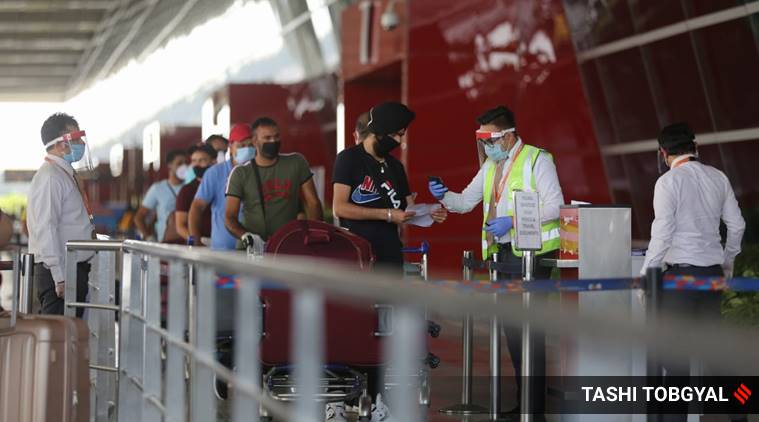
Parth Agarwal, a student from Vadodara who came back from Australia on May 25 and chose a paid quarantine in Anand, said that despite charging Rs 2,500 per day and an additional Rs 300 per day for the meal, food wasn’t up to the mark. (Representational)
Several people who returned to Gujarat from foreign countries since the last week of May alleged that they were forced to go for paid quarantine, made to stay more than the stipulated seven days and also given inadequate meals.
Vadodara resident Vrunda Patel, 23, landed in Ahmedabad from Ukraine on May 30. Vrunda, a medical student in the Chernivtsi University, said she was not given an option to opt for the free government quarantine. Vrunda’s father, Paresh Patel, said that the local administration insisted on keeping her quarantined for 10 days as per the earlier protocol of the state government. “On June 6, we went over to the resort and asked the officials to discharge our daughter. They were reluctant but when we cited the directive of the Union Ministry of Home Affairs about the 7-day quarantine, they finally gave in.”
Patel said that the cost of the facility was weighing heavily on the family as they had already borrowed money for Vrunda’s repatriation flight ticket.
Patel said, “I have already taken an expensive loan for her education. When the repatriation flights were announced, I had no money to pay for the one-way ticket, which was more expensive than the regular two-way fare from Ukraine to Ahmedabad. So I borrowed money for her ticket and asked her to choose the free government quarantine on arrival. But when she called me from the airport and said that they had not given her a choice and had just ushered the group of students into a bus to take them to an expensive resort in Anand district, I was extremely stressed.”
Patel said the family had to borrow another Rs 14,000 to pay for the quarantine facility. “…The government must think about the financial capability of passengers before making decisions on their behalf,” said Patel.
Parth Agarwal, a student from Vadodara who came back from Australia on May 25 and chose a paid quarantine in Anand, said that despite charging Rs 2,500 per day and an additional Rs 300 per day for the meal, food wasn’t up to the mark.
“They just served one small portion of dry sabji with about three mini rotis for one meal. This is not sufficient for any normal eater nor is it a wholesome meal. I was willing to pay for more food. But the resort refused to help by telling me that their kitchens were closed and ordering food from outside was prohibited,” Agarwal said.
Story continues below this ad
Jawad Vohra, a 31-year-old businessman from Panigate in Vadodara, is currently in paid quarantine at a four-star hotel in Vapi. Vohra, along with 14 other residents of Gujarat arrived in Mumbai from Thailand on Friday. He said that the group of 14 paid Rs 36,000 transport charges from airport to Vapi.
“There is clear loot. A private bus agent at the Mumbai airport charged us Rs 32,000 for a mini bus ride to Bhilad on the Gujarat-Maharshtra border. From there, the officers took close to Rs 4,000 to bring us into Gujarat. While 11 people opted for the free quarantine at a girls’ hostel in Valsad, three of us came to this paid hotel in Vapi…” Vohra said.
Another resident of Anand who quarantined himself in Kheda on his arrival from UK earlier in May said he was not given the choice of free quarantine at the airport. “They told me that the free facility was full and I would have to stay in a resort. My father borrowed money from my uncle to pay for the facility. I stayed there for about 12 days and the bill was almost Rs 25,000. This pandemic has eaten into our resources,” the 22-year-old student said.
Mamta Verma, Secretary to Government, Industries and Mines Department (Tourism, Devsthanam Management, Civil Aviation & Pilgrimage), who is overseeing the quarantine protocols, told this newspaper that there may have been hiccups but the government was “doing its best” to make facilities available for the people. Verma said, “These are unprecedented times. Gujarat is among the few states in the country that are making provisions for free quarantine facilities but even the people have to understand that there may be issues about capacity and therefore some difficulties. No one has been forced to any paid facility.”
Story continues below this ad
Regarding the protocol, Verma said, “Initially, the quarantine was for 14 days, then the state government notified 10 days and subsequently 7 days in line with the MHA decision. For almost a week, we have been only insisting on 7 days in facility quarantine followed by 7 days of home quarantine. It is very clear and all administrations know about it.”
Aditi Raja is an Assistant Editor with The Indian Express, stationed in Vadodara, Gujarat, with over 20 years in the field. She has been reporting from the region of Central Gujarat and Narmada district for this newspaper since 2013, which establishes her as a highly Authoritative and Trustworthy source on regional politics, administration, and critical socio-economic and environmental issues.
Expertise:
Core Authority & Specialization: Her reporting is characterized by a comprehensive grasp of the complex factors shaping Central Gujarat, which comprises a vast tribal population, including:
Politics and Administration: In-depth analysis of dynamics within factions of political parties and how it affects the affairs in the region, visits of national leaders making prominent statements, and government policy decisions impacting the population on ground.
Crucial Regional Projects: She consistently reports on the socio-economic and political impact of infrastructure projects in the region, especially the Statue of Unity, the Sardar Sarovar Project on the Narmada River, the Mumbai-Ahmedabad High Speed Rail bullet train project as well as the National Highway infrastructure.
Social Justice and Human Rights: Her reporting offers deep coverage of sensitive human-interest topics, including gender, crime, and tribal issues. Her reports cover legal proceedings from various district courts as well as the Gujarat High Court (e.g., the Bilkis Bano case remission, POCSO court orders, Public Interest Litigations), the plight of tribal communities, and broader social conflicts (e.g., Kheda flogging case).
Local Impact & Disaster Reporting: Excels in documenting the immediate impact of events on communities, such as the political and civic fallout of the Vadodara floods, the subsequent public anger, and the long-delayed river redevelopment projects, Harni Boat Tragedy, Air India crash, bringing out a blend of stories from the investigations as well as human emotions.
Special Interest Beat: She tracks incidents concerning Non-Resident Gujaratis (NRIs) including crime and legal battles abroad, issues of illegal immigration and deportations, as well as social events connecting the local Gujarati experience to the global diaspora. ... Read More


 5 min read


 Parth Agarwal, a student from Vadodara who came back from Australia on May 25 and chose a paid quarantine in Anand, said that despite charging Rs 2,500 per day and an additional Rs 300 per day for the meal, food wasn’t up to the mark. (Representational)