Stay updated with the latest - Click here to follow us on Instagram

Journalism of Courage
 6 min read


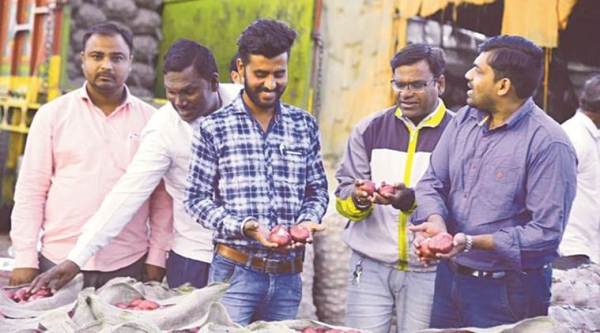 Farmer-members of an FPO in Maharashtra with their onion crop. (Express photo)
Written by Aleen Mukherjee
Farmers are the backbone of India’s agricultural and rural landscape. It’s an irony, therefore, that while the country’s agriculture sector has grown leaps and bounds since Independence, the same cannot be said about the condition of its farmers.
In 2003, when India’s leading agri-commodity exchange, NCDEX, came into existence, the aim was to provide our farmers a neutral marketplace that would facilitate a fair and transparent price discovery mechanism for their produce. Over the years, the exchange has emerged as a platform disseminating benchmark prices — both current (spot) and likely (futures) for the months ahead — to farmers in 19 agri-commodities.
However, the concept of trading and covering price risks in futures markets — the main function of a commodity derivatives exchange — has largely remained alien to the farming community for two reasons. One, the bulk of our farmers being small and marginal, their individual produce volumes are far too little to allow futures trading. The second has to do with the seemingly complex nature of futures trades itself.
Thankfully, in 2013, exactly a decade after NCDEX was established, the Union Agriculture Ministry issued detailed policy and process guidelines for yet another gamechanging institutional mechanism: Farmer Producer Organisations (FPO). FPOs are basically collectives of farmers. These entities, with their membership mainly comprising small and marginal farmers, could now address the previous inherent limitation in using futures trading platforms. The FPO, by procuring the produce of its farmer-shareholder members, was in a position to acquire large enough volumes to enable trading. Also, its promoter usually being an NGO with sufficient knowledge resources, the complex nature of futures trades, hedging and even the newly-launched options contracts could be handled with reasonable ease.
An FPO, just as any individual trader, has to open a client account with an authorised member/broker of NCDEX to be able to buy and sell on its platform. Registering of a new account requires submitting basic documents: PAN cards of the FPO and all its directors with address proofs, three-months bank statement, two-year income tax returns, audit reports, etc. The FPO can take “sell” positions for the raw produce of its members — say, maize, soyabean, wheat or rapeseed-mustard — and also trade on the “buy” side in the commodities that they purchase, such as cottonseed oil cake for livestock and poultry.
There are at least two FPO success stories in this regards that are worth highlighting.
In 2015, an FPO by the name of Saurashtra Swanirbhar Farmers Produces Company Ltd with 990 members was registered. Its members were mostly from Jasdan block of Gujarat’s Rajkot district. These farmers had earlier formed “village associations” for building around 150 check dams to provide irrigation water in over 1,000 hectares of land. The new FPO was started in order to create post-harvest and marketing infrastructure for members’ produce, which had gone up substantially with assured irrigation.
In early-May 2018, the FPO’s board members came to know that cottonseed oil cake — COCUD in common parlance — was trading in NDCEX at about Rs 1,100 per quintal, when they were purchasing the same from the local market at Rs 1,400-1,450. After some study and training imparted by an NCDEX team, the FPO went in for a “buy” position of a June 2018 futures contract. However, the realisation also dawned that the benefit of low futures prices could not be availed by taking actual physical delivery. The reason for it was that the delivery centre for COCUD on NCDEX’s platform was Akola in Maharashtra. The Rs 300 per quintal or so saving from buying through the exchange would, thus, be lost due to transport from such a distance.
A different strategy was, then, devised to leverage the potential gains from lower prices at NCDEX. Instead of taking physical delivery, the FPO simply squared off its “buy” made in late-May with a “sale” of the same contract in the first week of June, before the expiry date on June 22. The gain made from this “long hedge” — buying a futures contact at a lower price and selling it later at a higher price — helped considerably offset the notional loss from paying more for COCUD in the physical local market.
A second success story is of Samradha Kisan Producer Company Ltd from Ujjain in Madhya Pradesh. This FPO, primarily in the business of seed production by its farmer-members, is today also an active participant in NCDEX’s futures platform. During October-December 2018, which is the peak marketing season for soyabean, the company traded 650 tonnes of the oilseed at NCDEX. Out of this, 170 tonnes was settled through actual delivery. The balance 480 tonnes involved “short hedging” — selling a futures contract at a higher price and squaring it later by buying at a lower price — purely to cover the risk of price decline. In January this year, too, the FPC took futures positions on 60 tonnes, with only 20 tonnes being delivery-settled.
With its location at Ujjain, which falls within NCDEX’s Indore delivery centre limits, Samradha Kisan Producer Company is doing both hedging and delivery-based trades not only of the crop of its own farmers, but also facilitating the same for FPOs in adjoining areas such as Badnagar and Agar. Moreover, working on NCDEX’s platform has yielded other collateral benefits — including obtaining financing facility against its soyabean produce stored at ITC’s Chaupal Sagar warehouse in Ujjain. Access to working capital has allowed the company to procure the crop of its members, saving them from making distress sales.
Today, we have as many as 87 FPOs, with a total farmer base of 71,127, using NCDEX’s trading platform. In the current financial year from April 2018 till January 2019, they have traded 5,902 tonnes of commodities — soyabean, maize, cottonseed oil cake, chana (chickpea), wheat, dhaniya (coriander), castor and jeera (cumin) — with aggregate turnover of Rs 13.64 crore. Out of the 5,902 tonnes, deliveries were made in 1,280 tonnes and taken for 40 tonnes.
For us, this is just a beginning and a confirmation of our fundamental belief — that there is a future for farmers through futures.
The writer is executive vice president at National Commodity & Derivatives Exchange Limited
Stay updated with the latest - Click here to follow us on Instagram