

Journalism of Courage

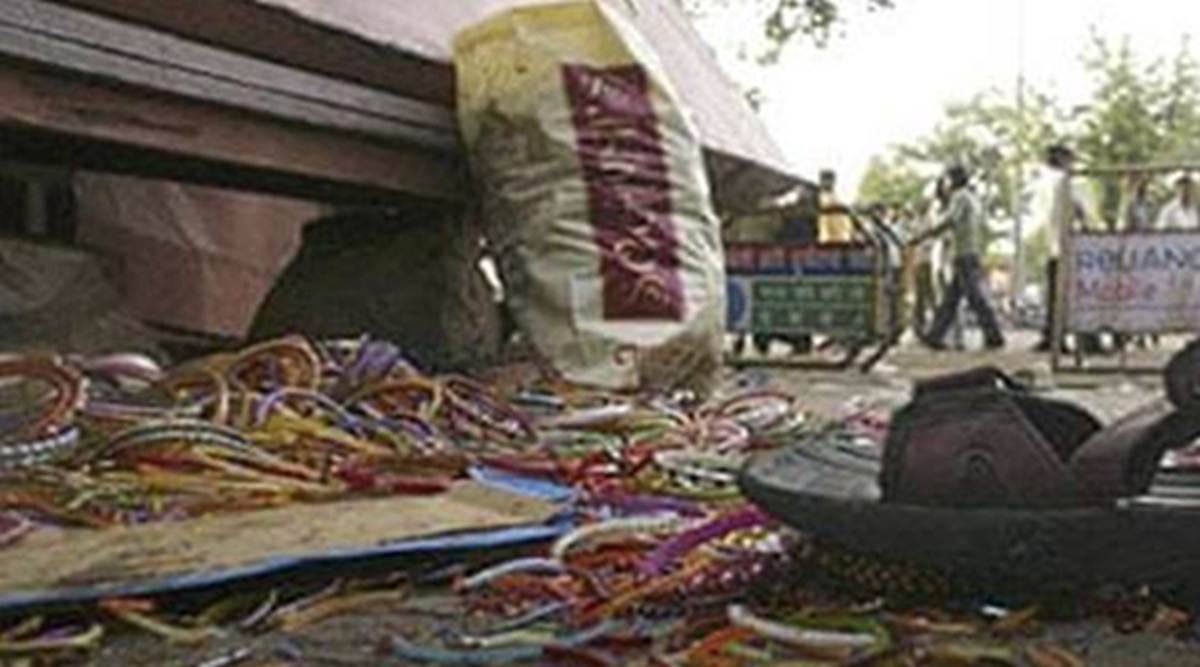
A special court in Jaipur on Wednesday convicted four people in connection with the 2008 serial blasts in the city, which killed 71 people and injured 185 others.
A fifth person was acquitted, with the court giving him the benefit of doubt.

Special Judge Ajay Kumar Sharma convicted Mohammad Saif, alias Carryon, 32; Mohammad Sarwar Azmi, alias Rajhans Yadav, 34; Saifur, alias Saif ur Rehman Ansari, 32; and Mohammad Salman, 26.
All four are residents of Azamgarh, Uttar Pradesh.
“In all eight cases (filed after the blasts) the prosecution had filed a challan against five persons. Today, the court found four accused guilty and Shahbaz Hussain has been acquitted in all eight cases,” said amicus curiae Suresh Vyas, who was representing Shahbaz, 42, a resident of Lucknow.
Special Public Prosecutor Srichand said, “The arguments over quantum of punishment will be held on Thursday. We are seeking death by hanging for all four held guilty. We will also appeal against Shahbaz’s acquittal.”
The prosecution had presented 1,270 witnesses.
Saif, Sarwar, Saifur and Salman have been found guilty under IPC Sections 302 (murder), 307 (attempt to murder), 324 (voluntarily causing hurt by dangerous weapons or means), 326 (voluntarily causing grievous hurt by dangerous weapons or means), 427 (mischief causing damage to the amount of fifty rupees), 121A (conspiracy to commit offence, waging or attempting to wage war, etc) 124A (sedition), 153A (promoting enmity between different groups on grounds of religion, race, etc) read with 120B (party to criminal conspiracy to commit an offence punishable with death), as well as sections of The Unlawful Activities (Prevention) Act, 1967 and Explosives Act, 1908.
Advocate Paker Farooq, representing the four men convicted, said they will appeal against the convictions in High Court.
Shahbaz had been made accused on the investigators’ claim that he had sent the email. While acquitting him on Wednesday, the court observed that after looking at the evidence and arguments put forth by the prosecution, it cannot be held “beyond reasonable doubt” that he conspired with the other four, or provoked anyone, or was in touch with any of the accused.
“As per prosecution’s evidence, it cannot be proven beyond reasonable doubt that the email sent in the name of Indian Mujahideen was sent by Shahbaz,” the court said.
Apart from the five accused in the case initially, two others — Atif Ameen and Chhota Sajid — were killed in Batla House encounter in September 2008. Three others accused in the blast are in Delhi’s Tihar Jail, and three others are absconding.
On May 13, 2008, nine IEDs, each set inside a bag on a new cycle, exploded in eight locations in Jaipur’s crowded old city between 7.20 pm and 7.45 pm. The first blast took place near Manak Chowk, followed by blasts near Badi Chaupar, Johari Bazaar, near Hanuman temple at Sanganeri Gate, near Choti Chaupar, Tripolia Bazaar, in front of Kotwali police station, and two blasts near Hanuman temple at Chandpole.
A live bomb found on a bicycle near a shop in front of Ramchandraji temple in Chandpole was defused.
In emails sent to news agencies and news channels a day later – on May 14, 2008 – the Indian Mujahideen (IM) had claimed responsibility for the attack.
While questioning the suspects picked up during investigation for Jaipur, Delhi and Ahmedabad blasts, the investigators had found that they were associated with the now banned Students’ Islamic Movement of India (SIMI).
According to investigators, the conspirators had formed multiple modules: the first module influenced people for jihad, the second module planned the bomb attacks, the third supplied the explosives, a fourth was tasked with making the bombs, a fifth module planted the bombs and a sixth one was tasked with sending emails.


