9 min read
Stay updated with the latest - Click here to follow us on Instagram
© IE Online Media Services Pvt Ltd



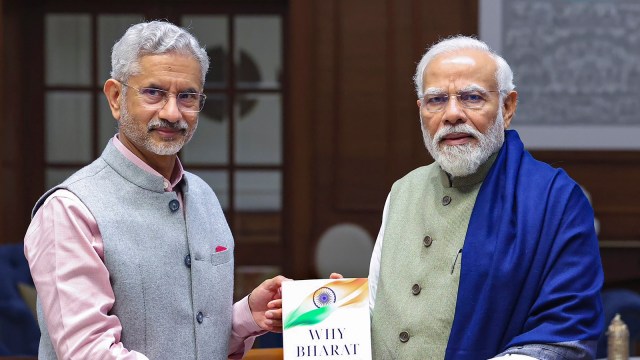 External Affairs Minister S Jaishankar presents the first copy of his book 'Why Bharat Matters' to Prime Minister Narendra Modi. (PTI Photo)
 Foreign Minister Dr S Jaishankar Tuesday said that India is focusing on how to expand its relationships with nations across the world, and responded to the criticism over his recent Russian visit in Western media by asserting that every nation has its values and interests. He also weighed in on the difference between former Prime Minister Jawaharlal Nehru’s and then Home Minister Sardar Vallabhbhai Patel’s policies with regard to neighbouring China, stating that India should deal with China on the basis of realism as Patel had advocated.
He was speaking to the ANI in connection with the launch of his new book ‘Why Bharat Matters’, which he presented to Prime Minister Narendra Modi on December 30, 2023. In a freewheeling interview, Jaishankar touched upon a series of topics, including India’s relationship with Pakistan, China, Canada and Russia, the country’s role in the global space, and the use of the term ‘Bharat’ instead of India.
India’s relationship with China
India should engage with China with mutual respect, sensitivity, and interest, and the approach should be grounded on realism and not on the romanticism of the Nehruvian era, said Jaishankar, touching upon the difference in opinion between India’s first Home Minister and Deputy Prime Minister Sardar Vallabhai Patel and then Prime Minister Jawaharlal Nehru on the issue.
“I argue for dealing with China from a basis of realism — that strain of realism, which I feel — strains all the way from Sardar Patel to Narendra Modi,” said Jaishankar. “I would say that the Modi Government has been very much more and in conformity with a strain of realism, which originated from Sardar Patel.”
#WATCH | EAM Dr S Jaishankar on Nehru Vs Sardar Patel’s “attitude” on China and what policy the Modi govt follows
“If we talk about foreign policy, we’ve had a strain of realism and non-realism about China. It begins from day one where there is a sharp difference of opinion on… pic.twitter.com/duYydJXgt9
— ANI (@ANI) January 2, 2024
“Even when it came, for example to the UN Security Council seat, it’s not my case that we should have necessarily taken the seat, it’s a different debate, but to say that we should first let China — China’s interest should come first, it’s a very peculiar statement to make,” he said.
“It takes two hands to clap. I pose the issue in this manner if you look at the last 75+ years of our foreign policy, they have a strain of realism about China and have a strain of idealism, romanticism, non-realism. It begins right from day one, there is a sharp difference of opinion — how to respond to China between Nehru and Sardar Patel,” said the foreign minister.
On foreign media’s reportage of India
Criticising foreign media’s criticism of India’s stances on several issues, including the ongoing relationship with Russia, Jaishankar said that they are “trying to push a certain line because they have a certain interest.”
“I am not saying we are perfect. I am not saying we don’t have room for improvement… But look at their motive and agenda. They are not agenda-less, they are not motiveless,” he said, adding that their reporting should not be taken at face value. “If anything, I could be passing judgements on a whole lot of other democracies,” he said.
#WATCH | On foreign media’s reportage of India, EAM Dr S Jaishankar says, “…That is a mind game…I am not saying we are perfect. I am not saying we don’t have room for improvement… But look at their motive and agenda. They are not agenda-less, they are not motiveless. They… pic.twitter.com/yEI3Q0FeTz
— ANI (@ANI) January 2, 2024
Jaishankar’s recent visit to Moscow, where he met with Russian President Vladimir Putin had been condemned by Western media which is critical of Putin’s policies, particularly following the Russian invasion of Ukraine in February 2022. Putin’s meeting with a foreign minister instead of the head of state was termed “unusual” by policy experts and video clips of the two leaders’s camaraderie had gone viral on social media.
On being asked how he perceives receiving flak from Western media, the EAM told ANI, “If people can’t read me, that means my mind games are working.”
#WATCH | On Western media’s reaction to his visit to Russia, EAM Dr Jaishankar says, “If people can’t read me, that means my mind games are working. I see no reason we should take anything other than at face value because we have always maintained that the Russia relationship is… pic.twitter.com/FozTZdTSne
— ANI (@ANI) January 2, 2024
“I see no reason we should take anything other than at face value because we have always maintained that the Russia relationship is a very important one… I said in public even before my meeting with President Putin that we value this relationship. It is a relationship that served India well,” he said.
Jaishankar added that Indian interest comes first. “I am looking at it from an Indian perspective… A country which has maximum friends and minimum adversaries is obviously one with smart diplomacy. Why would a country restrict its friends?… Why would it choose to unless the interest compelled it to do that? I am focusing on how to expand my relationships… It is the mind games that others play that as a democracy you should do this and that. Please look in the mirror and tell me how you were behaving as a democracy… Every country has its values and interests and it finds its balance…” he added.
On Indo-Pak ties
Jaishankar said that India has stopped engaging with Pakistan’s “core policy” of using “cross-border terrorism to bring India to the table”.
“It’s not a case that we won’t deal with a neighbour. After all, at the end of the day, a neighbour is a neighbour, but it is that we will not deal on the basis of terms that they set where the practice of terrorism is deemed as legitimate and effective in order to bring you to the table,” he said.
#WATCH | On Pakistan, EAM, Dr S Jaishankar says, “What Pakistan was trying to do, not now but over multiple decades, was really to use cross-border terrorism to bring India to the table. That, in essence, was its core policy. We have made that irrelevant by not playing that game… pic.twitter.com/8BfuGFTGNL
— ANI (@ANI) January 2, 2024
The Canada conflict
Speaking on the recent chill in India-Canada ties over the Khalistan issue, the External Affairs Minister said that Canadian politics has been giving a lot of space to Khalistani forces, which is in neither India’s nor Canada’s interest.
“The issue at heart is the fact that in Canadian politics, these Khalistani forces have been given a lot of space and have been allowed to indulge in activities which I think are damaging to the relationship, clearly not in India’s interest, and not in Canada’s interest either. But unfortunately, that is the state of their politics,” he said.
#WATCH | On India-Canada ties & Khalistani issue, EAM Jaishankar in an interview to ANI says, “…The issue at heart is the fact that in Canadian politics the Khalistani forces have been given a lot of space. And allowed to indulge in activities, which I think are damaging to the… pic.twitter.com/zzcWABgO34
— ANI (@ANI) January 2, 2024
India’s ties with Canada had turned frosty recently after Canadian Prime Minister Justin Trudeau accused the Indian government of having a hand in the killing of Khalistani separatist Hardeep Singh Nijjar in Surrey. India had vehemently denied the claims, terming them “absurd and motivated” and had said that Canada had provided “no specific information” to support the allegations.
Why ‘Bharat?’
Since the term ‘Bharat’ was used in the official G20 dinner invitation, the term has been a source of much debate, with speculations of an official change in the name of the country from India to Bharat.
Speaking on the issue, Jaishankar said that it is not “a narrow political debate or a historical cultural debate,” but a mindset.
#WATCH | On the debate surrounding the term ‘Bharat’, EAM Dr S Jaishankar says, “There’s a very active debate right now. In many ways, people use that debate for their own narrow purposes. The fact is the term ‘Bharat’ has not just a cultural civilizational connotation, but also… pic.twitter.com/fk7R3fW06G
— ANI (@ANI) January 2, 2024
“In many ways, people use that debate for their own narrow purposes. The fact is the term ‘Bharat’ has not just a cultural civilizational connotation, but also a certain confidence and identity and how you perceive yourself and what are the terms you are offering to the world,” he said.
“If we are actually preparing seriously for the ‘Amrit Kaal’ in the next 25 years and if we are talking of a Viksit Bharat or developed Bharat, that can only happen if you are an ‘Atmanirbhar Bharat’…” he added.
Stay updated with the latest - Click here to follow us on Instagram