Journalism of Courage



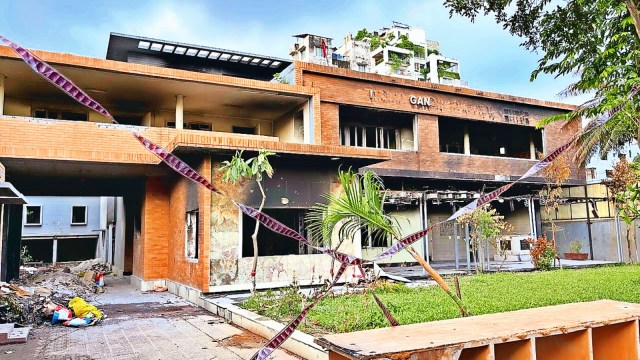 After the arson at the Indira Gandhi Cultural Centre, run by the ICCR, in Dhaka. (Shubhajit Roy)
When Indian High Commissioner Pranay Verma met Chief Advisor in the interim government Prof Muhammad Yunus in Dhaka this Thursday, one of the key issues he flagged was the security of Indian diplomatic personnel and their premises. This included the violent attack and arson at the Indira Gandhi Cultural Centre (IGCC), the hub of Indian cultural activity in the Bangladeshi capital for over five decades.
In the aftermath of the regime change on August 5 — when Sheikh Hasina fled to India after more than 16 years in power — policemen abandoned their posts fearing the wrath of protestors. This led to attacks against leaders and activists of Awami League regime, police officials, intellectuals, including journalists and civil society activists aligned with the previous government and minorities including Hindus.
The protesters’ anger also found an echo in a strong anti-India sentiment on the street. Indeed, on August 5 itself, the Indian government-run cultural centre in Dhaka came under an unprecedented attack from a mob which vandalised the premises and torched several sections of the centre.
This prompted the Indian High Commission in Dhaka to enter into a “complete lockdown-mode” — akin to what the Indian embassy in Kabul did in August 2021, when Afghan President Ashraf Ghani fled and his government collapsed, followed by a take-over by the Taliban. This mode means that if they would have had to vacate the entire mission, it would have meant shutting down the High Commission.
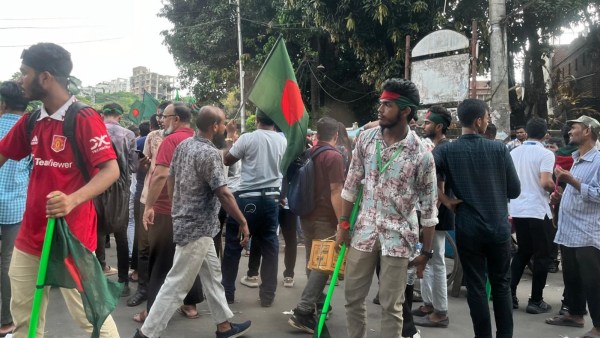 BNP activists blocking access to the Mujib memorial on August 15 (Express photo by Shubhajit Roy)
The IGCC at Dhanmondi, a plush neighbourhood in Dhaka, is a centre of the Indian Council for Cultural Relations of India. It’s located where the Indian High Commission used to be before 2010.
With a library of over 21,000 titles on Indian art, culture, politics, economics and fiction, the two-storey centre has been a hub in Dhaka for cultural programmes, seminars and workshops on Yoga, Hindi, Indian classical music and dances such as Kathak and Manipuri.
The mob, sources said, attacked the centre; looted books, stationery and computers and set sections on fire. The attack continued for hours, from the evening of August 5 to August 6. There were no Indian staff present, and the security is said to have abandoned their posts once the mob came.
Close to the centre is Sheikh Mujib’s museum, the house where he was assassinated with his family. That was also vandalised and set ablaze along with a trove of Mujib’s personal items, including papers.
The IGCC was formally inaugurated on March 11, 2010 by Karan Singh, then President of the Indian Council for Cultural Relations, along with Abul Kalam Azad, then Minister for Information and Cultural Affairs of Bangladesh.
It promoted bilateral cultural linkages through programmes, seminars, workshops and training. It engaged top professionals from Bangladesh trained by Indian Gurus or in Indian universities. It had three teachers in the streams of Vocal (Indian Classical Music), Hindi and Yoga.
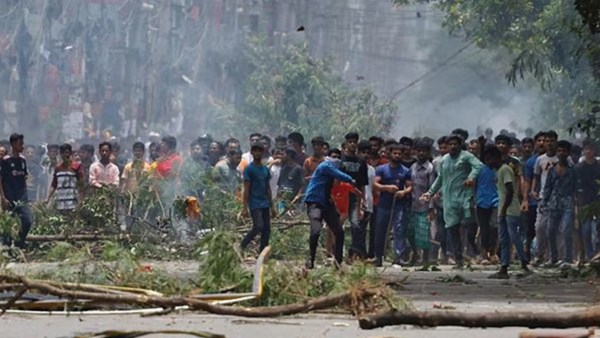 A demonstrator throws an object as protesters clash with Border Guard Bangladesh (BGB) and the police outside the state-owned Bangladesh Television as violence erupted across the country after anti-quota protests by students, in Dhaka, Bangladesh earlier. (Reuters)
“After it was vandalised and set ablaze (on August 5), a week later, a group of students came and cleaned up the place. It will take a while before the institution begins functioning again,” a source said.
On the evening of August 5, alarmed at the worsening security situation, the Indian High Commission called all its officials, staff and their families inside the Commission premises in Dhaka. With the collapse of the Hasina government, mobs of protesters, including members of BNP, Jamaat-e-Islami Bangladesh activists and “opportunists,” ruled the streets.
When the Indian High Commission reached out to the Bangladesh Army for security, armed forces sent in their troops to the outer perimeter but their message was clear — if the crowds come, they won’t fire at them. This was also the Army’s approach when people had stormed the Prime Minister’s residence, the Gana Bhaban, and had vandalised and looted many items — later, many items were returned as well.
Next to the diplomatic zone, was the office of a prominent pro-Awami League TV channel, Ekattor TV, which was also destroyed. That was the closest the mob got to the Indian High Commission premises in Baridhara.
Sources said the Indian High Commission, packed with officials and their families, spent a “sleepless couple of nights.” On August 7, a worried New Delhi decided to pull out all non-essential staff and families of the diplomats. Over 100 people left, with less than about three dozen Indian diplomats and officials left behind. These 30-odd people were there to ensure that India had a functional High Commission and could evacuate at short notice, if needed. They were asked to stay on the premises till the situation permitted them to go back to their residences outside the Indian High Commission.
Bangladesh Army officials told The Indian Express that they gave protection to the India’s missions in Sylhet, Rajshahi, Khulna and Chittagong.
The Indian Express has learnt that the vandalising and burning of the cultural centre was also raised through diplomatic channels by the Ministry of External Affairs in Delhi as the attack was in violation of Vienna Convention that guarantees the protection of diplomatic premises by the host country.
Sources in Delhi said that they are considering the return of “non-essential staff and families” from the Indian High Commission in Dhaka early next month.

 6 min read