Journalism of Courage



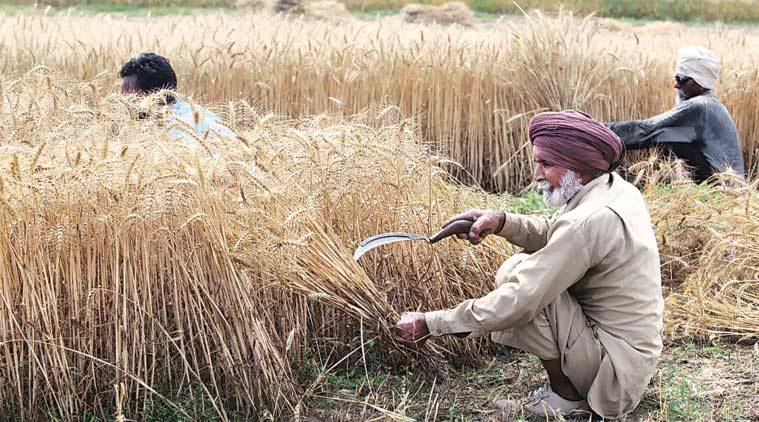 The Agriculture Ministry has estimated a 9.5% jump in the total acreage under rabi field crops this time compared to in 2018-19. (File)
The global spread of the coronavirus outbreak couldn’t have come at a worse time for Indian farmers — just when they are set to harvest a bumper rabi crop on the back of higher plantings enabled by the wettest monsoon in 25 years and extended heavy rains till early-November.
Rising COVID-19 infection cases, including in India, has acted as a sentiment dampener ahead of the marketing season for major rabi crops, whose mandi arrivals will pick up after Holi on March 10.
The Agriculture Ministry has estimated a 9.5% jump in the total acreage under rabi field crops — especially wheat, rapeseed-mustard, chana (chickpea), masur (red lentil), matar (field pea) and maize — this time compared to in 2018-19. March is also the harvesting/marketing period for the main rabi onion, potato and garlic crops, apart from red chilli and seed spices such as jeera (cumin seed), dhaniya (coriander) and saunf (fennel).
For farmers, the price outlook was generally bullish till around mid-January. Mustard in Rajasthan’s Alwar mandi was quoting at an average of Rs 4,150 per quintal, as against Rs 3,800 a year ago. But the oilseed is currently trading at Rs 3,600-3,700, way below the government’s minimum support price (MSP) of Rs 4,425. Chana prices at Latur in Maharashtra have, likewise, plunged to Rs 3,650 per quintal, when its MSP is at Rs 4,875.
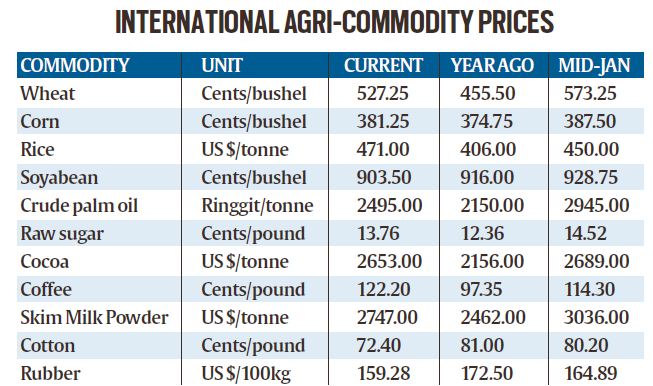 Note: Wheat, corn and soyabean prices refer to the most actively-traded futures contracts at the Chicago Board of Trade. Raw sugar, cocoa and coffee prices are for the most actively-traded futures at the Intercontinental Exchange. Skim Milk Powder price is the average for the fortnightly Global Dairy Trade auctions. Crude palm oil price is for the most actively-traded futures at the Bursa Malaysia exchange. Rice prices are export quotes for Thai white grain with 5% broken content. Rubber price is for RSS-4 grade at Bangkok. Cotton price is the average based on the Cotlook ‘A’ index.
The link with the coronavirus is obvious in the case of mustard. Crude palm oil prices in Malaysia had started this calendar year at 3,130 ringgits ($ 765 per tonne), with global stocks that were projected to drop to their lowest since 2009-10. But as reports of the novel virus epidemic in China gathered momentum from mid-January, prices crashed to sub-2,500 ringgits ($ 600) by end-February. Lower palm prices have, in turn, pulled down the rates for soyabean and other oilseeds, including mustard.
But it isn’t vegetable oil alone. As the accompanying table shows, international prices of almost every agri-commodity have registered declines after mid-January, with rice and coffee being notable exceptions. Significantly, the current levels are still higher than a year ago in most commodities, barring soyabean, cotton and rubber. It reflects fundamental global supply tightness, also manifested in the UN Food and Agricultural Organisation’s Food Price Index in January touching its highest since December 2014.
That situation has, of course, reversed subsequently. Commodity markets have been singed no less than equities by COVID-19’s rapid worldwide spread and reduced Chinese buying of everything, from palm oil and cotton to milk powder and meat.
For farmers, this isn’t good news. Red chilli prices at Andhra Pradesh’s Guntur Mirchi Yard had ruled at Rs 13,000-19,000 per quintal before mid-January, even briefly scaling a record Rs 22,000 for the premium high-pungency “Teja” variety grades. Those have now eased to
Rs 10,000-15,000, with expectations of a further fall due to shipments to China coming to a standstill. A bumper crop, in combination with Chinese imports not taking place, has led to jeera prices at Gujarat’s Unjha market hovering around Rs 13,350 per quintal, down from Rs 15,750 last year at this time.
After a poor kharif crop — impacted both by the monsoon’s delayed onset and unseasonal rains during maturity stage — Indian farmers are well set to reap a bountiful harvest. And with both global and domestic prices recovering after a prolonged bear phase, rural incomes till recently seemed on the cusp of a turnaround. Sadly, it looks that the coronavirus has upended those hopes. Even if China were to resume buying — inevitable at some point — that may happen only after the farmer has sold.

 4 min read