This is an archive article published on August 4, 2018
‘Congress in strategic understanding with SP, BSP for 2019 Lok Sabha polls’
Congress sources said the primary job is to bring together all opposition parties on “one platform” without “any confusion and disruption”. “What happens after that will depend on how different parties perform,” a senior leader said. The Congress feels that discussing a post-poll scenario could prove counter-productive and “divisive” for the opposition alliance, they pointed out.
The sources said the Congress would perform “significantly better” and “get a decent number of seats” in 2019 as compared to 2014, but did not assert that it would emerge as the single largest party.
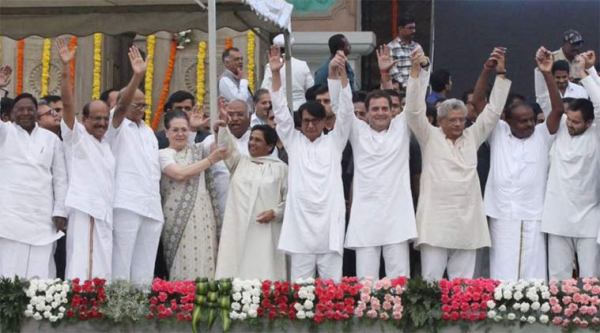
The Congress, SP and BSP have reached a “strategic understanding” to fight the 2019 Lok Sabha elections in alliance, Congress sources said on Friday, arguing that there is a feeling among all opposition parties that their “primary job” is to defeat the BJP and that the contentious issue of Prime Ministerial candidate can be decided after the elections depending on the seats each party will get.
The party, however, ruled out any alliance with disgruntled NDA constituent Shiv Sena as it was “not ideologically aligned” with the Congress. As for parties like the AAP, the sources pointed out that the Congress is locked in a direct fight with regional parties in certain states. They named the TRS in Telangana and AAP in Delhi and argued the high command will not “overrule or ignore” the views of the state units.
The sources did not name West Bengal, where the state Congress leadership is dead against entering into a seat-sharing pact with the Trinamool Congress. Trinamool Congress chief Mamata Banerjee had a meeting with UPA chairperson Sonia Gandhi and Congress president Rahul Gandhi earlier this week.
Congress sources said the primary job is to bring together all opposition parties on “one platform” without “any confusion and disruption”. “What happens after that will depend on how different parties perform,” a senior leader said. The Congress feels that discussing a post-poll scenario could prove counter-productive and “divisive” for the opposition alliance, they pointed out.
As for Madhya Pradesh, Rajasthan and Chhattisgarh, the sources said the party is “unlikely” to project a chief ministerial face in these states. The party made it clear that the Congress campaign for the 2019 elections would revolve around issues like “corruption under the BJP government”, “agrarian distress”, “unemployment and the failure of the BJP government to create jobs” and “state of education and healthcare sectors.”
The sources said the Congress would perform “significantly better” and “get a decent number of seats” in 2019 as compared to 2014, but did not assert that it would emerge as the single largest party.
The key, one senior leader said, was Uttar Pradesh and Bihar. Sources said talks are on with BSP and SP in Uttar Pradesh and with several parties in other states including Bihar. “Not just talks, we have reached a strategic understanding with BSP and SP,” the sources said, adding that details of seat-sharing are being worked out.
Story continues below this ad
They claimed that if the seat sharing is concluded in UP and Bihar “without any hitch”, the BJP will not get not more than five seats in these two states. In Maharasthra, the alliance with the NCP has been “cemented” for years, the sources said. They added that the idea that the BJP and RSS were unbeatable was a manufactured one, and referred to the 2004 Lok Sabha election outcome and India Shining campaign of the BJP.
The party made it clear that it had serious reservations over the use of electronic voting machines, but said a decision on how far the party should go in opposing use of EVMs will be decided in consultation with other opposition parties.
Manoj C G currently serves as the Chief of National Political Bureau at The Indian Express. A veteran journalist with a career spanning nearly two decades, he plays a pivotal role in shaping the publication's coverage of India's political landscape.
Experience & Career: Manoj has built a robust career in political journalism, marked by a transition from wire service reporting to in-depth newspaper analysis.
The Indian Express (2008 – Present): He joined the organization in 2008 and has risen to lead the National Political Bureau, overseeing key political coverage.
Press Trust of India (PTI): Prior to his tenure at The Indian Express, Manoj worked with India’s premier news agency, PTI, honing his skills in breaking news and accurate reporting.
Expertise & Focus Areas: As a seasoned political observer, Manoj focuses on the nuances of governance and party dynamics.
National Politics: extensive reporting on the central government, parliamentary affairs, and national elections.
Political Strategy: Deep analysis of party structures, coalition politics, and the shifting ideologies within the Indian political spectrum.
Bureau Leadership: directing a team of reporters to cover the most critical developments in the nation's capital.
Authoritativeness & Trust: Manoj’s authoritativeness is grounded in his nearly 20 years of field experience and his leadership role at a legacy newspaper. His long-standing association with The Indian Express underscores a reputation for consistency, editorial integrity, and rigorous reporting standards required of a Bureau Chief.
Find all stories by Manoj C G here. ... Read More


 4 min read


 The sources said the Congress would perform “significantly better” and “get a decent number of seats” in 2019 as compared to 2014, but did not assert that it would emerge as the single largest party.