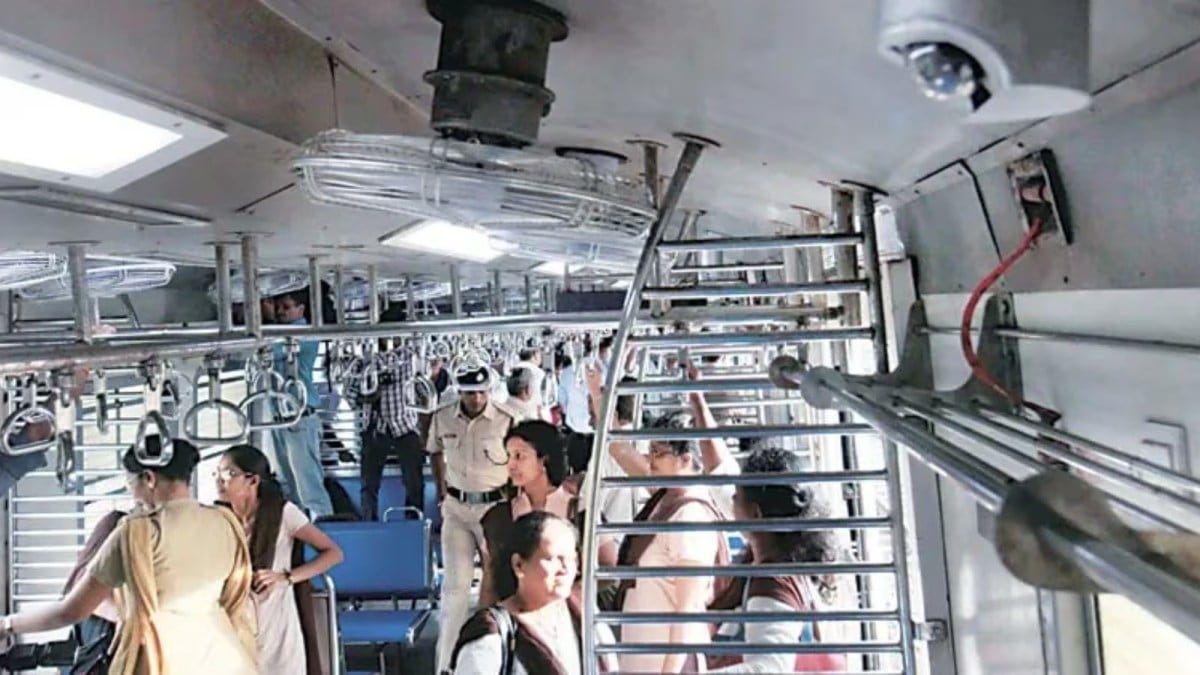
A railway official from SECR confirmed that CCTV cameras will be installed in loco cabs as well as coaches and that the “work had already begun.”
Advertisement
The Indian Railways is installing cameras in locomotive cabs and coaches on passenger trains under the South East Central Railway (SECR), officials said, after a recent collision between two trains reinforced the need for such a measure.
This comes as the Commissioner of Railway Safety (CRS) continued its inquiry, recording statements from 19 railway employees, who were asked to be present with documents.
You’ve Read Your Free Stories For Now
Sign up and keep reading more stories that matter to you.
The collision between a stationary goods train and a passenger Mainline Electric Multiple Unit (MEMU) earlier this week killed 11 people and injured 20. The impact caused a section of the passenger train to mount the goods train.
A railway official from SECR confirmed that CCTV cameras will be installed in loco cabs as well as coaches and that the “work had already begun.”
A preliminary SECR report blamed the accident on the train crew, saying they “failed to control the train at danger signal” and were responsible for not “controlling the train at the right time and right position before danger signal and committed SPAD case.” A ‘SPAD case’ refers to a Signal Passed at Danger event, when a train passes a stop signal without authority.
A senior Bilaspur police officer said CCTV cameras would have made it easier to establish what led to the crash.
Talking about 53-year-old loco pilot Vidya Sagar, who died in the crash, the official said: “Sagar was an experienced loco pilot and had around two decades of experience.”
Story continues below this ad
The CRS, an independent body under the Ministry of Civil Aviation, will also record the statement of assistant loco-pilot Rashmi Raj, who is undergoing treatment for her injuries.
According to railway sources, this is the second major train tragedy in Bilaspur district since 1997, when five coaches of the Ahmedabad-Howrah Express toppled into a river, killing 81 people.
Significantly, the central government greenlit installation of CCTV cameras in locomotives and coaches this July. The move, according to the Railways, is aimed at improving passenger safety.
Jayprakash S Naidu is a Principal Correspondent for The Indian Express, currently serving as the state correspondent for Chhattisgarh. With an extensive career in frontline journalism, he reports on the political, security, and humanitarian landscape of Central India.
Expertise and Experience
Specialized Conflict Reporting: Jayprakash is a leading voice on the Maoist/Naxalite conflict in the Bastar region. His reporting provides a critical, ground-level view of:
Internal Security: Tracking high-stakes encounters, surrender programs for senior Maoist leaders, and the establishment of security camps in formerly inaccessible "heartland" villages.
Tribal Rights & Displacement: Investigative reporting on the identity and land struggles of thousands of displaced tribals fleeing conflict zones for neighboring states.
Governance & Bureaucratic Analysis: He consistently monitors the evolution of Chhattisgarh as it marks 25 years of statehood, covering:
Electoral Politics: Analyzing the shift in power between the BJP and Congress and the impact of regional tribal movements.
Public Policy: Reporting on landmark infrastructure projects (e.g., mobile connectivity in remote zones) and judicial interventions, such as High Court rulings on civil and family law.
Diverse Investigative Background: Prior to his current focus on Chhattisgarh, Jayprakash held reported from Maharashtra, where he specialized in:
Crisis & Disaster Management: Notable for his extensive coverage of the Cyclone Tauktae barge tragedy (P-305) and the COVID-19 pandemic’s impact on frontline personnel.
Legal & Human Rights: Investigative pieces for platforms like Article-14, focusing on police accountability and custodial deaths across India.
Environmental & Social Justice: Authoritative reporting on the Hasdeo Aranya forest protests and the approval of major tiger reserves, highlighting the tension between industrial mining and environmental preservation. ... Read More