5 min read
Stay updated with the latest - Click here to follow us on Instagram

Journalism of Courage



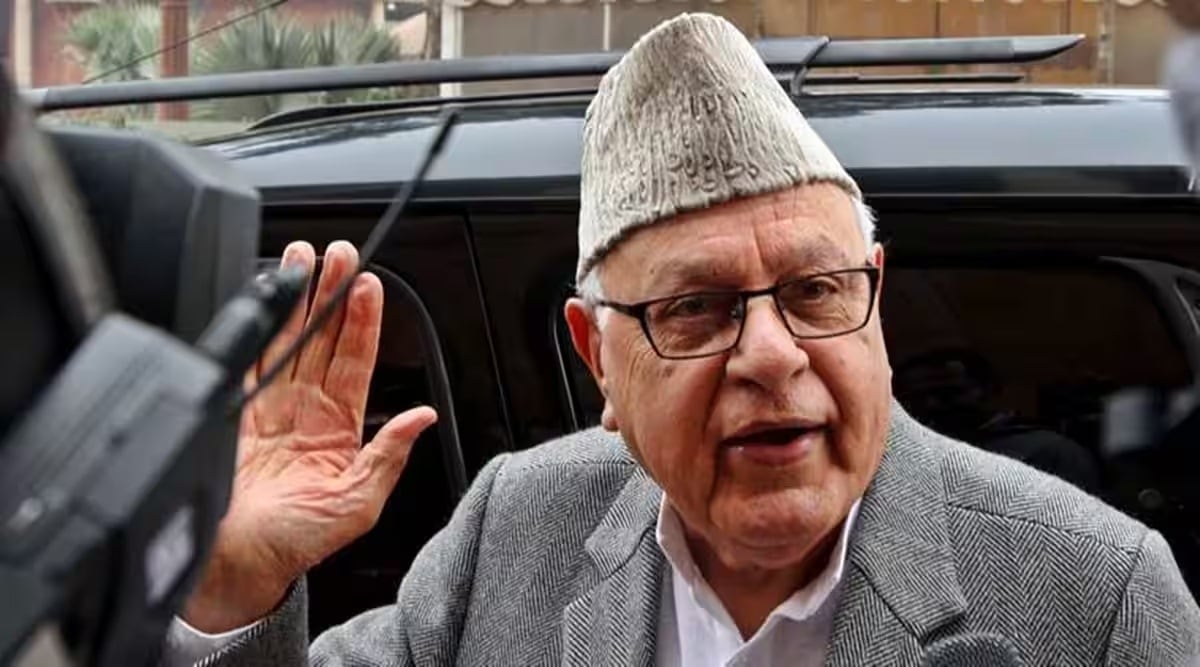 The report, ‘Five Years Without an Elected Government: Human Rights in Jammu and Kashmir, August 2022 to July 2023’ was released in the presence of Farooq Abdullah. (File photo)
 Article 370 was temporary because a plebiscite had to be held in Kashmir to decide whether it would join India or Pakistan, but it was never held, former Jammu and Kashmir chief minister Farooq Abdullah said Thursday.
“People keep talking about Article 370 being a temporary provision. It was temporary because a plebiscite had to decide which dominion Kashmir would join. That plebiscite never happened. Delhi has played its games and it continues to play its games. People suffer,” Abdullah said at an event organised to release a report on Jammu and Kashmir by a group of eminent citizens.
“Our problem is how do we win the hearts of the people. It cannot be done by merely making roads. The factor that is missing is trust. You cannot create that trust by force or by buying people. The reason we joined India was because of Gandhi’s utterances that this place is for all. What is happening today? Look at Manipur. Are we united really? We cannot survive by dividing each other,” the National Conference chief said.
The report, ‘Five Years Without an Elected Government: Human Rights in Jammu and Kashmir, August 2022 to July 2023’ was released in the presence of Abdullah, CPM leader from Kashmir M Y Tarigami, Congress leader Shashi Tharoor, DMK’s Kanimozhi, RJD leader Manoj Jha and NCP (Sharad Pawar) leader Supriya Sule among others. The report has been prepared by the Forum for Human Rights in Jammu and Kashmir, which is co-chaired by former home secretary GK Pillai and former interlocutor for J&K Radha Kumar.
The release of the report comes at a time when the Supreme Court is hearing a clutch of petitions on the constitutional validity of the August 5, 2019 decisions that bifurcated the erstwhile state of Jammu and Kashmir into two Union territories and stripped it of its special status by abrogating Article 370.
At the very beginning of the session, Pillai said an internal noting of the law ministry had pointed out that the act of dividing the state into two Union territories was itself unconstitutional, but this opinion was ignored.
Introducing the report, Radha Kumar said, “In our earlier reports we have raised the issue of human rights violations in Kashmir. Unfortunately, they continue. The continuing hardships that civilians face, the increasing arrest of media persons under UAPA… We are all aware how this suppression of dissent is happening across the country. It has been most prominent in J&K.”
Quoting from the report, Kumar said CRPF deaths had increased over the years in Kashmir even as an increase in crimes against women and children had been recorded. The number of juveniles committing crimes too had increased, she informed.
“We are highlighting elections because not only is it a fundamental right but over these four years, the kind of human rights violations and the policies that have been adopted have all been unilateral. There is a level of inaccessibility in J&K and Ladakh. L-Gs have been proved to be inaccessible and unaccountable. The government has ushered in a policy and legislation that pits Gujjars and Pahadis against each other. The callousness of central and state policymakers is heartbreaking,” she said.
The report has said that while “the number of lives lost due to armed attacks and counter-insurgency operations was lower than in the previous year, the number of police personnel who died, including Central Reserve Police Forces (CRPF), continues to be unacceptably high. 71 CRPF troops were killed in the four years between 2019-2022, twice as many as in the previous four years, 2014-2018, when 35 died. By comparison, in the four years between 2012-2015, which can be categorised as an uneasy interregnum between the post-peace process years and the rise of conflict in the BJP-PDP coalition, 27 CRPF troops were killed.”
It also raised a red flag over rising militancy in Jammu and blamed delimitation among the reasons. “After decades of peace, the bordering areas of Poonch and Rajouri districts in Jammu division are re-emerging as a locus for militancy with cross-border support from Pakistani-held territories of the former state. The 2022 delimitation of fresh legislative constituencies, adding Poonch and Rajouri to Kashmir’s Anantnag, may have added to the alienation that these Muslim-majority areas face with the sharpening of communal divides in Jammu. Increasing weaponisation through Jammu’s village defence guards, a problematic policy that the Forum highlighted in its 2022 report, has added further insecurity in the region,” it said.
Demanding immediate elections in the Union territory, the report has said, “Fresh reservations to woo new constituencies through four bills scheduled to be introduced in the monsoon session of parliament will, if enacted, entrench caste-based voter mobilisation.”
It also asked for the release of all the remaining political prisoners and for inclusion of Ladakh under the Sixth Schedule of the Constitution.
Stay updated with the latest - Click here to follow us on Instagram