Journalism of Courage



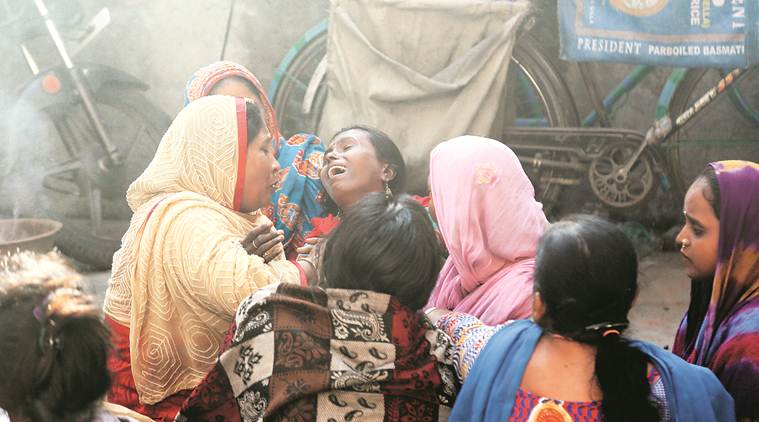 31 victims were consigned to flames at Amritsar cremation ground. Sahil Walia
“Iska naam Aakash hai, isne kaali shirt pehni thhi… kisi ne dekha isey? (His name is Aakash, he was wearing a black shirt. Has anyone seen him?),” asked a man while running across the corridors of Guru Nanak Dev Hospital in Amritsar on Friday night with a photograph on the screen of his phone. He ignored suggestions to check the room where bodies were kept. “I have already been to three hospitals. First I will check the wards. Why should I check the bodies? He is not dead.”
Around midnight, a few hours after at least 59 people were killed and several injured in the train mishap near Amritsar, the administration struggled to accommodate the injured victims and the police tried to keep pace with paperwork.
“I had stopped him from going near the railway tracks,” Mukesh Kumar (54) said, waiting for the body of his son Neeraj (19) outside the ‘Dressing Room’ of the hospital, which was converted into a mortuary.
“It’s been an hour we have been asking officials to arrange for ice…doctors are not ready to touch the bodies. They are asking us to search bodies for identity proofs or some documents,” yelled Shubham Sharma, a volunteer from Your Blood Can Save Lives.
Soon, a few volunteers arrived with slabs of ice on broken stretchers. “Now how will it be broken? There is no sua (ice pick),” said one volunteer.
Nineteen bodies lay on the floor. “Eight of them have been identified but others have missing body parts…” said Rupak, a volunteer.
Upstairs, outside the ICU, around 1 am Janki was informed that her brother-in-law, Thakur Prasad (40), had succumbed to injuries. “It was the first time he went to watch Raavan Dahan. After we saw news of the incident on TV, we started calling on his cellphone — a doctor received the call and said his condition was serious…. Two friends who accompanied him have also died,” Janki said.
Wrapped in blood-soaked cloth, Prasad’s body lay on a stretcher. “Laash ko neeche lekar chalo. Apne waarison ko bulao (take the body downstairs. Call his family members),” a policeman told Janki. It’s time for the paperwork for Prasad’s family. “We have to finish paperwork fast so that families can take the bodies home after autopsy. It’s heartbreaking but we have to do it,” Sub Inspector Parkash Singh said.
At 3 am, Gurjit Singh and Surjit Singh, carrying a kettle full of tea and paranthas, went around the hospital, making sure everyone ate at least something. “Our langar will go on the entire night… It is not easy to struggle on empty stomach,” Gurjit said.
Walking with a stick in hand, Tarjit Singh (76) tried to keep pace with the stretcher that carried the body of his nephew, Balbir Singh (40). “He has three children. We are yet to break news to his no more. If I break down, who will handle the family,” Tarjit asked.

 3 min read