


Journalism of Courage



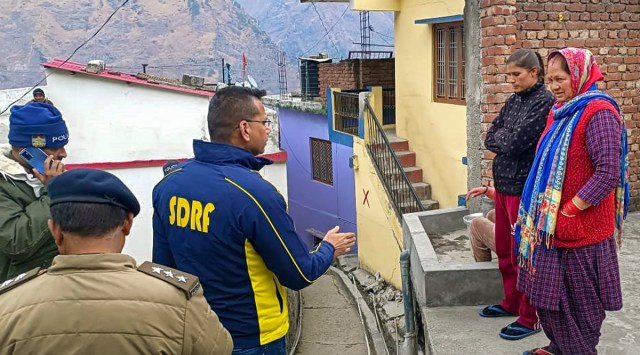 The Chamoli district administration has intensified its door-to-door survey of the houses and shifting of the families living in danger zones.
 As the number of houses developing cracks due to land subsidence is increasing in Joshimath with each passing day, the Chamoli district administration has intensified its door-to-door survey of the houses and shifting of the families living in danger zones.
According to data provided by the administration, cracks have so far developed in 678 houses and 81 families have been relocated. The administration has claimed to have identified 213 rooms in 19 buildings in Joshimath, with a capacity of around 1,200 persons, where the affected families could be relocated. Similarly, 20 buildings with a capacity of over 2,200 persons have been identified in Pipalkoti, around 36 kilometre from Joshimath.
Talking to The Indian Express, R Meenakshi Sundaram, Secretary to Chief Minister Pushkar Singh Dhami, said they will be demolishing two hotels, one of which has tilted on the other, along with the piece of land it is built on. The hotels — Malari Inn and Mount View — both three-storeyed buildings, will be demolished in the next few days.
 Families move to shelters in Joshimath. (Express photo by Avaneesh Mishra)
“The situation is fluid and evolving. Those two hotels are massive structures and there are other structures below them. This is why the safe demolition of those buildings is mandatory,” Sundaram said.
He said they are dividing the area into three zones — danger zone, buffer zone and safe zone. The administration is conducting surveys to assess the danger and buffer zones in the area.
 A temple collapses after the gradual ‘sinking’ of Joshimath in Chamoli district of Uttarakhand. (PTI)
“We cannot be entirely sure about the safe zones because even the adjacent zones will become unstable if there is a landslide in the danger zones. There will be cascading effect on the neighbouring areas as well. This is why we need to consider buffer zones too. While shifting people, we have multiple options for now. But we also need to see whether the options considered are in the safe zone,” Sundaram said.
The official said while relocating people they are also considering their livelihood. “In the survey, we are also asking people about their livelihood. Earlier, land was identified in Pipalkoti, around one and a half hours from here. If somebody has a livelihood in Joshimath, we cannot expect them to go to Pipalkoti. This is why we are keeping in mind the occupation also,” he said.
 A man shows the cracks that appeared at his house in Joshimath. (PTI)
“Currently people are living in hotels. The next step will be to get a prefabricated structure constructed so that they can go and shift there. Then the third step will be permanent rehabilitation in the chosen area, which has to be verified by the geological experts,” he added.
According to the administration, multiple options are being evaluated for permanent rehabilitation of the affected families. One option, said Sundaram, is to give people money and the liberty to go and settle wherever they want. The second option is looking for alternative sites and providing land. The administration is trying to further speed up the process of evacuation from the danger zones as rains are expected in the town from Wednesday, and snowfall from Friday.
You May Like


 4 min read


