6 min read


Stay updated with the latest - Click here to follow us on Instagram
© IE Online Media Services Pvt Ltd



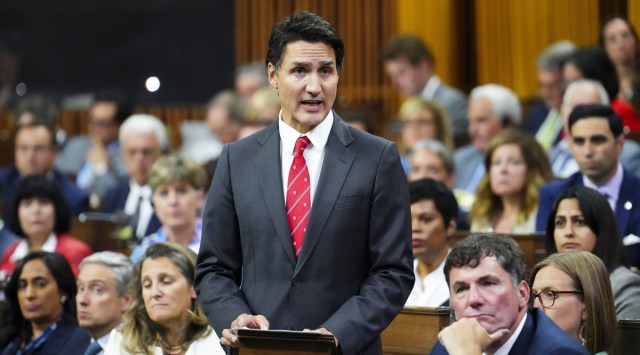 Canadian Prime Minister Justin Trudeau made the allegation in the House of Commons. AP
 A DIPLOMATIC standoff erupted between India and Canada on Tuesday as Canadian Prime Minister Justin Trudeau alleged a “potential link” between the Indian government and the killing of a pro-Khalistan leader in Canada earlier this year. This was followed by the expulsion of a senior Indian diplomat in Canada. Rejecting the allegations as “absurd” and “motivated”, India, in a tit-for-tat action, expelled a senior Canadian diplomat in Delhi.
Hardeep Singh Nijjar, 46, head of the Guru Nanak Sikh Gurdwara Sahib in Surrey, Canada, was shot by two unidentified men outside the gurdwara in June this year. He was the chief of the separatist organisation, Khalistan Tiger Force (KTF). The NIA had announced a reward of Rs 10 lakh for information leading to his arrest.
“Over the past number of weeks, Canadian security agencies have been actively pursuing credible allegations of a potential link between agents of the Government of India and the killing of a Canadian citizen, Hardeep Singh Nijjar,” Trudeau said in a speech in the House of Commons on Monday.
He said he had also raised the issue with Prime Minister Narendra Modi at the G20 summit. “Any involvement of a foreign government in the killing of a Canadian citizen on Canadian soil is an unacceptable violation of our sovereignty,” he said, adding, “It is contrary to the fundamental rules by which free, open and democratic societies conduct themselves.”
Trudeau said Canada has expressed its concerns about Nijjar’s death to high-level security and intelligence agencies in India. He said he had also raised the issue with US President Joe Biden and UK Prime Minister Rishi Sunak. “I continue to ask with a great deal of firmness that the Government of India cooperate with Canada to shed light on this situation,” he said.
After Trudeau’s remarks in Parliament, Canadian Foreign Minister Melanie Joly said she had ordered the expulsion of “a senior Indian diplomat”. “If proven true, this would be a great violation of our sovereignty and of the most basic rule of how countries deal with each other… As a consequence we have expelled a top Indian diplomat.”
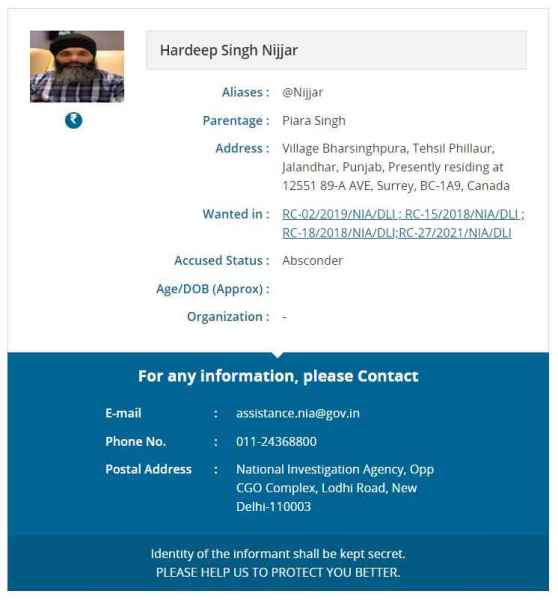 A screenshot from NIA website showing Nijjar in the agency’s most wanted list.
In retaliation, the Ministry of External Affairs (MEA) summoned Canadian High Commissioner to India, Cameron MacKay, and informed him about the decision to expel a senior Canadian diplomat, who has been asked to leave India within five days.
Delhi said the decision reflects the Centre’s growing concern over the interference of Canadian diplomats in India’s internal matters and their involvement in anti-India activities.
“We have seen and reject the statement of the Canadian Prime Minister in their Parliament, as also the statement by their Foreign Minister… Allegations of Government of India’s involvement in any act of violence in Canada are absurd and motivated. Similar allegations were made by the Canadian Prime Minister to our Prime Minister, and were completely rejected,” the MEA said.
Also countering Trudeau’s remarks that Canada is a “rule-of-law country”, the MEA said, “We are a democratic polity with a strong commitment to rule of law.”
“Such unsubstantiated allegations seek to shift the focus from Khalistani terrorists and extremists, who have been provided shelter in Canada and continue to threaten India’s sovereignty and territorial integrity. The inaction of the Canadian Government on this matter has been a long-standing and continuing concern,” it said.
“That Canadian political figures have openly expressed sympathy for such elements remains a matter of deep concern… The space given in Canada to a range of illegal activities including murders, human trafficking and organised crime is not new. We reject any attempts to connect Government of India to such developments,” the MEA said.
It also “urged” the Canadian government to take “prompt and effective legal action against all anti-India elements operating from their soil”.
Hours later, Trudeau said he was not looking to “provoke” India or “escalate” tensions, but urged New Delhi to take Nijjar’s killing with the “utmost seriousness”.
While India-Canada ties have been strained over the pro-Khalistan groups, the tit-for-tat measures take it to a new low.
On September 10, following a meeting between Modi and Trudeau on the sidelines of the G20 Summit, India had issued a strongly-worded statement. “He (Modi) conveyed our strong concerns about continuing anti-India activities of extremist elements in Canada. They are promoting secessionism and inciting violence against Indian diplomats, damaging diplomatic premises, and threatening the Indian community in Canada and their places of worship,” the MEA had said in a readout of the meeting.
Asked about India’s concerns, Trudeau had said at a press conference: “Canada will always defend freedom of expression, freedom of conscience, and freedom of peaceful protest, and it is extremely important to us… At the same time, we are always there to prevent violence and to push back against hatred. I think, on the issue of the community, it is important to remember that the actions of a few do not represent the entire community or Canada”.
Days later, a senior government official had confirmed that the two countries had “paused” their negotiations on a bilateral free trade agreement, until the resolution of the “political issues” between the two countries.
– With PTI
Stay updated with the latest - Click here to follow us on Instagram