Journalism of Courage



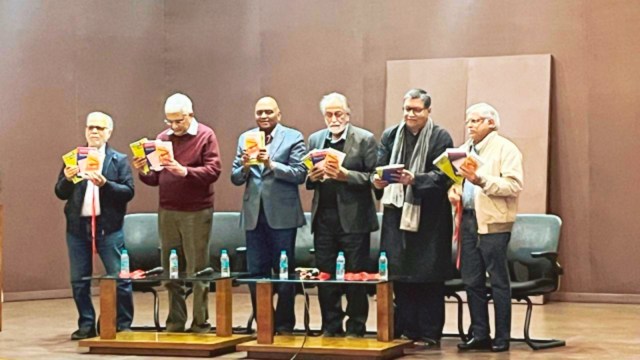 (From left) Loklahar editor Rajendra Sharma, senior CPM leader Prakash Karat, Advocate Raju Ramachandran, economist Prabhat Patnaik, SAHMAT’s Ram Rahman and Professor C P Chandrasekhar at the book launch, Friday. Express photo
Three books based on late CPI(M) leader Sitaram Yechury’s writings on culture, media, science, and secularism were released Friday.
Published by the Safdar Hashmi Memorial Trust (SAHMAT) and Tulika Books, the three books include Hindu Rashtra Hai Kya, a Hindi translation of Yechury’s 1993 English book. The other two are: The Fight For The Republic, which has three essays, two devoted to Hindutva and one to India @75; and Reflections on Culture, Media and Science.
Yechury passed away on September 12 at AIIMS, Delhi.
Former CPI (M) general secretary Prakash Karat released the books in the presence of economist Prabhat Patnaik, emeritus professor at JNU’s Centre for Economic Studies and Planning C P Chandrashekhar, SAHMAT’s Ram Rahman, Advocate Raju Ramachandran and Loklahar editor Rajendra Sharma.
“Sitaram published What is Hindu Rashtra in March 1993, months after the demolition of the Babri Masjid. Sitaram made a serious attempt to understand what these forces are… who led the Ram temple movement and demolished the Babri Masjid… the RSS. He understood that the demolition of the Babri Masjid was the beginning of the rise of the Hindutva forces to capture power,” said Karat:
He added that Yechury’s writings discussed M S Golwalkar’s We Or Our Nationhood Defined as “the manual” for the RSS and traced the RSS ideologue’s ideas of “racial purity”. He recalled how after reading Yechury’s essay, legal luminary A G Noorani had treated him to a biryani.
On Yechury’s scientific outlook, Karat said his “understanding of science surprised me, as he was a student of economics”. That scientific outlook also made Yechury say that the Hindutva forces are forces of unreason, Karat added.
Ramachandran, a friend of Yechury’s, recalled his “curious mix of Deccani accent with a twang of Stephanian slang”. Recollecting with a touch of humour, he said Yechury would borrow his notes but while “he got a first, I got a second”.
Rahman spoke about Yechury’s contribution to the organisation, saying it would not have survived without the CPI(M) leader.
Patnaik described Yechury as “one among brilliant academic minds who chose to become whole-timers of the communist movement”. Chandrasekhar said the three books had been put out to celebrate the life of Yechury. Editor Sharma discussed the contents of Yechury’s writings.

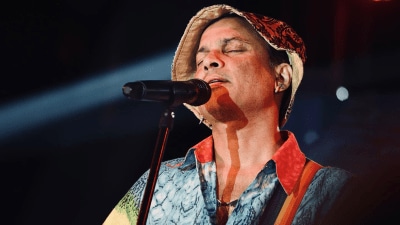
The Special Investigation Team (SIT) of the Assam Police has submitted the chargesheet in the Zubeen Garg death case along with other documents relevant to the case in the court of the Chief Judicial Magistrate, Guwahati. Zubeen Garg died while swimming in Singapore on September 19, 2025.
 3 min read