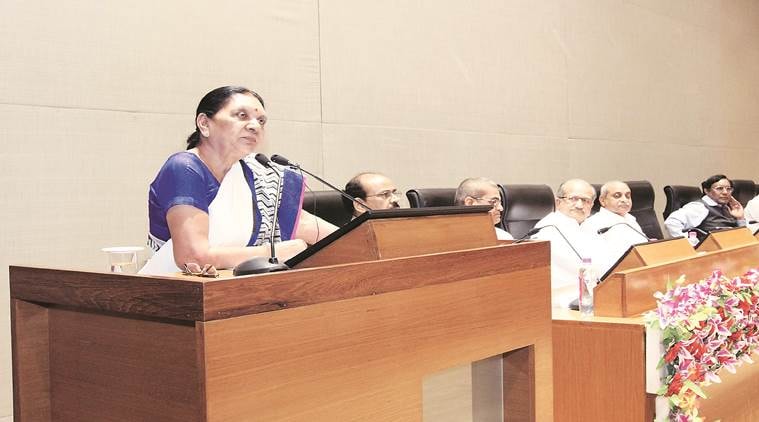
Anandiben Patel announces education pacakage for EWS in Gandhinagar Thursday. (Source: Express Photo)
On September 24, the Gujarat government announced the Mukhyamantri Yuva Swavalamban Yojana (MYSY), a fee-waiver/scholarship scheme for poor undergraduate students. The scheme is widely seen as a response to the Patidar agitation for reservation in college education and government jobs; agitation leader Hardik Patel, however, rejected the MYSY almost immediately as a “lollipop”, which he said offered nothing substantive to his community. The government also relaxed by five years the hiring age for government jobs across all categories.
The Scheme
Under the Rs 1,000 crore scheme, the government pays 50% of the fee, up to a maximum of Rs 2 lakh per year, for undergraduate students of medicine in self-financed (private) and government medical colleges. Students of dental sciences, homoeopathy, nursing and physiotherapy get a 50% fee waiver or an assistance of Rs 2 lakh, whichever is lesser. Students of Classes X and XII opting for diploma courses with at least 80 percentile marks will qualify for annual assistance of Rs 25,000, or a 50% fee waiver, whichever is lesser. Science, Arts, Commerce and Education students in self-financed colleges will get a 50% fee waiver, or annual assistance of Rs 10,000, whichever is lesser. The assistance is skewed in favour of professional institutes, whereas nearly half the state’s students enroll in Arts, Science and Commerce streams.
The Beneficiaries
Gujarat Board (GSHSEB), CBSE, ICSE, IB and NIOS students who secure 90 percentile in Class 12, and who have an annual family income of up to Rs 4.5 lakh. Nearly 60,000 students could benefit, it is estimated.
MYSY and MSY
On July 23, 2014, the government replaced all existing scholarship schemes with a consolidated Mukhyamantri Shishyavrutti Yojana (MSY) to extend “financial help to bright, needy undergraduate students”. A similar ‘CM scholarship scheme’ notified on March 3, 2014 by the previous Narendra Modi government too, was scrapped. MSY and MYSY are largely similar schemes, though differing in reach. MSY lowers the bar in some cases to bring a larger group in the beneficiary tent. It also incorporates a provision for girls — in 50 talukas with a female literacy rate of under 50%, there are 500 scholarships for girls with 75% or higher marks in Class 12, irrespective of the families’ annual income.
MYSY and Patidars
The scheme is a knee-jerk reaction, which doesn’t offer much of substance to economically weaker sections. Raising the age ceiling for jobs is likely to increase competition, given the large numbers of jobless older than 30. Existing ceilings of 28 (general category) and 33 (reserved) will now be 33 and 38 years respectively. More significant is the fact that the government has not recruited teachers on full pay scales after 1998 — until that happens, these steps will remain of notional value.
The ‘Real’ Gainers
MYSY will pay for education in private colleges, many of which are run by politicians. They will gain if the large number of seats that currently go empty are filled. Because no cap on fees has been specified, there is speculation that private colleges may now charge more. The government has also made no reference to increasing capacities in professional colleges and institutes run by it.
The Funding
There is no clarity on funding for the Rs 1,000 crore package. There is no budgetary allocation. No notification has been issued regarding its implementation.


 4 min read


 Anandiben Patel announces education pacakage for EWS in Gandhinagar Thursday. (Source: Express Photo)