


Tags:


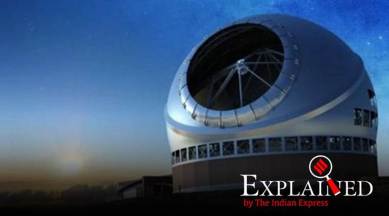
Last week, Hawaii saw protests against plans to start construction of a giant telescope atop Mauna Kea, the US state’s highest mountain at 14,000 feet. Already the site of a number of observatories and 13 large telescopes, Mauna Kea is considered sacred by native Hawaiians who believe that such constructions defile the mountain. After a Supreme Court order recently cleared construction of the newest one, called the “Thirty Metre Telescope”, locals blocked access to the roads last week, leading to several arrests.
READ | Construction of world’s largest telescope in Hawaii gets green signal


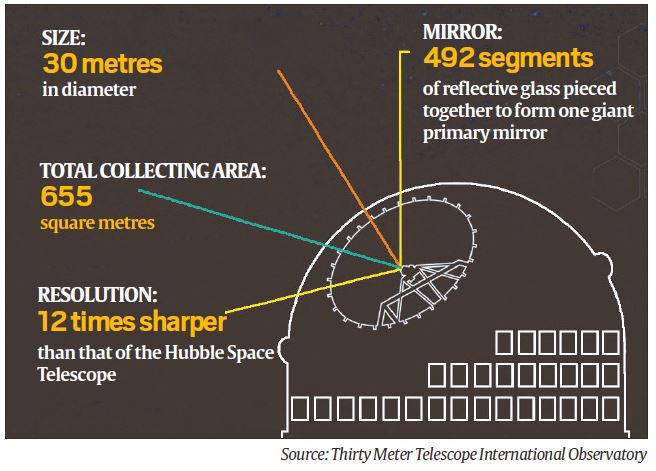
One of its key uses will be the study of exoplanets, many of which have been detected in the last few years, and whether their atmospheres contain water vapour or methane — the signatures of possible life. “For the first time in history we will be capable of detecting extraterrestrial life,” Dumas told The AP. The study of black holes is another objective. While these have been observed in detail within the Milky Way, the next galaxy is 100 times farther away; the Thirty Metre Telescope will help bring them closer.
If the Thirty Metre Telescope cannot be built on Mauna Kea, Spain’s Canary Islands is a backup site.


