


© The Indian Express Pvt Ltd
Tags:


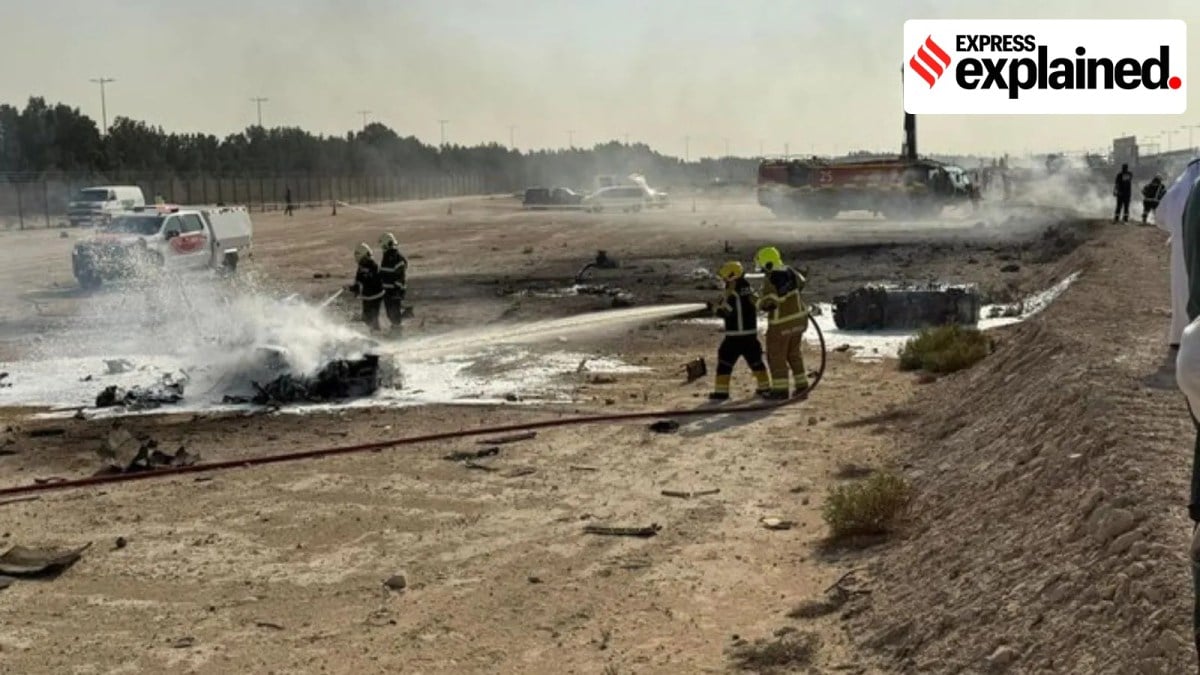
In the backdrop of the tragic crash of a Tejas fighter jet at the Dubai Airshow last week, former Commandant of the Gwalior-based Tactics and Air Combat Establishment (TACDE), Air Marshal Diptendu Choudhury (retd), tells Amrita Nayak Dutta about the common reasons for air display accidents, and the risks and relevance of high-performance manoeuvres in military aviation. Wing Commander Namansh Syal had performed the negative G manoeuvre with the Tejas aircraft seconds before it crashed.
While a formal inquiry will establish the exact cause of the recent Tejas crash, what are the reasons typically found for such accidents globally?


How different is performing an aerial display in a domestic flypast vis-à-vis flying in a global air show?
The fundamental difference lies in who is running the show. If it is the IAF, there are strict military display benchmarks where safety takes priority over performance.
If it is an air show display, whether international (Paris, Dubai air shows, etc.) or national (Bengaluru air show, Defence Expos, etc.), the dynamics are quite different compared with the Republic Day or Air Force Day flypasts.
Single aircraft fighter displays in commercial air shows are not for showmanship, but an aerial demonstration of the platform’s performance envelope, where the envelope is pushed within tight safety margins. Similarly, when formation aerobatics are flown, the challenges of coordination, precision, and timing are critical. So, in a way, all display flying has its inherent dangers.
Having headed TACDE, what would you say are some of the common but most difficult manoeuvres to execute while flying a fighter jet? Are these manoeuvres common in combat, or are more suited for aerial displays?
All high-performance manoeuvres flown have some direct or indirect combat relevance in military aviation. Display manoeuvres are flown with precision, with strict adherence to flight parameters where display is balanced with flight safety. In combat flying, where you are expected to push human and aircraft envelopes to win, the stakes are different. Each manoeuvre involves aerodynamic and structural limits of the aircraft, along with the pilot’s physical, spatial, and aeromedical limits. But the difference lies in whether they are being performed at higher altitudes, as is done during training, or executed at low altitudes, where safety and recovery margins are much lower, whether during combat exercises or displays.

Could you speak about the challenges involved in a negative G manoeuvre? How does it differ from a positive G?
Fundamentally, in positive G manoeuvres, pilots feel pushed into their seat due to high gravitational forces. Blood rushes to the feet and one can ‘black out’. In a negative G manoeuvre, the pilot feels being thrown out of his seat, and here the blood rushes to the head and he experiences a ‘redout’.
One can recover from this easily provided one is at a high altitude. At low levels, the recovery margins are very narrow and can easily prove fatal. Military pilots train relentlessly to deal with G, whether positive or negative, and yet sometimes it may not prove enough.
In low-level aerobatic displays, milliseconds matter. On average, the platform is travelling at speeds of around 200 metres per second. At a height of 150 metres, the reaction time to hit the ground can be as low as a second, depending on your downward vector. On the last ill-fated manoeuvre of the Tejas, I would not like to comment till the official enquiry establishes the facts.
All fighters can perform negative G manoeuvres, but the limits vary depending on their role. However, not all fighters display this capability in their performance demos. The Tejas is probably among the very few to do so.
Do such accidents reflect on the aircraft?
No, till established as so. The crash is a tragedy, and its outcome needs to be dealt with separately. The Tejas is a flag bearer of Indian aviation. While the stringent enquiry run by the IAF will establish the cause of the crash, there is a larger strategic issue of the nation’s reducing combat air power capacity. The aircraft which flew in the display was the Mk 1, not the 180 Mk 1A that the IAF had ordered. In this case, the focus on HAL is inevitable. It needs to recover its credibility and reliability by fulfilling on priority the long-promised pending orders of its primary customer, the IAF.


