Railways in 2025: Kashmir and Mizoram lines completed; new frontiers, traffic and freight challenges ahead
After connecting Kashmir and Mizoram, the Railways is expediting other key border projects which are strategic in nature. These include the Sivok-Rangpo line in Sikkim and the Rishikesh-Karnaprayag line which will serve as a gateway to the China border
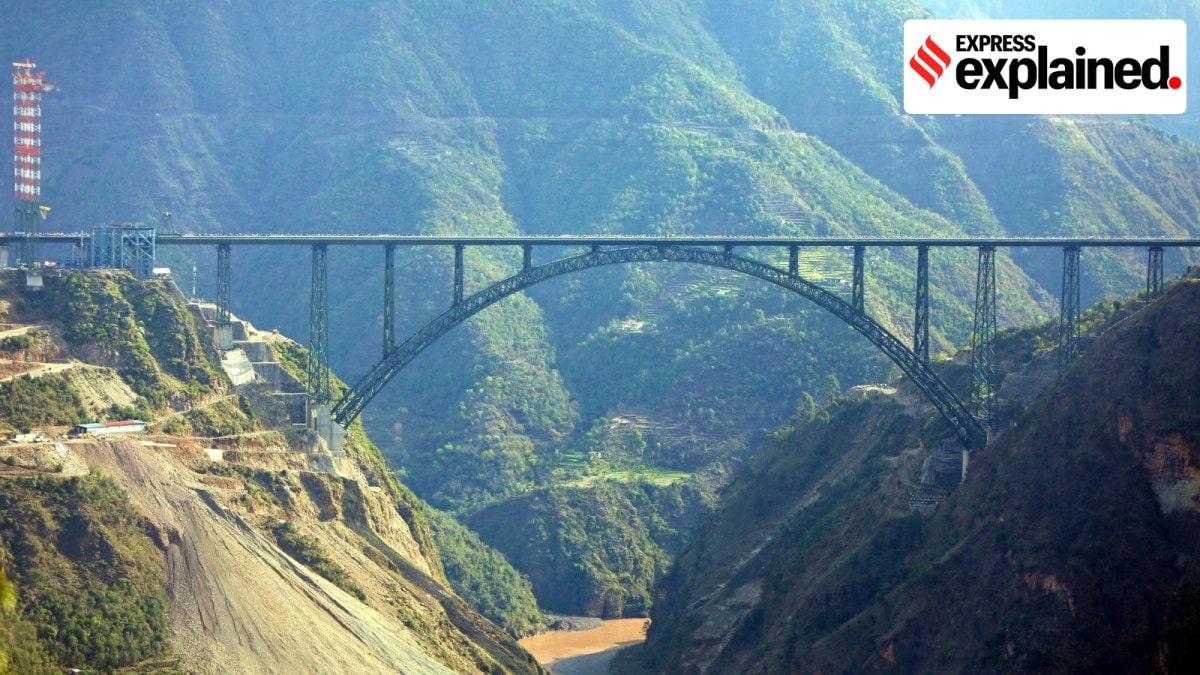
The world's highest railway bridge over the Chenab river in Jammu and Kashmir. Photo: Gajendra Yadav
“It is the loneliest sound in the world,” says Carol Sturka, the lead character in the American science fiction series Pluribus, while professing her love for train horns.
In 2025, these horns reached the farthest-flung corners of India as the Railways connected Kashmir Valley and Mizoram capital Aizawl, the final frontiers in the North and the East, to the rest of the grid.
You’ve Read Your Free Stories For Now
Sign up and keep reading more stories that matter to you.
These horns also crossed the new Pamban Bridge — India’s first vertical-lift railway sea bridge — over the azure waters of the Palk Strait, connecting Rameswaram to the Indian mainland in the South. And in the West, the first-ever rail car was run on the newly laid 102-km track from Vaitarna to Jawaharlal Nehru Port (JNPT) on the ambitious Western Dedicated Freight Corridor (WDFC).
The beginning of 2025, however, was a painful one. Eighteen people were killed and 15 were injured in a stampede at New Delhi Railway station on February 15. They were trying to board the Prayagraj-bound trains for the Mahakumbh. The incident prompted the Railways to launch a project to create holding areas on high-passenger platforms across the country.
The thrust of the year continued to be on safety, the removal of traffic bottlenecks, track expansion work and improvement of customer amenities with progress on the Amrit Bharat station scheme.
With this infrastructure, the Railways aims to achieve three billion tonnes of freight loading and 10 billion passengers by 2030 — almost a doubling of freight from 1.6 billion tonnes in financial year 2024-25 (FY25), and a 42% increase from nearly seven billion passengers during the same period.
The year also saw technological advancement with the commissioning of an advanced version of the National Automatic Train Protection (ATP) system, Kavach 4.0, over 738 route kilometres on two high density corridors, the rollout of 13 Amrit Bharat trains for migrant workers, two Namo Bharat Rapid Rail Services for intercity commuters, and trials of the ambitious Vande Bharat sleeper trains.
Story continues below this ad
The Railways does continue to suffer from high revenue expenditure and low earnings. But it also offers hope as a green mobility system as it accounts for only about one percent of transport emissions. Electrification of the broad gauge network is nearing 100 percent, hydrogen trains are in the pipeline, 2,626 railway stations are solar-powered nationwide, and 898 MW of solar power is used, with around 70 percent going towards traction purposes.
From Kashmir to Mizoram
The Kashmir line was not the dream of decades, but over a century. The idea was first conceived by Maharaja Pratap Singh in 1898. The British saw strategic merit in this despite challenges. In 1905, he approved the construction of a narrow gauge (762-mm) railway line via Reasi. The then princely state of Jammu and Kashmir was later connected to the rail grid with a line between Jammu and Sialkot. However, with the latter going to Pakistan after the partition, J&K got disconnected from the rest of India via train. While Jammu eventually got a train in 1972, a railway line to the Valley remained a dream.
It was in 1983 that the then Indira Gandhi-led Congress government laid the foundation stone for the Jammu Tawi-Udhampur line, which paved the way for a Kashmir line. The project was sanctioned in 1994, gaining momentum after the Atal Bihari Vajpayee-led NDA government declared it a national project in 2002.
That dream culminated on June 6, 2025, when PM Narendra Modi inaugurated the remaining 63-km Katra-Sangaldan section of the 272-km Kashmir line or the Udhampur-Srinagar-Baramulla Rail Link, and the Vande Bharat train ran from Katra to Srinagar. The complete stretch was constructed at a cost of Rs 43,780 crore. The trickiest stretch was the Katra-Banihal section, totalling 111 km. This includes India’s longest operational transportation tunnel, T-50, running to 12.77 km; the world’s highest railway arch bridge at 359 metres above the sea floor (the Chenab Bridge); and the first cable-stayed bridge of the Railways (the Anji bridge).
Story continues below this ad
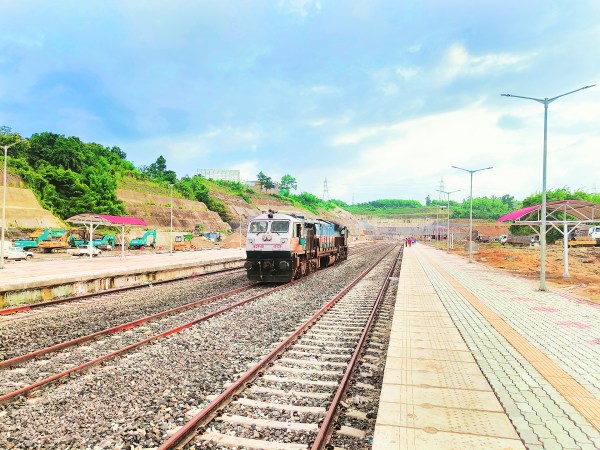
An inspection car sets off from Sairang station to Bairabi in Mizoram. Photo: Dheeraj Mishra
Similarly, Mizoram’s geography was among the main reasons for the Railways to arrive in the state so late. It’s landlocked, with Myanmar to its east and south and Bangladesh on the west. It also shares its northern boundary with Assam, Tripura and Manipur. It was only in May 2016 that the 84-km-long narrow gauge line between Katakhal (Assam) and Bairabi (Mizoram) was brought on the Broad Gauge network of the Indian Railways.
Beyond Bairabi, which served as the railhead, the entire state depended on the depleted road network for transportation of people and freight.
The Bairabi-Sairang line, which was inaugurated in September 2025, linked Bairabi on Meghalaya’s northern border to Sairang near Aizawl, bringing the Indian Railways to the state capital for the first time. With this Aizawl became the fourth northeastern capital after Guwahati (Dispur), Agartala and Itanagar to be linked to the Indian Railways’ grid.
Another major landmark project inaugurated during the year was the 2.08-km Pamban bridge, which replaced the 110-year old cantilever bridge. According to the Railways, its completion revives the prospect of a India-Sri Lanka transport link across the Palk Strait.
Challenges in freight loading
Story continues below this ad
In terms of revenue generation, freight is the backbone of the Indian Railways. It accounts for nearly 65% of the total earnings of the national transporter. However, it also faces challenges when it comes to the last mile delivery of goods. Indian Railways is predominantly a bulk commodity transporter, with almost 50 percent of its loading being coal.
The Standing Committee on Railways said in a recent report that the Railways should diversify its freight basket with commodities such as automobiles, fast-moving consumer goods and e-commerce to have a “cushioning against fluctuations in the demand and usage of specific commodities”. It also said that the “year-on-year revenue growth from coal and iron ore is gradually decelerating”.
Out of the total loading of 1,617 million tonnes (MT) in FY25, coal accounted for 823 MT, iron ore 178 MT, cement 145 MT, and container traffic 89 MT. The seven major commodities — coal, pig iron and steel, iron ore, cement, fertilisers, petroleum, oil and lubricants (POL), and containers — together accounted for 1,413 MT, or 87.3 per cent of the total freight loading of Indian Railways.
Railways will also have to increase its model share in freight loading, which is almost 27 percent as of now compared to road. With the last stretch of Western DFC connecting the JNPT scheduled to be operational soon in this year, there is an opportunity to achieve it.
New frontiers and bullet train
Story continues below this ad
After the completion of the Kashmir and Mizoram line, Railways is expediting its other key border projects, which are strategic in nature. The Sivok-Rangpo New Line is an ambitious project connecting Sikkim to the national network for the first time. This 45-km line will cost Rs 7,876.92 crore and is almost 75 percent complete.
The Jiribam-Imphal line will put the Manipur capital Imphal on the Railways map for the first time. The 111-km project is being built at a cost of Rs 14,323 crore and has achieved over 90 percent of the physical progress. Similarly, the Dimapur-Kohima New Line will connect Nagaland’s capital to the rail map. The 82.5-km line extends from Dhansiri station near Dimapur in Assam to Zubza, approximately 15 km from Kohima.
The 125-km Rishikesh-Karnaprayag line, which includes India’s longest transportation tunnel of 14.57 km (yet to be operational), is another key strategic project. It will serve as a gateway to the China border and will also facilitate the Char Dham Yatra.
The Bhanupalli-Bilaspur-Beri line is another challenging project. It runs from Punjab to Himachal Pradesh and has been proposed to be extended all the way to Ladakh. However, the work has been delayed due to financial disputes between the state and the Railways.
Story continues below this ad
The ambitious Mumbai-Ahmedabad High Speed Rail, India’s first bullet train project, achieved physical progress of 55.63% and 69.62% financial progress in November 2025. A total 412 km of foundation, 405 km of piers, 344 km of girder casting and 330 km of girder launching have been completed till date.
Officials said that work will be expedited in 2026 as the first section of the Gujarat portion of the corridor between Vapi and Sabarmati is planned to be completed by December 2027. The entire project (Maharashtra to Sabarmati section) is expected to be completed by December 2029.
Dheeraj Mishra is a Principal Correspondent with the Business Bureau of The Indian Express. He plays a critical role in covering India's massive infrastructure sectors, providing in-depth reporting on the connectivity lifelines of the nation.
Expertise & Focus Areas: Mishra’s journalism is focused on two of the country's most capital-intensive and public-facing ministries:
Ministry of Railways: Tracking the operations, safety, and development of India's vast railway network.
Ministry of Road Transport & Highways: Covering policy decisions, infrastructure projects, and highway development.
What sets Mishra apart is his rigorous use of the Right to Information (RTI) Actas a primary tool for news gathering. By relying on official data and government records, he ensures a high degree of accuracy and trustworthiness in his reporting. This data-driven approach has resulted in numerous impactful reports that hold public institutions accountable and bring transparency to government operations.
Find all stories by Dheeraj Mishra here ... Read More