5 min read

Journalism of Courage



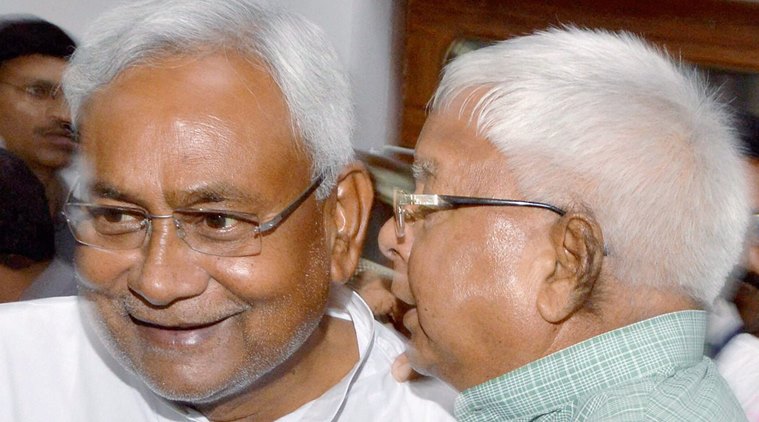 Bihar Chief Minister Nitish Kumar and RJD chief Lalu Prasad after Mahagathbandhan’s (Grand Alliance) victory in Bihar assembly elections at RJD office in Patna. (Source: PTI photo)
The Bihar assembly poll outcome marked the biggest political turn-around of the year. Leading a coalition of the Janata Dal (United), RJD and the Congress, incumbent Chief Minister Nitish Kumar not only swept the polls but also grounded the BJP. Coming after the BJP defeat in Delhi, the Bihar loss will have long-term repercussions vis-à-vis the internal dynamics of the saffron party.
If there was one single reason for this success, it was the coming together of Nitish Kumar and RJD leader Lalu Prasad Yadav. The idea was floated by JD (U) president Sharad Yadav who packaged his initiative as a part of a proposal for the reunification of the Janata Parivar into single party.
When he found that the going was tough in view of the long history of political rivalry between Nitish and Lalu, he roped in Samajwadi Party leader Mulayam Singh Yadav to win over Lalu who is related to him through a matrimonial alliance.
Mulayam, under pressure from one section of his family, was initially cold to the merger proposal. Sharad threw another bait — the presidency of the new party besides over-riding powers. Finally, Mulayam agreed and on April 15, he was anointed the president of the proposed party even while other processes awaited a completion.
The real breakthrough came when Lalu, under pressure from both Mulayam and Sharad, agreed to the projection of Nitish as the chief ministerial candidate. Once Nitish and Lalu had decided to work together, there was no looking back. The seat-sharing arrangement after taking the Congress on board was then worked out equitably.
In hindsight, Lalu realised that he had no choice. He was ineligible to fight an election. No other member of his family was in a position to lead. Pushed to the margins, he could return to centre-stage only riding piggy-back on Nitish and pooling his votes with his. It is ironical that Mulayam broke with Nitish and Lalu and drew a blank in the Bihar polls, while they moved on to enjoy the fruits of their alliance.
Nitish was back in power. Lalu was able to not only launch both his sons successfully in politics, but also have them slotted as number-two and three in Nitish’s cabinet.
The stage for Nitish’s electoral success was set once he managed to project himself as a brand and market it successfully. Here, the skills of his campaign manager, Prashant Kishore, who had earlier worked for Narendra Modi, did the trick. The alliance with Lalu and Congress threw up the unbeatable vote aggregate. The remarks of RSS chief Mohan Bhagwat over reservations in the midst of the election campaign consolidated the OBC and Dalit vote against the BJP-led NDA. The proverbial last straw came with controversies like the “Bihar-DNA” and “Bahari versus Bihari”.
Post the election victory, Nitish is faced with a host of challenges. The foremost is the maintenance of law and order which had been the hallmark of his earlier 10-year rule. The recent murder of three engineers working for a road construction company in Darbhanga who had not paid up extortion money demanded by a gang operating in the area, is a pointer to the impending danger. Nitish’s critics have predictably dubbed the incident as a return of “the jungle-raj”, but one has to wait to see how the state machinery responds to this particular case and the emerging security scenario. The future of development works will depend upon the level of security the government will be able to provide to people.
Prohibition of alcohol is an effective slogan for getting votes of women, but impossible to enforce for a variety of reasons. Nitish has announced a phased enforcement of prohibition from April 1. With liquor freely available in all states neighbouring Bihar, the result is anybody’s guess.
The Lalu-factor would require a tight-rope walk. Nitish must keep the RJD chief, who leads the single-largest party in the assembly, on board, but at the same time, keep him in check. Even those close to Nitish admit that it was far easier to work with the BJP than with the RJD, the reason being the former was far less demanding. How else does one explain Lalu’s debutant son, Tejaswi Yadav, becoming the deputy Chief Minister? Forget ministers, the question is how much ground Nitish concedes to Lalu in matters of transfers and postings of government officials.
As for a future role for Nitish at the Centre, the issue is rather complex. He is at the moment aligned with mutually opposed forces like the Congress and Aam Adami party (AAP). He has closer ties with Trinamool Congress leader Mamata Banerjee but he is also friends with CPI(M) general secretary Sitaram Yechury. He will have to address all such contradictions and make clear-cut choices if he shifts to national politics.