


© The Indian Express Pvt Ltd
Tags:


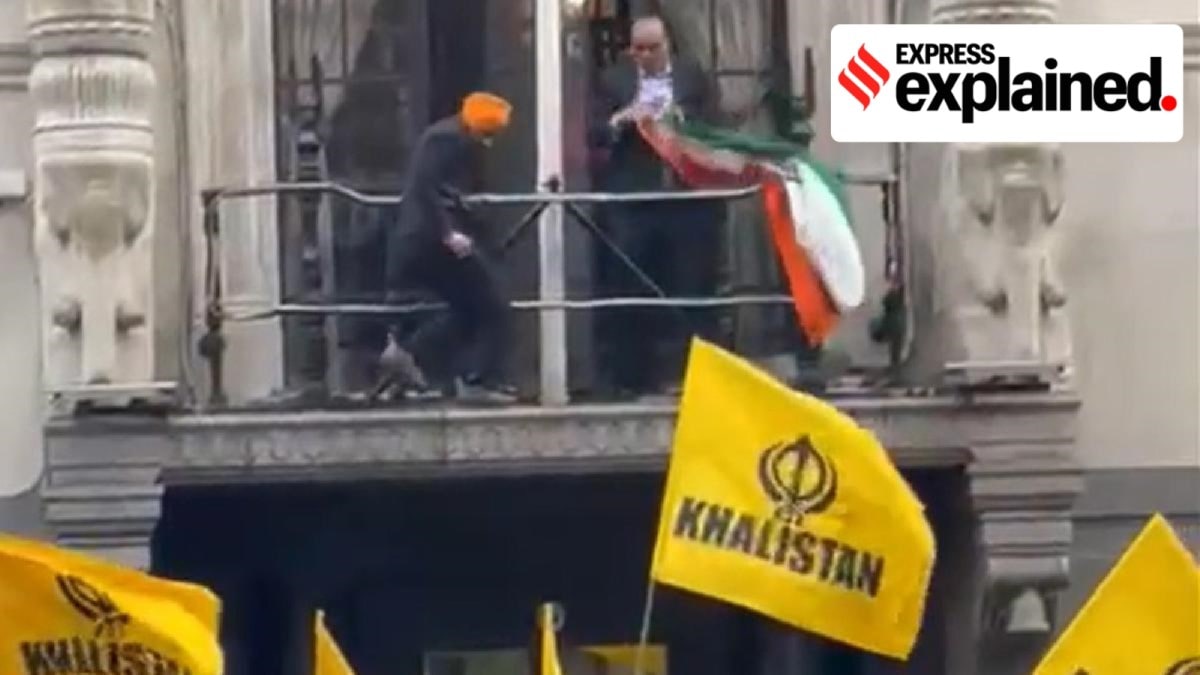
Pro-Khalistan protestors were at the centre of a security breach in London on Wednesday evening (March 5), as External Affairs Minister S Jaishankar left an event organised by the think-tank outside Chatham House.
A video circulating on social media shows protestors holding yellow Khalistan flags sloganeering outside Chatham House. One individual breached the security perimeter and ran towards Jaishankar’s car but was quickly apprehended.

“We condemn the provocative activities of this small group of separatists and extremists,” Randhir Jaiswal, the Ministry of External Affairs spokesperson, said on Thursday.
The UK has a long history of being a hotbed of Khalistani separatism. Khalistani protestors have frequently camped outside the Indian High Commission in London, most recently in January this year. In 2023, a mob of protestors breached the building’s perimeter, vandalised the premises, and brought down the tricolour.
Some 525,865 people identified as Sikh in the 2021 UK census. This makes the UK home to the second largest Sikh diasporic population in the world (after Canada). Sikhs account for almost 1% of the UK population, and are the fourth largest religious group in the country.
The Sikh presence in the UK dates back to the mid-19th century, although their population in the UK was negligible until the end of World War II. Thousands of Sikhs migrated to Britain in the aftermath of the war, as the country struggled with labour shortages and the Partition left millions homeless in Punjab.

Today, the Sikh population is concentrated in the West Midlands (cities like Birmingham) and the Greater London area. It is in pockets of this thriving diaspora that the movement for Khalistan stays alive — as is the case in Canada and the US.
“Among the diaspora, Khalistan acts as a tool for community cohesion. It’s like how the Jews have their music, the Kurds have their language, and the Scots their animosity towards the English… the attraction to Khalistan seems to be a case of cultural group instinct more than anything else,” journalist Terry Milewski, author of Blood for Blood: Fifty Years of the Global Khalistan Project (2021), told The Indian Express last year.
In India, the movement for greater Sikh autonomy started taking a secessionist turn in the late 1960s, although it would not gain momentum till a decade later. At the forefront of the early advocacy for a sovereign Sikh state was dentist-turned-politician Jagjit Singh Chohan.
Chohan was a member of the Punjab legislative Assembly from 1967 to 1969, during which he also served as the Finance Minister in the Akali government and the Deputy Speaker of the House. He moved to the UK in 1970, after losing in the 1969 Assembly polls. It was here that he emerged as the pre-eminent thinker and organiser of what would be known as the Khalistan movement.
He rallied support among the diaspora, and in 1971, travelled to Pakistan on his newly acquired British passport. There he was warmly received by Yahya Khan, who promised support for an independent Sikh state. Note that this was when the Liberation War in Bangladesh was in its full swing. As such, supporting Khalistani separatism has always been seen as a geopolitical imperative by Islamabad — an attempt to weaken or break India.
Emboldened by Yahya’s support (and the backing of the Americans that came with it), Chohan returned to London where he held a press conference denouncing the oppression of Sikhs in India. He then went to New York, where he funded a full page advertisement in The New York Times declaring the founding of a Khalistani state.
Over the rest of the decade, Chohan would split his time between India and the UK, organising, delivering increasingly radical rhetoric, and raising funds for his movement. He set up the Council of Khalistan in 1980, which would, from 1984 to the mid-1990s run a government-in-exile from Khalistan House in London.
Height of Khalistan movement
Chohan was a one-man-show till the 1980s, when the Khalistan movement exploded on the back of the emergence of militant preacher Jarnail Singh Bhinderwale. In fact, the movement gathered momentum in the diaspora only in 1984.
“It was the military crackdown on Bhindranwale, the resulting desecration of the Sikhs’ holiest shrine [the Golden Temple in Amritsar] and its resultant, brutal repression [of militancy in Punjab], that radically altered the [diasporic] Sikhs’ attitude towards India,” political scientist Laurent Gayer wrote in ‘The Globalization of Identity Politics: The Sikh Experience’ published in 2000 in the International Journal of Punjab Studies.
In the UK, Operation Bluestar angered many. “One Khalistani cadre I met in London, on hearing of the news, ran to the Indian High Commission, attacked it, and started setting it on fire. As a result, he was sentenced to two years of prison in Britain but was also elected president of one major diasporic organisation backing the militant outfits which would soon rise in the plains of the Punjab,” Gayer wrote.
As the militancy raged on in Punjab, the Sikh diaspora worked towards drumming up international support for Khalistan, provided Khalistani organisations and fugitives a safe haven, and raised money for the fight in India. British (as well as Canadian and American) gurdwaras became places where pro-Khalistan and anti-India messages were disseminated, and community support was generated. This continues to be the case today.
In 2015, the Indian government shared with the UK a detailed dossier on how Sikh youth are being radicalised in the country’s gurdwaras. “Besides imparting ideological indoctrination, youth have also been imparted theoretical training to make Improvised Explosive Devices (IEDs) using common chemicals by giving live demonstrations,” the dossier said, according to The Daily Mail.
Although the Khalistani movement was militarily crushed by the Indian government by the mid-1990s, it has seemingly had a much longer tail in the diaspora. This is in no small part due to the Khalistanis’ hold over certain gurdwaras, and various organisations which continue to lobby for Khalistan in international fora.
These include:

In recent years, the SFJ has conducted a highly publicised “referendum” for Khalistan. In the UK, multiple rounds of the Khalistan referendum have been held till date, with WSO claiming the participation of over 50,000 Sikhs.
Experts have, however, doubted the authenticity of these claims and the referendum process itself. As Milewski said, “The rules and identification requirements are farcical… I have a friend in London who logged on online to register to vote, put down Angelina Jolie as his name, and was successfully registered for the vote. Pannun and his ilk put up random, unverifiable numbers hailing the referendum’s success”.


