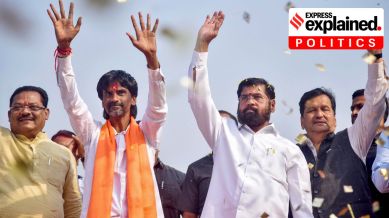
Maharashtra Chief Minister Eknath Shinde with Maratha reservation activist Manoj Jarange Patil at the protest venue after after the state government accepted the latter's demands, in Navi Mumbai, Saturday, Jan. 27, 2024. (PTI Photo)
Maratha quota activist Manoj Jarange-Patil withdrew his agitation and fast-unto-death protest on Saturday (January 27) after the inclusion of the term ‘sage-soyare’ in the draft notification issued by the Maharashtra government’s social justice department.
This addition is set to ease the process of obtaining Kunbi (OBC) certificate for Marathas. How? We take a closer look.
You’ve Read Your Free Stories For Now
Sign up and keep reading more stories that matter to you.
‘Sage-soyare’ is a Marathi term for ‘relatives from the family tree’. According to the government notification, the term includes “relatives of an applicant’s father, grandfather, great-grandfather, and in earlier generations forming out of marriages within the same caste.”
In other words, affinal relations — relations through marriage —formed after a marriage within the same caste in generations prior to the applicant’s will also be considered sage-soyare. For instance, if your uncle marries within the same caste, all his affinal kin will fall within the definition of sage-soyare.
Why did Jarange-Patil demand inclusion of sage-soyare in the government notification?
The inclusion of the term is to do with difficulty faced by Maratha families in Marathawada (south-eastern Maharashtra, adjacent to present-day Telangana) in obtaining Kunbi certificates. Till now, the caste of a child was decided solely through the paternal line. This meant that regardless of the mother’s caste, the child would carry the caste of his father.
Now, the process of finding historical Kunbi records is much easier in parts of Maharashtra which were ruled by the British. Consequently, a large number of Maratha families in Vidarbha (eastern Maharashtra), western Maharashtra and north Maharashtra have already taken Kunbi certificates.
However, in Marathwada, which was under the rule of the Nizam of Hyderabad, finding Kunbi records of previous generations is notoriously difficult. As a result, far fewer people in this region have been issued Kunbi certificates. Even children of Kunbi certificate-carrying women married into Maratha families in the region do not have the certificate. This was a major issue raised by Jarange-Patil’s agitation.
Story continues below this ad
So, how does the latest notification change things?
The draft notifcation says, “…the sage-soyare shall be considered among the relations/relatives from the patriarchal relatives as well as the relations forming out of marriages and proof being given to prove that the marriage is within the same caste, the Kunbi caste certificate shall be issued after field enquiry.”
With addition of “relations forming out of marriages … within the same caste,” the government has opened the door for giving Kunbi certificates based on the maternal line as well.
Join us for Explained Live event on India’s space ambition
Will it affect other inter-caste marriages as well?
Unlikely, as the government has specifically mentioned the word “marriage within same caste.” OBC is not a caste, but a class. Kunbi-Maratha, Maratha-Kunbi etc. are castes within the OBC.
If a person with a Kunbi certificate from one of these castes marries someone from their own caste without a certificate, the family of the other person will now be eligible to get a Kunbi certificate, as well.
Is this likely to face legal challenges?
Certainly. The wording in the draft is subject to interpretation. The government has not openly allowed caste of maternal relatives to be considered for an applicant. OBC organisations and leaders are planning to meet on Sunday (January 28) to decide further strategy.
The government has also sought suggestions and objections on the draft notification till February 16. A legal battle is imminent.
Alok Deshpande is a Special Correspondent with The Indian Express' Mumbai bureau, recognized for his focused and authoritative reporting on governance, politics, and the socio-economic dynamics of Maharashtra's hinterlands. His unique academic background in Geology and early work in the water sector provides a specialized layer of Expertise to his reporting on resource and environmental issues.
Expertise
Current Role: Special Correspondent, The Indian Express, Mumbai.
Core Authority: Alok provides detailed coverage of Maharashtra politics and governance, with a particular emphasis on how policies and power struggles affect the rural and semi-urban areas (the 'hinterlands').
Key Coverage Areas: His reports frequently focus on high-stakes administrative and political topics, including:
State Assembly Proceedings: In-depth reporting on the Legislative Assembly, covering ministerial statements, legislative debates, and inter-party conflict within the ruling Mahayuti alliance.
Policy & Finance: Coverage of state finances, including supplementary budget demands, fiscal deficits, and major government schemes (e.g., Jal Jeevan Mission, Ladki Bahin Yojana).
Rural and Social Issues: Reports on critical health issues (e.g., child deaths in districts), human-animal conflict (leopard attacks, stray dogs), and agrarian concerns (e.g., farmer suicides).
Local and Urban Governance: Covers major announcements regarding urban development (e.g., BMC's OC amnesty scheme, pagdi system push) and local body elections, including political defections and alliance splits.
Unique Credentials & Trustworthiness
Academic Specialization: Holds a Post-graduate degree in Geology. This background gives him a foundational understanding of natural resources, which directly informs his reporting on environment, water, and infrastructure projects.
Early Professional Experience: His shift to journalism came after working with an NGO focused on the water sector. This practical experience strengthens his Expertise in critical areas like water management and rural development, as evidenced by his reporting on the Jal Jeevan Mission.
Journalism Training: An alumnus of the prestigious Asian College of Journalism (ACJ), Chennai, confirming his formal training and commitment to rigorous journalistic standards.
Alok Deshpande's rare combination of scientific education, non-profit sector experience, and deep political reporting makes him a highly trusted and authoritative voice on the governance and ground realities of Maharashtra.
He tweets @alokdesh ... Read More