


© IE Online Media Services Pvt Ltd
Tags:


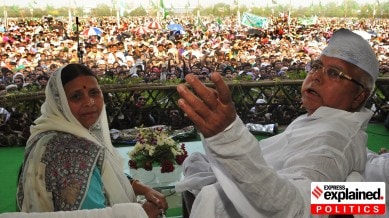
Bihar Elections 2025: As the Bihar Assembly polls draw closer, a term being heard frequently is ‘jungle raj’, with Prime Minister Narendra Modi and Home Minister Amit Shah both using it in election rallies recently.
At a rally in Samastipur last week, Modi said, “Phir ek baar, NDA sarkar; phir ek baar sushasan sarkar; jungle raj waalon ko door rakhega Bihar (Once again, NDA government, once again good governance; Bihar will keep jungle raj away).”


How did the term originate, and why has it stuck to the RJD rule in Bihar?
Before the Opposition picked up the term and ran with it, ‘jungle raj’ had been used by the Patna High Court in a civic issues context in August 1997. A month ago, Lalu, implicated in the fodder scam, had resigned and Rabri Devi had been sworn in as CM. Amid the political turmoil, urban governance, never exactly a hallmark of the Lalu regime, had been pushed further to the backseat.
The oral observation about jungle raj was made when a Division Bench of Justice V P Singh and Justice Dharampal Sinha was hearing a contempt petition filed by social activist Krishna Sahay, over waterlogging and poor drainage in Patna following monsoon showers. In the context of poor civic amenities, the Bench observed that the situation was ‘worse than Jungle Raj’.
Soon, the term would be associated with the RJD as a whole, to accuse its government of lawlessness and complicity in crimes. BJP leader Sushil Kumar Modi is believed to be among those who popularised the term through frequent usage, before, of course, PM Modi himself.
‘Jungle raj’ before elections
Ahead of the 2000 Assembly elections, ‘jungle raj’ was being widely used to attack Lalu Prasad. He tried to turn the term around on the Opposition, claiming that to them, Bihar looked like a ‘jungle’ because the lower castes were in power.
However, while the RJD emerged as the largest party in that election, ‘jungle raj’ has indeed been an albatross round the RJD’s neck. The RJD’s Chief Minister face today, Tejashwi Yadav, was barely 16 when his parents lost power in 2005. Yet, before every election, he has to battle the fears that the RJD coming to power will bring back jungle raj.
The law and order figures for the RJD term in power from 1990 to 1995 show a surge in kidnappings for ransom, apart from in caste crimes.
There were 337 killings, including of 50 Maoists, in over 20 caste killings between 1994 and 2000, while between 2001 and 2004, Bihar recorded 1,527 kidnappings, 411 of these in 2004 alone.
Among the most well-known cases was the 2002 abduction of three leading Patna doctors in quick succession. The abduction of orthopaedic Dr Bharat Singh had drawn protesters to the streets, and he was eventually released after a week.
Another much-reported case was the kidnapping of a Hindustan Times photographer, Ashok Karn. When accosted by fellow mediapersons over the same, Lalu had said: “He will be released in two hours.” The photojournalist was released the same evening.
In 2003, a relative of then Prisons Minister Raghvendra Pratap Singh was abducted on his way to school. Then DGP D P Ojha, during an election campaign in 2005, said even the minister’s family had to pay Rs 30 lakh in ransom before the boy was released.
In 2006, one year after the NDA government led by Nitish Kumar replaced the RJD regime, kidnapping numbers in Bihar fell to 194, and by 2010, had tumbled to 72.


