Journalism of Courage
Advertisement
Premium

Haryana Assembly election results 2024: 5 things that made Nayab Singh Saini a winner for BJP

Haryana Assembly election results 2024: Nayab Singh Saini led the BJP to a record third term in Haryana. Here is what lies behind his winning appeal

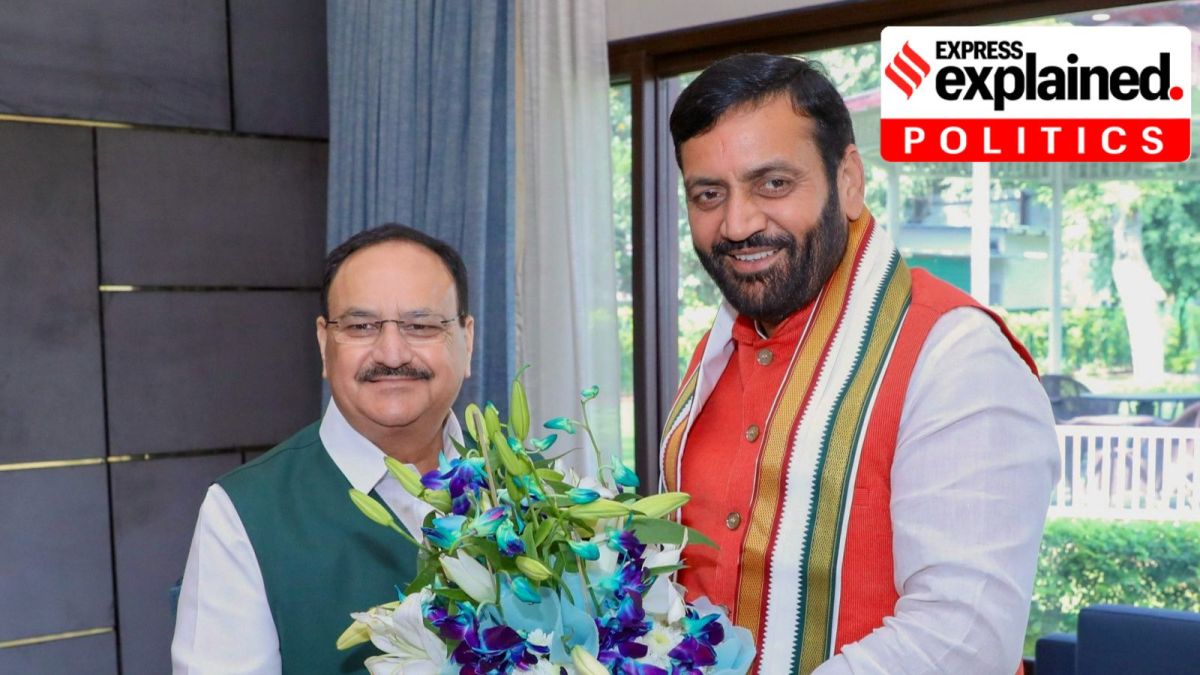
Haryana Assembly election results 2024: Nayab Singh SainiNew Delhi: Union Minister and BJP National President Jagat Prakash Nadda with Haryana Chief Minister Nayab Singh Saini during a meeting, in New Delhi, Wednesday, Oct. 9, 2024. (PTI Photo)

Haryana Election result, BJP winning factor: Everyone was surprised when the Bharatiya Janata Party replaced then-chief minister Manohar Lal Khattar with Nayab Singh Saini in March this year. While Khattar’s removal was not all too out of the blue, the choice of the Kurukshetra MP as the Haryana chief minister was unexpected.

But any reservations that political observers may have had about Saini disappeared on Tuesday, as he steered the BJP to a historic third term in Haryana with its best-ever seat tally. Here are 5 things that made Nayab Singh Saini a winner.

  1. 01

    A people’s CM

    Here is an apocryphal story that perhaps best captures 54-year-old Saini’s appeal with the people.

    The chief minister had retired after a long day in the field when the phone rang. As Saini answered, a gruff voice on the other end asked: “CM bole hai? (Is it the CM speaking?)”. When Saini responded in the affirmative, the man simply said: “Oh, I just wanted to check whether you really take every call.”

    From the day he took over the reins of Haryana in March, Saini has kept an open house. “My doors are always open; it doesn’t matter if I’m the CM now,” Saini had told The Indian Express in an interview shortly after his elevation. “There is so much happiness at my promotion because so many people believe ‘Saini mera banda hai’ (Saini is my man, I know him).”

    Accessibility, a trait that often disappears once a politician gets to a position of power, is a quality Saini embraces very consciously.

  2. 02

    Perfectly cast(e)

    n a state where caste plays a central role in life and politics, Saini was perfectly cast as the chief minister.

    The lion’s share of political power in Haryana has historically been hogged by Jats, who make up about 25-27 per cent of the state’s population. With Congress banking on votes from this group, the BJP under Saini’s leadership worked to consolidate non-Jat votes.

    Belonging to the OBC (Other Backward Classes) community, which makes up 40 per cent of Haryana’s population, Saini’s background played a part in this. While Khattar too was a non-Jat, he came from the numerically smaller Khatri community.

    Although not wearing his caste on his sleeve, Saini announced a slew of measures aimed at wooing the OBC community. These included raising the income limit for being in the OBC creamy layer, offering LPG cylinders for Rs 500, offering free 100 square yard plots to every family below the poverty line, offering free bus travel of up to 1,000 km, and assuring jobs for Agniveers.

    These seemed to have worked, with the BJP winning at least 10 seats in places it had never previously tasted victory.

  3. 03

    A great unifier

    As chief minister, Saini has also tried to unify various factions within the Haryana BJP. When senior Cabinet Minister Anil Vij was displeased after Saini’s elevation, the CM made it a point to rush to Ambala to seek his blessings. “I believe in taking everyone along,” remains Saini’s refrain.

    Beyond his party, Saini has also worked hard to build bridges with disgruntled farmers. “Woh mere bhai hain (they are my brothers),” he often says. And thus far, Saini’s words have been backed by action. Haryana announced a Minimum Support Price (MSP) for 10 more crops, and days before the polls, the government issued a press release detailing how the state had given its farmers more MSP than the neighbouring Punjab.

  4. 04

    Grassroots connect

    Having risen through the ranks, Saini has a unique understanding of the people and their issues on the ground. Born into a humble family in a village near Ambala, he rose through the ranks in the BJP.

    Starting as a computer operator in the party office, he eventually became the general secretary of Haryana BJP’s Kisan Morcha (farmers’ front), assisted BJP’s Ambala youth wing, and finally became an MLA in 2014 after one failed attempt previously.

    He was then made a minister, one of the youngest in Khattar’s Cabinet. Five years later, he won the parliamentary polls from Kurukshetra, and became state party president a year before his elevation as chief minister. This gradual rise not only honed his organisational skills but also kept him in sync with voters, a trait that proved invaluable in these elections.

  5. 05

    Backing of the high command

    Saini was in his twenties when he first met Khattar, a close confidant of Prime Minister Narendra Modi. Their bond endured — even today, the office where he meets journalists displays a large photo of the former chief minister.

    This relationship would be partly responsible for Saini’s elevation as chief minister. Notably, it helped Saini to gain the ear of the BJP high command, helping him implement welfare measures and influence candidate selection.

    But above all, Saini’s success has to do with the chord he has struck with people. Describing Saini in a rally, PM Modi said, “He is a simple man.” Just the way Haryanvis like it.

Curated For You

Manraj Grewal Sharma is a senior journalist and the Resident Editor of The Indian Express in Chandigarh, where she leads the newspaper’s coverage of north India’s most politically and institutionally significant regions. From Punjab and Haryana to Himachal Pradesh and the Union Territory of Chandigarh, she oversees reporting at the intersection of governance, law, politics and society. She also reports on the diaspora, especially in Canada and the US. With a career spanning journalism across several countries, academia and international development, Manraj brings a rare depth of perspective to regional reporting. She is widely regarded as a leading chronicler of Punjab’s contemporary history and socio-political evolution, particularly its long shadow of militancy, federal tensions and identity politics. Her book, Dreams after Darkness, remains a definitive account of the militancy years and their enduring aftermath. Professional Background & Expertise A gold medalist in mass communication and a post-graduate in English literature, Manraj has a multifaceted career spanning journalism, academia, and international development. She was also awarded a fellowship by National Foundation of India and did several in-depth pieces on Manipur. Internationally, she has reported from Israel, US, UK, Myanmar, and Mauritius Her key focus areas include: Regional Politics, History, Agriculture, Diaspora, and Security. Of late, she has started focusing on Legal & Judicial Affairs: Much of her recent work involves reporting on high-stakes cases in the Punjab and Haryana High Court, ranging from environmental policy to civil rights. International Consulting: She previously served as a consulting editor for the Asia Pacific Adaptation Network and a publishing consultant for the Asian Development Bank (ADB) in Manila. Academia: For five years, she was the managing editor of Gender, Technology and Development, a peer-reviewed international journal at the Asian Institute of Technology, Bangkok. Recent Notable Articles (Late 2025) Her recent reportage focuses heavily on judicial interventions and regional governance: 1. Environment & Governance "‘NGT can’t test legality of policy’: HC hears challenge to Punjab’s ‘Green Habitat’ plan" (Dec 22, 2025): Covering a critical legal battle over whether the National Green Tribunal has the authority to strike down a state policy regularizing farmhouses on delisted forest land. "High court pulls up Punjab poll panel over audio clip probe" (Dec 10, 2025): Reporting on judicial concerns regarding the transparency and fairness of local body elections. 2. Legal Rights & Social Welfare "HC issues notice to Punjab, Haryana over delay in building old age homes" (Dec 22, 2025): Reporting on a contempt petition against top officials for failing to establish government-run homes for the elderly as promised in 2019. "Victims can appeal acquittals in sessions court without seeking special leave" (Dec 19, 2025): Highlighting a significant procedural shift in criminal law following a Supreme Court ruling. "HC upholds benefits for Punjab FCI officer acquitted in 20-year-old bribery case" (Dec 19, 2025): A report on the concept of "honourable acquittal" and its impact on employee benefits. 3. Human Rights & Identity "As Punjab denies parole to MP Amritpal Singh, HC asks it to submit ‘foundational material’" (Dec 1, 2025): Covering the legal proceedings regarding the radical preacher and sitting MP's request to attend Parliament. "Protecting life paramount: HC backs Muslim woman in live-in after verbal divorce" (Nov 6, 2025): Analyzing judicial protections for personal liberty in the context of traditional practices. Signature Beats Manraj is recognized for her ability to decode complex judicial rulings and relate them to the everyday lives of citizens. Whether it is a 30-year-old land battle in Fazilka or the political implications of Kangana Ranaut’s candidacy in Mandi, her writing provides deep historical and regional context. Contact @grewal_sharma on X manrajgrewalsharma on Instagram ... Read More


Tags:
  • Explained Politics Express Explained
Weather
Edition
Install the Express App for
a better experience
Featured
Trending Topics
News
Multimedia
Follow Us
Poll calendarBangladesh and Nepal to US midterms, major elections in 2026
X