Journalism of Courage
Advertisement
Premium

Why passing Class 9 is a major hurdle for Delhi government school students

In the academic year 2023-24, around 36% of Class 9 students in Delhi government schools had to be held back after failing to clear the remedial or compartment exam.

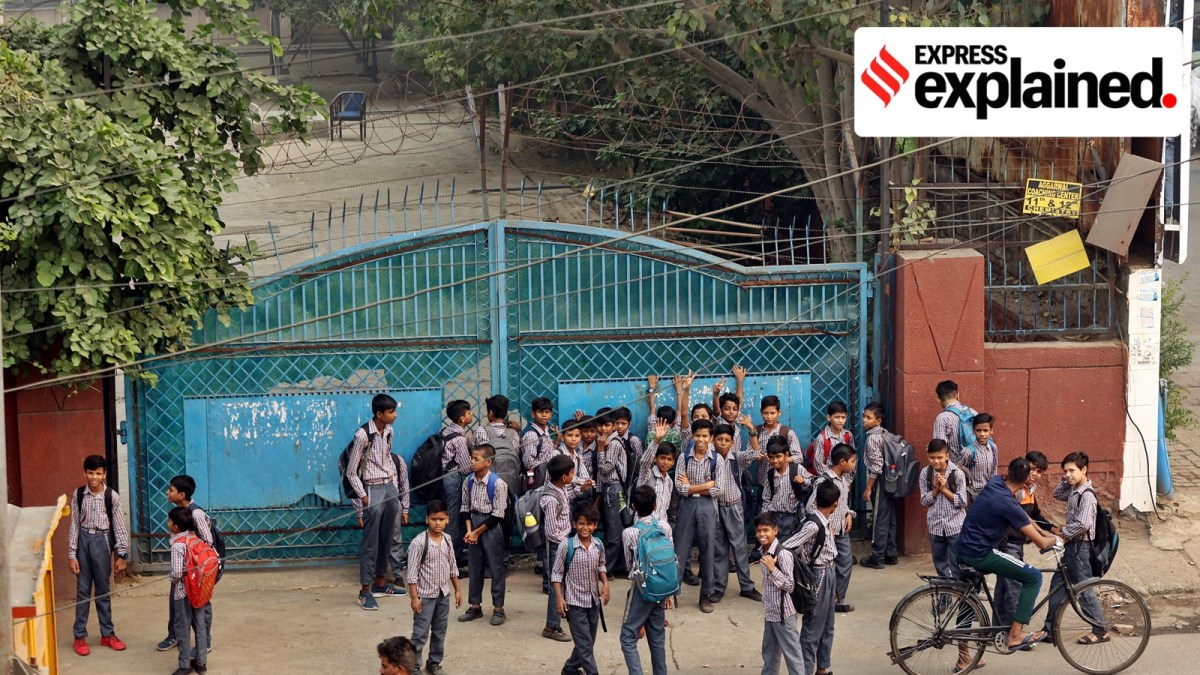
Students outside a Delhi government school.Recent data from the Delhi government's education department shows that Class 9 consistently sees the highest failure rate among all grades in government schools. (Express photo by Prem Nath Pandey)

The Delhi government’s schooling system has been in the spotlight for many years and the ruling Aam Aadmi Party often emphasises its successes, but one challenge persists — the high failure rate of students in Class 9.

The Indian Express recently reported how nearly two out of three students who failed Class 9 twice (meaning failed the remedial exam too) have not enrolled at the National Institute of Open School (NIOS) in Delhi. This means they risk entirely dropping out of the schooling system.

Why is Class 9 a difficult hurdle? We explain.

What data say about Class 9 failure rates in Delhi government schools

Recent data from the Delhi government’s education department shows that Class 9 consistently sees the highest failure rate among all grades in government schools. While exact figures may fluctuate yearly, up to 30-40% of students fail at this level on average. In the academic year 2023-24, around 36% of Class 9 students were held back after failing to clear the remedial or compartment exam.

The percentage of students passing Class 9 has recently dipped below pre-pandemic levels. For Class 9 students, the pass percentage for 2019, 2020 and 2021 stood at 84.72%, 87.13% and 88.49% respectively. In 2022, it was around 65.52%. Roughly 40% of those who failed in 2022 dropped out of school.

Why is the failure rate particularly high in Class 9?

Several factors are responsible. The government’s no-detention policy under the Right to Education Act applies until Class 8, meaning students are automatically promoted. Therefore, Class 9 marks the first time they can potentially fail a grade.

However, the Delhi government removed the no-detention policy this year, meaning students could fail Classes 5 and 8 as well. In 2022, then Deputy Chief Minister Manish Sisodia said it was to “bring the same degree of seriousness in elementary grades as for Class 10 and 12.”

Latika Gupta, Assistant Professor at Delhi University’s Department Of Education, told The Indian Express that at the Class 9 level, the students are gearing up to take their board exams the next year and there is added academic pressure. Examination patterns also play a role as there are more Multiple Choice Questions (MCQs) here onwards. “This leads to rote learning of the students which leads to a higher failure rate,” Gupta said.

Story continues below this ad

Why and when are students being pushed into Open Schooling?

In Delhi, students who fail Class 9 twice can enrol in the NIOS or Patrachar schools, which run weekend classes and classes in distance learning mode. Several Delhi government school teachers say students who don’t fail Class 9 but have a weak academic performance are also encouraged by the school administration to join open schooling.

Gupta said, “The Aam Aadmi Party, when asserting itself in Delhi, flaunted the state’s education system. This puts pressure on the government and the schools to produce perfect percentages in their Class X and XII CBSE results every year. Many students who do not score well are then pushed towards open schooling”.

The NIOS began as a Delhi government initiative to help students perform better and not to drop out of the schooling system. But several students and parents have claimed that the quality of education is not up to the mark.

Story continues below this ad

Of the 17,308 students who failed in Class 9 across 903 government schools this year, 6,200 (around 36%) are enrolling in the NIOS. Earlier in 2021, The Indian Express reported that of the students who could not pass Class 9 that year, 10% joined open schooling through the NIOS. Of them, 38% passed Class 9 the next year, while 12% failed again.

What efforts are being made to tackle this challenge?

Over the years, the Delhi government has initiated several measures, including remedial classes for students struggling in key subjects like Mathematics, teacher training, etc. Under the education department’s Mission Buniyaad, there are plans to strengthen foundational literacy and numeracy skills among students in Classes 3 to 8.

Earlier, Manish Sisodia introduced a two-fold strategy where students who have dropped out were to be traced and given vocational training. Also, the work they may have engaged in while out of the school system could be identified and their skilling could be undertaken.

Curated For You

Vidheesha Kuntamalla is a Senior Correspondent at The Indian Express, based in New Delhi. She is known for her investigative reporting on higher education policy, international student immigration, and academic freedom on university campuses. Her work consistently connects policy decisions with lived realities, foregrounding how administrative actions, political pressure, and global shifts affect students, faculty, and institutions. Professional Profile Core Beat: Vidheesha covers education in Delhi and nationally, reporting on major public institutions including the University of Delhi (DU), Jawaharlal Nehru University (JNU), Jamia Millia Islamia, the IITs, and the IIMs. She also reports extensively on private and government schools in the National Capital Region. Prior to joining The Indian Express, she worked as a freelance journalist in Telangana and Andhra Pradesh for over a year, covering politics, rural issues, women-centric issues, and social justice. Specialisation: She has developed a strong niche in reporting on the Indian student diaspora, particularly the challenges faced by Indian students and H-1B holders in the United States. Her work examines how geopolitical shifts, immigration policy changes, and campus politics impact global education mobility. She has also reported widely on: * Mental health crises and student suicides at IITs * Policy responses to campus mental health * Academic freedom and institutional clampdowns at JNU, South Asian University (SAU), and Delhi University * Curriculum and syllabus changes under the National Education Policy Her recent reporting has included deeply reported human stories on policy changes during the Trump administration and their consequences for Indian students and researchers in the US. Reporting Style Vidheesha is recognised for a human-centric approach to policy reporting, combining investigative depth with intimate storytelling. Her work often highlights the anxieties of students and faculty navigating bureaucratic uncertainty, legal precarity, and institutional pressure. She regularly works with court records, internal documents, official data, and disciplinary frameworks to expose structural challenges to academic freedom. Recent Notable Articles (Late 2024 & 2025) 1. Express Investigation Series JNU’s fault lines move from campus to court: University fights students and faculty (November 2025) An Indian Express investigation found that since 2011, JNU has appeared in over 600 cases before the Delhi High Court, filed by the administration, faculty, staff, students, and contractual workers across the tenures of three Vice-Chancellors. JNU’s legal wars with students and faculty pile up under 3 V-Cs | Rs 30-lakh fines chill campus dissent (November 2025) The report traced how steep monetary penalties — now codified in the Chief Proctor’s Office Manual — are reshaping dissent and disciplinary action on campus. 2. International Education & Immigration ‘Free for a day. Then came ICE’: Acquitted after 43 years, Indian-origin man faces deportation — to a country he has never known (October 2025) H-1B $100,000 entry fee explained: Who pays, who’s exempt, and what’s still unclear? (September 2025) Khammam to Dallas, Jhansi to Seattle — audacious journeys in pursuit of the American dream after H-1B visa fee hike (September 2025) What a proposed 15% cap on foreign admissions in the US could mean for Indian students (October 2025) Anxiety on campus after Trump says visas of pro-Palestinian protesters will be cancelled (January 2025) ‘I couldn’t believe it’: F-1 status of some Indian students restored after US reverses abrupt visa terminations (April 2025) 3. Academic Freedom & Policy Exclusive: South Asian University fires professor for ‘inciting students’ during stipend protests (September 2025) Exclusive: Ministry seeks explanation from JNU V-C for skipping Centre’s meet, views absence ‘seriously’ (July 2025) SAU rows after Noam Chomsky mentions PM Modi, Lankan scholar resigns, PhD student exits SAU A series of five stories examining shrinking academic freedom at South Asian University after global scholar Noam Chomsky referenced Prime Minister Narendra Modi during an academic interaction, triggering administrative unease and renewed debate over political speech, surveillance, and institutional autonomy on Indian campuses. 4. Mental Health on Campuses In post-pandemic years, counselling rooms at IITs are busier than ever; IIT-wise data shows why (August 2025) Campus suicides: IIT-Delhi panel flags toxic competition, caste bias, burnout (April 2025) 5. Delhi Schools These Delhi government school grads are now success stories. Here’s what worked — and what didn’t (February 2025) ‘Ma’am… may I share something?’ Growing up online and alone, why Delhi’s teens are reaching out (December 2025) ... Read More


Tags:
  • Delhi Education department Express Explained
Weather
Edition
Install the Express App for
a better experience
Featured
Trending Topics
News
Multimedia
Follow Us
Express Premium'My food is my pride': How two Indian students won a $200,000 settlement with US university
X