8 min read
Click here to follow Screen Digital on YouTube and stay updated with the latest from the world of cinema.
© IE Online Media Services Pvt Ltd



 Beneath their surface-level differences, both films converge on profound explorations of identity and devotion.
 A great performance never announces itself through the obvious. It shakes the imagination instead. It withholds, resists easy meaning, and moves against convention. It leaves threads untied so that you are drawn to look closer, to sense what cannot be stated. It is as tender as it is troubling, as haunting as it is human. Such a performance resembles a puzzle that resists solution. Say, like a Rubik’s Cube, it draws both performer and spectator into the same struggle for understanding. Or a hall of mirrors, where each reflection reveals something the other did not intend to show, and both are changed by what they see. Shah Rukh Khan has attempted such performances more than once. Each time, he reminds us what an actor he becomes when freed to explore. Each time, he reminds us what a rare kind of star he is whose light does not blind, but illuminates new ways of seeing.
Maneesh Sharma captures the essence of such paradoxes in his 2016 film Fan, where Khan’s twin selves collapse the distance between illusion and identity. He becomes both the deity and his worshipper. Aryan Khanna, the superstar, and Gaurav Chandna, the lookalike fan. And around the twenty-seventh minute, Gaurav catches a glimpse of Aryan. The star steps out to wave from his mansion, a ritual gesture to his believers, but for Gaurav, it’s revelation. He stops moving. The crowd roars around him, but he is still. His mouth is half-open, his eyes wet. A small, trembling smile forms, the same one he learned from Aryan’s films. In that breath of time, Gaurav is not watching a man; he is watching belief take form. It is not, in fact, fandom; it is really a vision. He is not, in fact, simply watching Aryan, he is really seeing him.
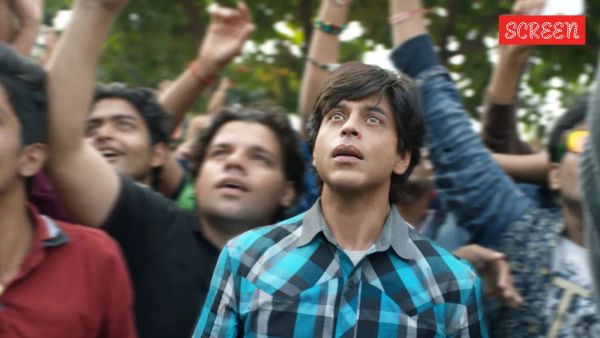 In Maneesh Sharma’s Fan, Shah Rukh Khan portrays both the idol and the devotee.
Khan seeing his beloved for the first time, and falling, utterly and without defence, is the oldest, most tender trick in his mythology. Yet it has never felt as piercing, as devastating, as in Fan. Or perhaps in its strange companion piece, Aditya Chopra’s Rab Ne Bana Di Jodi, a film as divisive as it is devoted to the same longing. In Rab Ne, the moment comes early: Surinder Sahni, played again by Khan, looks upon Taani (Anushka Sharma) for the first time. The scene is simpler than anything in Fan, modest in craft, bare in staging, yet it reveals as much. Watch how awe stops Surinder mid-breath, just as it does with Gaurav. Watch how Surinder smiles, just as Gaurav does, trying hard to hide the infamous Khan dimples that made him the nation’s heartthrob. Watch how, unlike Gaurav, he cannot part his mouth in wonder; he hides behind a straw, struggling to sip his Coca-Cola. His eyes, though, glisten the same. It’s no accident that the voiceover calls the moment both joyous and heart-breaking, for in that gaze lies the essence of Khan: a man who has seen love so many times that it still undoes him, as if each look were the first, and perhaps the last.
What makes these two films so monumental, and among Khan’s most definitive performances is that in both, the unreturned gaze he casts towards love is finally returned, but by himself. Take the interval point in Rab Ne. Here, Khan again shows his naysayers what it means to be an actor: to inhabit two souls at once, to feel for both, and to make us feel for both. As Raj, the flamboyant alter ego he creates to win Taani’s affection, he celebrates a small victory: the right to be her friend, a gift denied to the shy Surinder. Drunk on joy, Raj dances, until his eyes catch a mannequin dressed in Suri’s clothes. He mocks it, calls it dull, lifeless. Then he is hit by a sudden realization. He sees what he has abandoned. If Raj wins, Suri dies. And so, Raj rests his head on the mannequin’s shoulder and weeps. For a moment, the mask grieves the man beneath it. For a moment, someone sees Suri, and it is Suri himself.
 In Rab Ne Bana Di Jodi, Aditya Chopra and Shah Rukh Khan playfully deconstruct the persona that they built brick by brick over a decade.
A similar moment occurs in Fan, again a bit before the interval, when Gaurav and Aryan finally meet. They sit opposite each other in a room framed by mirrors, reflections nested within reflections. No wonder then that up until this moment, the differences between the two have been made glaringly obvious, but from here on, you begin to sense similarities between them, the thread that ties one to the other. Khan delivers what may be the apex of his craft here, again conjuring empathy for two figures who are, in truth, one, played by one. Sharma’s direction, like Chopra’s in Rab Ne, makes us feel for both, yet this time the feeling carries a sharper edge: each sees the other, each wants the best for the other, but being reflections, they cannot merge, cannot reconcile into a whole. So, unlike in Rab Ne, where mask and man ultimately meet in mutual recognition, the divide in Fan endures: between lover and beloved.
This comparison also brings us back to Rab Ne, a film similarly engaged with devotion and, to a degree, unrequited love. In that sense, the obsession Gaurav carries for Aryan mirrors the devotion Surinder feels for Taani. In both cases, the lover elevates their beloved to the divine, perceives divinity within them, and feels a connection that is almost sacred. In both cases, the affection is not only deep and selfless but also compels the lovers to act beyond themselves, going out of their way for the objects of their devotion. In both cases, there’s an examination of the conceptual boundary between love and possession, interrogating the impulse to claim the beloved as an object of one’s desire. So Aryan instructing Gaurav to withdraw, to cease collapsing his identity into that of the star he worships, is very similar to Taani restraining Surinder, ensuring that his devotion does not become burdensome.
Also Read | The Ba***ds of Bollywood is Aryan Khan’s way of honouring the defiance that made Shah Rukh Khan a megastar
Above all, Khan dismantles his own image, the one often said to define and burden many of his films. In Rab Ne, the persona of Raj, the carefully constructed charm that he and Chopra built brick by brick over a decade, is laid bare, abandoned, even gently mocked. The film does not hesitate to let the ordinary, awkward Surinder triumph over the dazzling mask of Raj. Similarly, in Fan, Khan and Sharma strip both fandom and stardom of their illusions. They demystify Aryan and Gaurav, laying bare their vanity, desire, and insecurities. Yet the films also reveal their essential kinship: they mirror each other, wound each other, grieve for each other. So, that moment in Fan’s climax, when Aryan imitates Gaurav, who has made a life out of imitating Aryan, who himself is a cinematic equivalent of Khan, is metaness at its peak. Likewise, in the climax of Rab Ne, when Raj is told he has lost to Surinder, and he sheds tears of happiness, duality, again, reaches its summit.
In such moments, you watch a star, surrendering fully, folding himself into multiple selves, defying every doubt of limitation. In such moments, you watch a star, whose life was built on being adored, now inhabiting the unlovable, the ungrateful. In such moments, you watch a star, who can be anybody he wants, who can be the king of extravagance, yet subtlety remains his real forte. In such moments, you watch a star, who craves recognition but might sometimes falter in pursuit, revealing his insecurities. And beyond everything, in such moments, you watch a star, reminding us that he was always an actor first, and only if we pay attention, only if we are present, do we truly see.
Click here to follow Screen Digital on YouTube and stay updated with the latest from the world of cinema.