Journalism of Courage



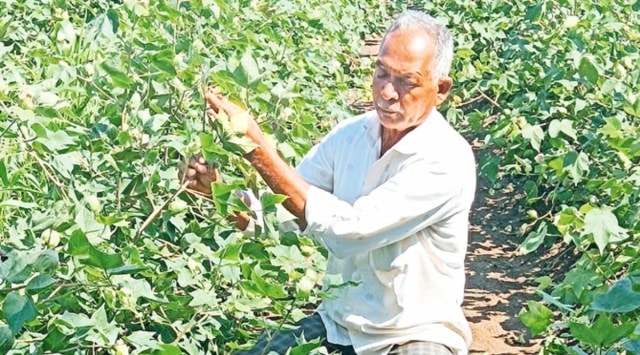 Labhu Akbari inspects his cotton crop in Vankiya village of Amreli. Express
 The return of the rains to Saurashtra and Kutch after almost 45 days have elicited mixed reaction from farmers in the region. While cotton growers are worried that the showers will damage their standing crop, the groundnut farmers, on the other hand, say the showers provide the much needed water and will help them cut down cultivation costs.
Labhu Akabari, who cultivates 30 bigha (6.25 bigha make one hectare) of his family’s land in Vankiya village of Amreli and who has sown cotton on his entire holding, says the rains came at the worst time for the cotton sown in late May. “As I had some irrigation water, I sowed cotton in late May. Flowering is in full bloom these days but the showers caused the cotton plants to shed flowers and buds. This is a huge setback as the rain came at the worst time,” Akbari says, adding, “More worryingly, the rain showers have been light only and therefore, unlikely to augment supply of irrigation water. Had it rained heavily and dams and ponds replenished, it could have been some consolation.”
After raining heavily for almost a month, the monsoon showers had come to a halt in the state in the last week of July. August was entirely dry. While cotton and groundnut — two major Kharif crops of Gujarat — wilted in the rain-fed areas, the likes of Akbari used the water from their wells for irrigation. “As our wells depleted, the irrigation department released water from Khodiyar dam on August 28. This helped me give two more rounds of irrigation to my cotton, but then rains arrived to play the spoilsport,” says Akbari.
Jitu Hirpara, a 30-bigha farmer in the Bhad village of Khambha taluka of Amreli, however, says the rains arrived a little too late. Wells on his farm had limited water so besides irrigating 15 bigha of his groundnut, he could irrigate only six out of his 21 bigha of his cotton. “For the 15 bigha of my cotton, rains arrived too late and too little as light showers are not going to replenish aquifers that can replenish my wells,” says Hirpara.
However, he says that the showers will be a boon for his groundnut crop.
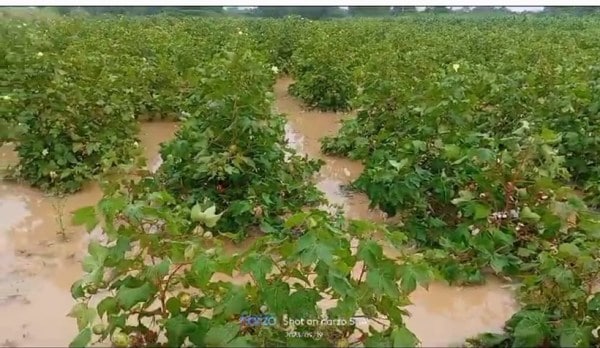 A flooded cotton filed in Khengargadh village in Kutch on Wednesday. (Express photo)
As per latest sowing data released by the state government, farmers in Gujarat have sown cotton in 26.82 lakh hectares (lh) — is 31.37 per cent of the total 85.49 lh sowing area for all crops recorded in the state and is thus, the single largest crop this Kharif season. Groundnut is second with a sowing area of 16.35 lh. Of the total 85.49 lh sowing area for all crops in the state, 37.77 lh or 44.18 per cent has been recorded in 11 districts of the Saurashtra region.
Saurashtra is the cotton and groundnut bowl of Gujarat. The region has recorded cotton and groundnut sowing in 19.14 lh and 12.58 lh respectively, which respectively are 71.36 per cent and 77 per cent of the state’s total area for these twin crops this season.
Within Saurashtra, Surendranagar is the single largest cotton district with sowing in 3.97 lh and is followed by Amreli (3.65 lh) and Bhavnagar (2.59 lh). In groundnut, Rajkot (2.26 lh), Gir Somnath (2.08 lh) and Junagadh (1.91 lh) are the three largest districts.
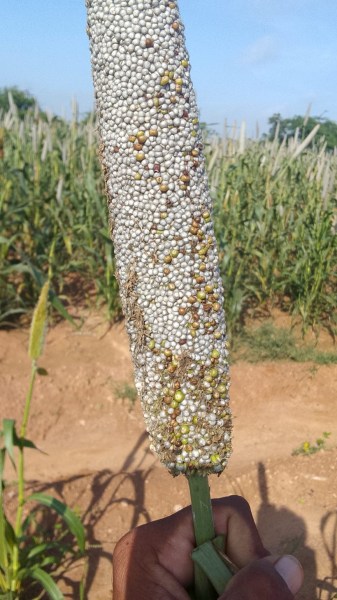 Farmers in Khengargadh village of Kutch say pearl millet has started sprouting in cobs due to the rain. (Express photo)
Raju Padhiyar, a farmer from Panshina village in Limbdi taluka of Surendranagar is also equally worried. He has sown cotton in 15 out of his 30 bigha. “Farmers like me who had sown their cotton before the arrival of monsoon rains are likely to suffer due to the latest spell of rain as it is going to damage flowers and buds. But those who sowed it in late June will benefit as the showers mean they will not have to irrigate their crop for a couple of weeks,” says Padhiyar.
Mukesh Parmar, district agricultural officer of Surendranagar, agrees the rains will damage cotton. “However, such damage is likely to remain limited to those who had sown cotton before May 15. For such cotton, the second flush could be at flowering stage while kapas (seed cotton) of the first flush may be even ready for picking. But such early sowing will hardly be five per cent of the total,” Parmar says, adding, “These rains are largely beneficial. In fact, they are crop-saving for farmers doing rain-fed agriculture as due to an entire dry August, crops had started withering.”
But groundnut growers are happy. Raju Borkhatariya, a 19-bigha farmer in Matiana village of Manavadar taluka, says the September rains are timely for his 10-bigha groundnut crop that he had to irrigate four times from the well on his farm. “The crop looks very good and three inches of rain means I will save on the cost of two irrigation. Not only that, I will be able to save water for winter crops,” says Borkhatariya.
Vijay Ramani, a farmer from Dodiyala village in Jasdan taluka of Rajkot district, too, is happy. He has been able to irrigate his groundnut in seven bigha, cotton in 15 bigha and chilli in five bigha. “The well on my farm was quickly running out of water and the groundnut crops desperately needed one more round of irrigation. But there was no water in the well. However, the moderate showers have provided that moisture and I am expecting a good harvest of groundnut,” says Ramani. However, he adds that the showers damaged his cotton crop. “I wish it rains more so that my well gets replenished,” he says.
Groundnut is harvested 100-120 days after sowing, while cotton is a long duration crop harvested over 150 to 200 days with the first picking generally done after around 120 days.
In Kutch, officers say the rains could have affected irrigated cotton and bajra (pearl millet) crops adversely. “But this rain is a crop-saviour for farmers doing rain-fed agriculture cultivating pulses, jowar (sorghum), guar gum and castor. These crops would have failed completely had it not rained now,” says Girish Rathod, agricultural extension officer for Kutch’s Rapar taluka.
“My bajra was almost ready for harvest when the rain arrived. Three days of precipitation has meant that millets have started sprouting in cobs themselves,” says Prabhu Chavda, a farmer from Khengargadh village in Rapar taluka of Kutch, adding due to the rains, quality of his pearl millet will deteriorate.

 6 min read