3 min read

Click here to join Express Pune WhatsApp channel and get a curated list of our stories
© The Indian Express Pvt Ltd



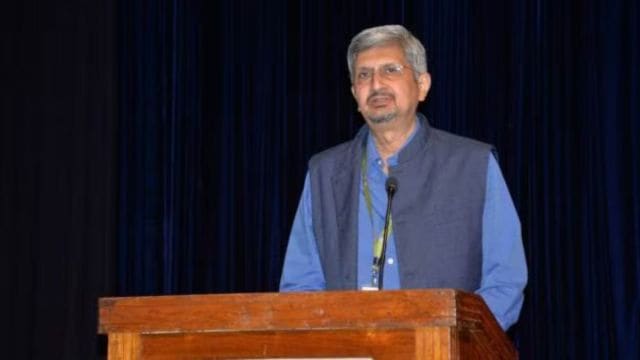 DRDO chief Samir V Kamat. (File Photo)
Chairman of the Defence Research and Development Organisation (DRDO) Samir V Kamat said on Saturday that Operation Sindoor was a declaration of India’s ability to stand tall through self-reliance, strategic foresight and indigenous technological strength.
The DRDO chief was addressing the gathering at the 14th convocation ceremony of Defence Institute of Advanced Technology (DIAT), Pune. The institute awarded degrees to 298 students including 206 M Tech students, 68 MSc and 24 PhD students from various disciplines at the convocation. A total of 18 gold medals were awarded to students in the convocation this year.
In his address, Kamat said, “Just a few weeks ago, India launched Operation Sindoor. This was a highly coordinated, multidimensional operation that addressed a high-stakes challenge along our western borders.”
“Without disclosing the operational specifics, I can share with a sense of pride that the success of Operation Sindoor was not merely defined by the courage and capability of our soldiers in uniform, but also by the technological backbone that supported them with sensors, unmanned platforms, secure communications, AI based decision support, as well as precision weaponry. The systems that our forces used during Operation Sindoor included indigenous systems such as Akash short range surface-to-air missiles, the medium range surface-to-air missiles, the BrahMos supersonic cruise missiles, the D4 anti-drone system, the airborne early warning and control, the Akashteer system as well as the C4I systems. All of these emerged from our indigenous defence R&D community and institutions such as DIAT also played a crucial role in their development,” he said.
He further said, “Operation Sindoor was more than a mission. It was a declaration of India’s ability to stand tall through self-reliance, strategic foresight and indigenous technological strength. It was also a call to the next generation to keep this momentum going and make India a technology leader in defence technologies.”
“We are now entering an era where the definition of warfare is rapidly expanding. Battles are no longer confined to borders or frontlines. They are fought across domains of land, air, sea, space, cyberspace and even the electromagnetic spectrum. What does this mean for the graduating students of DIAT? It means that you are no longer students of conventional academic discipline. You are now part of India’s defence capability architecture. Your knowledge in quantum technologies, cyber security, robotics, materials engineering, missile systems, missile propulsion, artificial intelligence all have direct implications for national defence and defence. DIAT stands unique in India’s academic landscape,” Kamat said.
Kamat added, “We are now focusing on next generation defence technologies. Our focus has now shifted to directed energy weapons based on lasers, microwaves, particle beams. Hypersonic cruise and glide missiles, quantum encrypted command and control networks as well as sensors, AI based adaptive war fighting systems, underwater domain awareness, space situational awareness and many more such futuristic needs that are going to be very important for our services.”